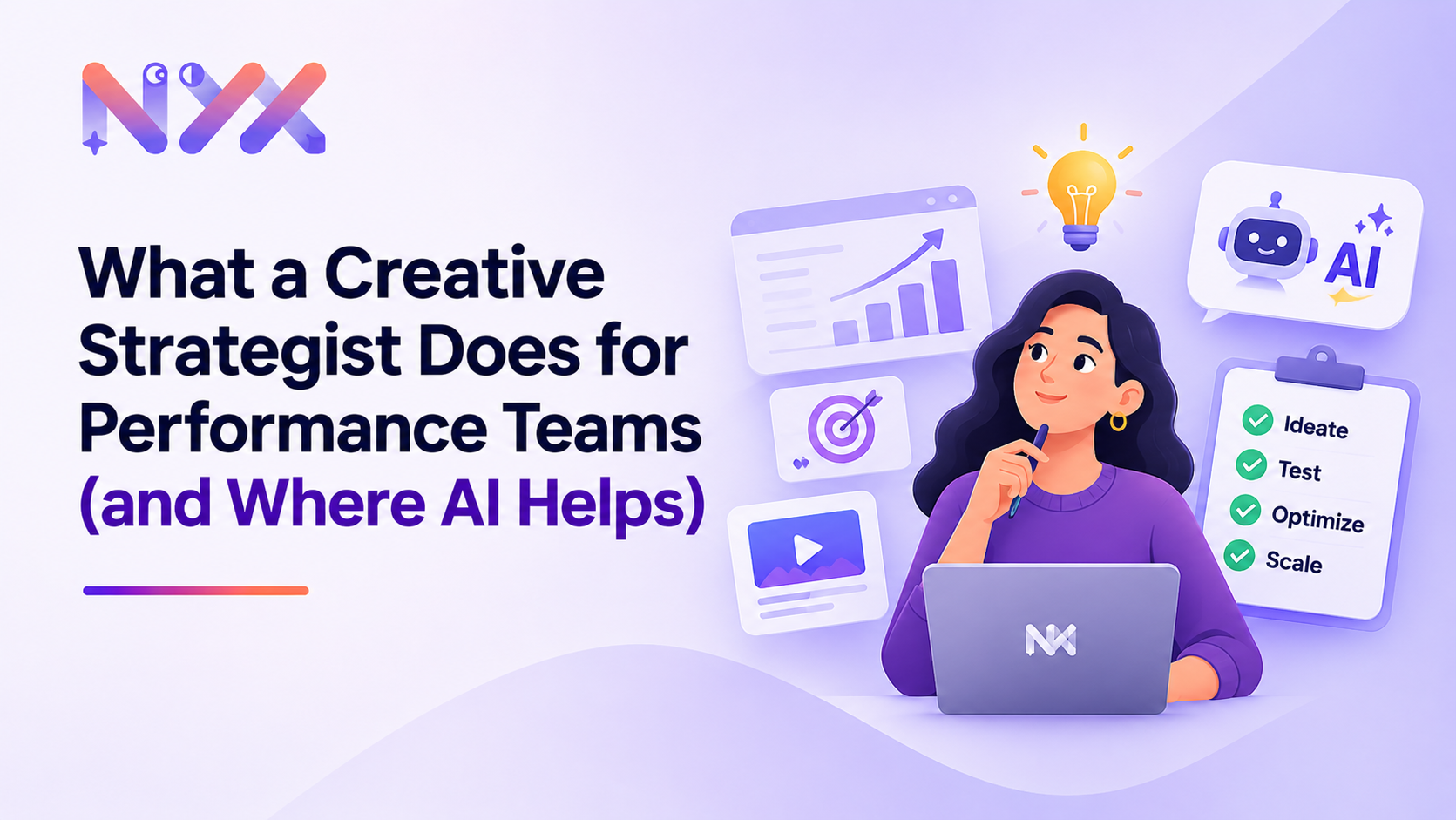
A few years ago, a performance team won by out-targeting the competition. Today Meta, Google and TikTok run targeting with AI, and every brand has access to the same automation. The one thing the algorithm cannot make for you is the ad itself. That is why the creative strategist has become one of the most important roles on any performance team.
This article explains what a creative strategist actually does, how they turn performance data into better ads, the creative strategy framework they follow week to week, and where AI now speeds up the work and where it still needs a human in charge.
Key Takeaways
|
What Is a Creative Strategist?
A creative strategist is the person who decides what ads a brand should make, why, and for whom, and then uses results to decide what to make next. They sit between three groups: the media buyers who manage spend, the designers, editors and creators who make the ads, and the customers whose problems the ads must speak to.
A designer asks, "How should this look?" A media buyer asks, "Where should this run and at what bid?" A creative strategist asks, "What should we say, to whom, and how will we know it worked?" Without that role, creative gets made on instinct, tested at random, and judged by whoever has the loudest opinion.
Why Performance Teams Need a Creative Strategist Now
Ad platforms have moved control away from audience settings and toward creative. Broad targeting and AI-led campaigns mean the ad itself now tells the algorithm who to find. A video that opens with a new mother's problem will be shown to more new mothers. The creative has become the targeting.
The research backs this up. NCSolutions' analysis of nearly 450 sales effect studies found creative accounts for 49 percent of incremental sales from advertising, while targeting accounts for only 11 percent. Yet in a 2025 Advertiser Perceptions survey, marketers credited creative with just 21 percent and ranked targeting highest, at 23 percent. Most teams are still spending their attention on the smaller lever.

Figure 1: Marketers underrate creative and overrate targeting.
What a Creative Strategist Does Day to Day
1. Researches customers and the market
Everything starts with understanding people. A strategist reads product reviews, support tickets, social comments, Reddit threads and sales call notes to find the exact words customers use for their problems, doubts and desires. They study competitors' ads in the Meta Ad Library to see which angles are crowded and which are open. This research becomes the raw material for every ad.
2. Writes the creative brief
The creative brief is the strategist's main deliverable. A good brief fits on one page and tells the production team exactly what to make:
Objective: what this ad must achieve, such as first purchases from new customers.
Audience and awareness level: who it is for and how much they already know.
Insight: the customer truth the ad is built on, in the customer's own words.
Angle and hooks: the main message and three to five opening lines to test.
Format and specs: UGC video, static, carousel, length, aspect ratio and placements.
Proof points: reviews, results, demos or guarantees to include.
What success looks like: the metric the test will be judged on.
3. Develops ad concepts and hooks
Ad concepts are distinct ideas, not small edits. "Founder explains why the product exists", "customer compares before and after" and "myth versus fact" are three different concepts. Inside each concept, the strategist writes multiple hooks, the first one to three seconds that decide whether anyone keeps watching. Testing many hooks on a strong concept is one of the cheapest ways to find a winner.
4. Leads UGC sourcing and production
User-generated style content still performs strongly because it looks native to the feed and feels like a recommendation, not an advert. UGC sourcing means finding the right creators, briefing them clearly, reviewing drafts, and building a bench of reliable creators the brand can return to. The strategist also works with editors to cut one shoot into many variations for different hooks and placements.
5. Plans and runs creative testing
Creative testing turns opinions into evidence. The strategist decides what each test is meant to learn, such as which angle, hook or format works best, and keeps other variables steady so the result is clear. They agree with the media buyer on budget, duration and the metric that decides the winner.
6. Reads performance data and feeds the next round
Finally, the strategist goes back to the numbers. They look beyond ROAS to the signals that explain why an ad worked or failed: hook rate (how many people watched the first three seconds), hold rate, click-through rate, cost per purchase and conversion rate. A high hook rate with low clicks means the opening works but the offer does not. Those lessons go straight into the next brief.

Figure 2: The work never ends at launch. Every test feeds the next brief.
A Simple Creative Strategy Framework
Most strong teams follow some version of the same creative strategy framework. Here is a practical one any performance team can adopt:
Stage | Key question | Output |
|---|---|---|
Insight | What does the customer feel, fear or want? | Customer language bank and pain points |
Angle | Which reason to buy will we lead with? | 3 to 5 angles ranked by potential |
Concept | What story or format will carry the angle? | Ad concepts with references |
Hook | What stops the scroll in 3 seconds? | 5 to 10 hooks per concept |
Test | Which version wins on the agreed metric? | Test plan with budget and success metric |
Learn | Why did it win or lose? | Learnings log and the next brief |
The learnings log is the part most teams skip, and it matters most. Over months it becomes a library of what works for your brand, which makes every future brief faster and sharper.
Creative Velocity: Why Volume Matters
Creative velocity is how many new, meaningfully different ads a team can launch and learn from each week or month. It matters because most ads lose. Only a small share of tests beat the current best ad, so the brands that test more ideas find more winners, and replace tired ads before performance drops.

Figure 3: Illustrative month. Many ideas go in to find a few winners.
Velocity is not about churning out random ads. Ten variations of the same idea teach you very little. Ten different concepts, each with a few hooks, teach you a lot. A creative strategist protects quality while pushing volume, which is exactly where AI now helps the most.
Where AI Helps a Creative Strategist
AI has not replaced the creative strategist. It has removed much of the slow, manual work, so one strategist can now do what used to take a small team.
Research at scale: AI can read thousands of reviews and comments and group them into themes, objections and phrases in minutes.
Competitor analysis: it can summarise patterns across hundreds of competitor ads, such as common hooks, formats and offers.
Performance analysis: it can tag every ad by angle, hook type, format and creator, then show which tags drive results across your account.
First drafts: it can produce hook variations, script drafts and brief outlines that a strategist then sharpens.
Variations and resizing: AI image and video tools can create new backgrounds, aspect ratios, captions and language versions quickly.
Where AI Still Needs a Human
Choosing the big idea. AI is good at averages. Breakthrough ads usually come from an insight or angle nobody else is using.
Taste and brand voice. Knowing what feels right for your brand, and what would embarrass it, is still a human call.
Real customer empathy. Talking to customers and noticing what they do not say is hard to automate.
Directing creators and shoots. Building trust with creators and getting a natural performance takes people skills.
Interpreting results in context. A test can be skewed by a sale, stock issues or a competitor launch. A strategist knows when to trust the data.

Figure 4: Use AI for speed and scale. Keep humans on judgement and taste.
Skills to Look For When Hiring a Creative Strategist
Comfort with ad platform metrics, from hook rate to cost per purchase.
Strong copywriting, especially short hooks and scripts.
Deep curiosity about customers and the ability to turn research into insight.
A testing mindset: clear hypotheses, clean tests, honest conclusions.
Experience briefing designers, editors and UGC creators.
Confidence using AI tools to speed up research, analysis and production.
How to Measure a Creative Strategist's Impact
Judge the role on business outcomes, not the number of ads made. Useful measures include the share of spend going to ads launched in the last 30 days, the test win rate over time, cost per purchase or lead on new creative compared with old, and how quickly fatigued ads are replaced. If the account keeps finding new winners and costs stay stable as spend grows, the strategist is doing their job.