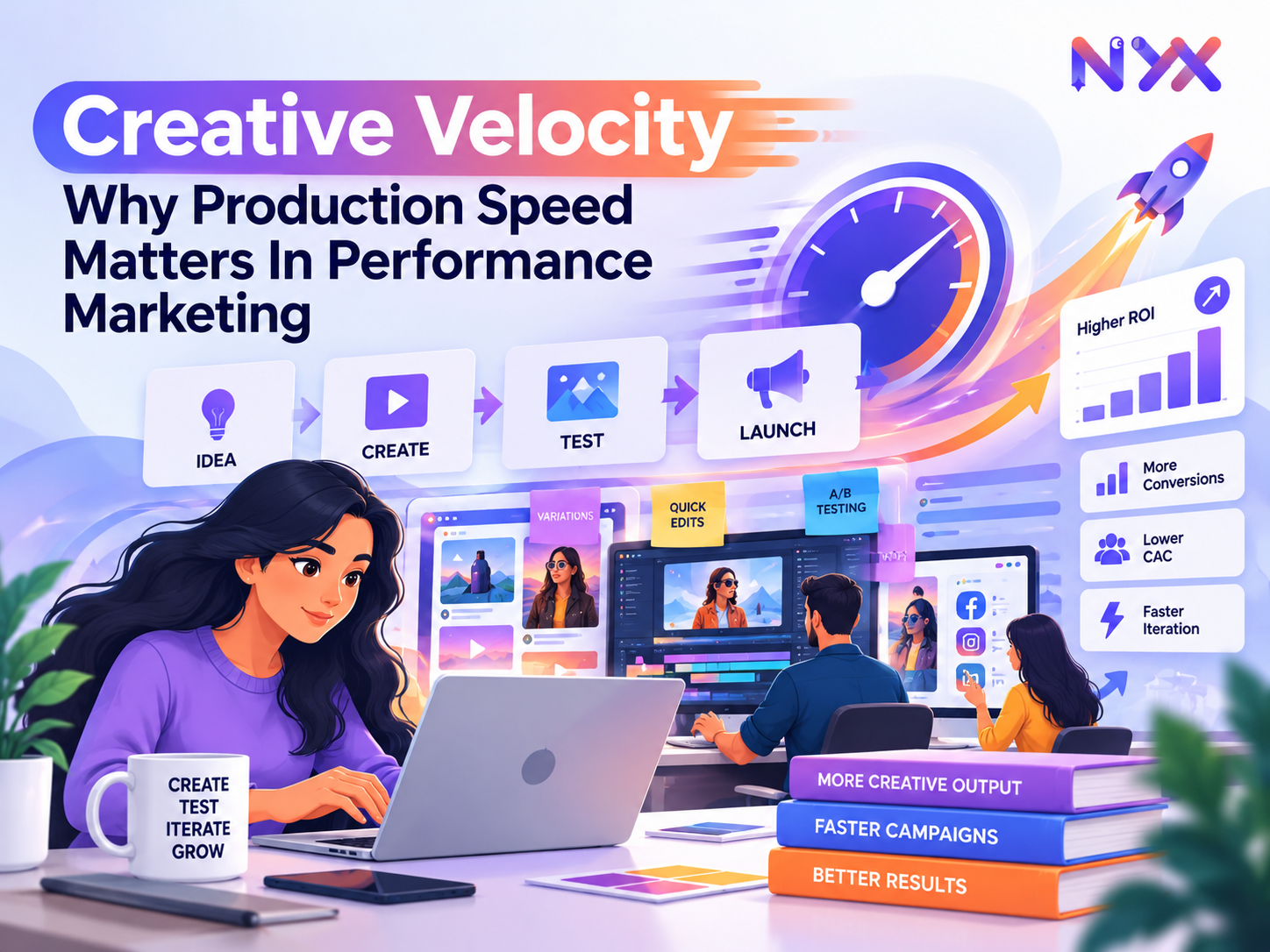
Creative velocity is the speed at which a team turns an audience insight into a distinct ad concept, launches it, learns from results and decides what to change. Faster production can improve performance because it gives a campaign more chances to find a message that works and lets the team respond when a previously useful ad weakens. The advantage comes from faster learning with quality control, not from publishing the largest possible number of files.
For founders and marketing directors, this is an operating question. How many days pass between a useful customer objection and a live test? How many rounds of approval delay an asset? Can the team explain what it learned from each test? These questions reveal more than a monthly count of banners.
Why The Old Creative Cycle Becomes A Bottleneck
Paid platforms can change bids and delivery continuously. Creative may still follow a slow sequence: campaign brief, copy, design, review, revisions, resizing, approval and upload. By the time the asset runs, a promotional window or customer insight may have passed. A team can respond by requesting more variants, but that often increases the queue without increasing the diversity of ideas.
Performance is sensitive to the match among audience, promise, proof, format and landing experience. If every new asset repeats the same promise, the team has little new information. A stronger process tests different problems, demonstrations, offers or proof points while preserving truthful claims and clear visual execution.
Define The Right Unit Of Output

An asset is a particular file or ad. A variant changes an element such as opening line or crop. A concept changes the underlying message. A learning is a supported conclusion from a test, such as “operations-led messaging produced a higher share of qualified meetings than generic efficiency messaging under this audience and offer.”
These units should appear separately in reporting. For example, 24 assets may represent only three concepts, each adapted for two formats and four text versions. Counting 24 “tests” exaggerates how much the team learned.
Build A Practical Creative Testing System
1. Choose A Business Outcome
Define qualified lead, sale or contribution profit before optimising toward a platform metric. If sales happen offline, agree on CRM stages and attribution limits.
2. Create An Insight Backlog
Collect common objections, search terms, product reviews, customer calls, sales notes and comments. Assign a source and date to each idea.
3. Prioritise A Small Set Of Hypotheses
Score ideas by buyer relevance, evidence available, likely impact and production effort. Reserve some space for genuinely new angles.
4. Write A One-Page Brief Per Concept
Include target audience, problem, promise, proof, desired action, visual treatment, landing page and claims that cannot be made.
5. Produce Modular Assets
A reusable proof card, product demonstration clip or approved CTA can speed adaptation. Keep hooks and concepts meaningfully distinct.
6. Review Before Launch
Check factual accuracy, offer consistency, rights, policy, mobile legibility, accessibility and destination quality. Give one person final ownership.
7. Launch With A Documented Test
Record dates, budget, audiences, placements, creative IDs and decision rules. Avoid declaring a winner after only a few impressions or clicks.
8. Read Results And Act
Compare conversion quality and economics. Iterate a promising concept; retire weak ones; record uncertainties and creative context.
The loop is continuous. A winning concept can be adapted for another persona, but its success may not transfer to a different channel or stage of the funnel.
What Should Be Tested First?
Start with high-impact differences: buyer pain point, offer, social proof, product demonstration and opening hook. For a B2B dashboard, “reconcile channel reports in one view” is a different concept from “get campaign recommendations your team can review.” A different purple gradient is usually a design variant. For an EdTech brand, “career transition outcomes” and “live mentor support” are separate concepts, provided both claims can be substantiated.
Test one meaningful difference at a time when possible. In real platforms, strict isolation can be difficult because delivery systems allocate impressions unevenly. Record this limitation and avoid treating observational differences as causal proof. Platform experiments can help, but they still require enough volume and a well-defined primary outcome.
Measure Velocity Without Rewarding Waste

Track median days from insight to live ad; concepts launched per month; proportion of assets approved on first review; spend and time per concept; time from test end to decision; and percentage of tests that produce an actionable learning. Pair these with business measures: qualified lead rate, CAC, conversion value and contribution margin where available.
An apparent decline in cost per click is not enough. An ad may attract broad, low-intent traffic. Conversely, a higher CPC may be acceptable if the resulting leads are more likely to buy. Segment by audience, placement and period before drawing conclusions. Allow for conversion lag.
Team Structure And Tools
Even a lean team needs four responsibilities: someone owns customer insight and the brief, someone makes the creative, someone owns media setup and measurement, and someone approves evidence and brand. One person may hold several roles. AI can help draft scripts, propose variations and create production-ready starting points, but it cannot validate a customer outcome it has never seen.
Create an approved asset library with current logos, screenshots, disclaimers and proof. Set a short review service level, such as one business day, only if stakeholders can actually honour it. Use a shared naming system: audience_problem_concept_format_version_date. The goal is to remove avoidable handoffs, not essential review.
Common Failure Modes
Producing many near-identical ads can fragment learning. Changing audience, offer and creative simultaneously makes results hard to interpret. Scaling from a small apparent winner can reveal that the concept only worked for a narrow pocket of inventory. Replacing an ad whenever daily performance dips mistakes normal variation for fatigue. Finally, optimising only to platform-reported conversions can hide duplicate or low-quality leads.
NYX can be mentioned naturally in a discussion of a team combining creative testing with cross-channel reporting and recommendations. Any case example should use approved numbers and explain the comparison period. Do not insert a generic performance lift simply to support the story.
A Four Week Rollout
Audit the last month of ads and identify how many distinct concepts actually ran. In week two, create a backlog and approve three new hypotheses. In week three, launch those concepts with a consistent offer and enough budget to collect useful evidence. In week four, review downstream quality with sales, refine the strongest concept and document what did not work. Repeat the cycle with better briefs.
How To Make The Review Meeting Useful
Bring one page per concept rather than a gallery of every file. Show the audience and hypothesis, creative and destination, spend, delivery, primary outcome, downstream quality and the next decision. Add screenshots because a chart cannot reveal a misleading crop or weak opening. State whether results are early, mature or inconclusive. The meeting should end with an owner and due date for each next brief.
Use a consistent decision vocabulary: scale the concept, revise a specific element, run a second controlled test, or stop. “Try more creatives” is too vague. A revision might change the proof, show the product earlier or use an objection voiced by prospects. If a concept delivered no meaningful volume, the right conclusion may be that the test was underpowered, rather than that the audience rejected it.
Balancing Speed, Diversity And Safeguards
Three constraints determine a sustainable cadence. Production capacity limits how many concepts can be made well; media budget limits how many can receive enough exposure; approval capacity limits what can be checked. Raising output without raising the other two creates a backlog of untested files or weakly reviewed ads. Set the cadence from the smallest constraint and improve the bottleneck.
For a small B2B team, a weekly cycle might include two new concepts, one iteration on a previous concept and adaptations for the highest-value formats. That is an illustrative cadence, not a universal benchmark. A lower-volume campaign may need a longer decision window; a high-spend commerce account can move faster. Give each concept a clear reason to exist. When a performance shift appears, also check offer, landing page, inventory, seasonality and tracking before declaring creative fatigue.
Example Of A Concept Matrix
Suppose a growth team markets an online course. It could test three substantive messages: a flexible schedule for employed learners, mentor feedback for those worried about self-study, and curriculum relevance for those changing roles. Each concept can then have a short video and static format, plus two opening hooks. That creates twelve possible assets but only three strategic ideas. Run enough of each concept to compare meaningful outcomes before selecting the best hook within a promising family.
The brief should specify what would falsify the idea. If the flexible-schedule ads attract working professionals but few eligible applications, the message may be too broad or the course hours may not match the promise. If mentor-led ads attract fewer clicks but a higher share of qualified applications, a CPC-only report would miss the useful insight. Document both findings and the next change to the page or offer.
Decide When To Stop A Test
Use a pre-agreed spend or evidence threshold appropriate to the account. Consider the expected cost of a meaningful conversion, the campaign's normal variability and the delay before a lead qualifies. A fixed rule such as “pause after 1,000 impressions” can be too early for a niche B2B offer. Stop immediately for false claims, broken destinations or policy problems; for ordinary performance uncertainty, wait for enough data to make a useful decision.
What Should A Team Do Next?
Pick one recent campaign and count its actual concepts. Write down the customer evidence behind each one, how long it took to launch, and whether the test led to a decision. Then choose a small number of new hypotheses that address different buyer concerns. Assign one owner to the brief and one to the final claim review. After launch, review qualified outcomes with sales before commissioning the next batch. This makes the production process easier to improve because the team can see whether the bottleneck sits in insight, approvals, media budget or measurement.