Quick Answer: Account-Level vs Lead-Level Attribution
Two dashboards can look at the same quarter and the same marketing spend and still reach very different conclusions. One might say paid search drove the pipeline, while another shows that paid search mainly captured buyers who had already engaged through other channels.
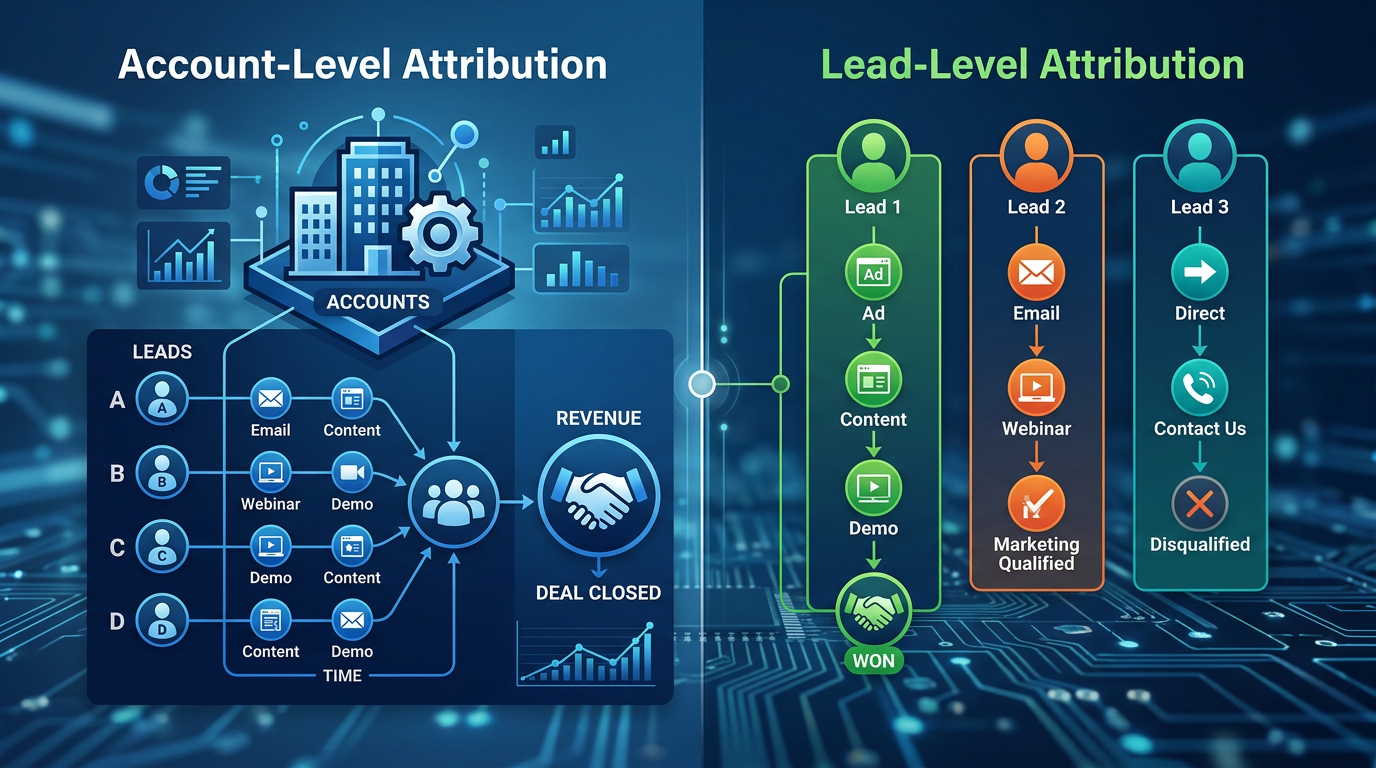
Neither model is necessarily wrong. They measure different things. Lead-level attribution focuses on individual people, while account-level attribution looks at companies and their buying groups. In B2B, where several people can influence one purchase, that distinction matters.
The practical answer is to use both for different jobs. Lead-level attribution is useful for campaign and conversion optimization, while account-level attribution is better suited to understanding account engagement, pipeline, and broader budget decisions.
What Does Lead-Level and Account-Level Attribution Measure?
Lead-level attribution assigns marketing credit to an individual contact. When someone fills out a form, that person's record can carry the original source and subsequent interactions. Multi-touch versions can then distribute credit across the touchpoints in that person's journey.
Account-level attribution brings activity from multiple contacts at the same company into one view. If five people from the same organization interact with several campaigns, those activities can be considered together as part of the account's journey toward an opportunity or customer.
The difference becomes clear in practice. A finance director might download a pricing guide after clicking a paid search ad. Lead-level attribution records that conversion as paid search. Account-level attribution might also show that two engineers from the same company attended a webinar six weeks earlier, giving the team a broader view of how the account engaged.
Why Is Lead-Level Attribution Limited for B2B Buying?
Lead-level attribution assumes that the individual conversion tells much of the story. That works reasonably well when one person is the buyer, but B2B purchases often involve several stakeholders.
Gartner's research on the B2B buying journey describes purchasing as a set of activities that include problem identification, solution exploration, requirements building, supplier selection, validation, and consensus creation. Buyers may move through these activities in different ways, while multiple people can be involved in the decision. Gartner
That creates three common problems with a lead-only view:
The buying committee is missing: The person who fills out a form gets the credit, while colleagues who influenced the decision may not appear in the journey.
Anonymous research isn't captured: Much of the evaluation happens before prospects identify themselves, which is why Account Intent Data can provide additional context.
Long sales cycles create tracking gaps: A 12-month buying cycle can span cookie expiry, device changes, and job changes. The original contact or touchpoint may no longer provide a complete picture.
What Are the Strengths of Each Attribution Model?
Neither model is simply a better version of the other. Each is useful for different questions.
Lead-level attribution is strongest when you need speed and detail. It can show which campaign, keyword, or landing page generated a conversion, making it useful for regular campaign optimization. It also works well when the lead itself is the outcome being measured.
Account-level attribution is stronger when the question is about revenue. It brings activity from multiple people together and follows the account as it moves toward an opportunity or customer. That makes it more useful for understanding which programs are influencing accounts and informing broader budget decisions.
The tradeoff is speed. Account-level signals generally take longer to develop because deals take time and there are fewer account-level outcomes to analyze.
What Data Is Needed for Account-Level Attribution?
The quality of an attribution model depends heavily on the data behind it. Account-level attribution needs more than just campaign reporting.
You typically need:
A reliable way to connect known contacts and anonymous activity to companies
Campaign and advertising data connected to CRM records
Consistent account definitions across marketing and sales
Without these pieces, an account-level view can simply become lead data presented in a different format.
This is where many teams run into problems. Advertising data, website analytics, and CRM records often sit in separate systems, leaving analysts to reconcile them manually. Platforms such as NYX's Neo assistant can bring marketing and performance data together, reducing some of that manual work. The broader question of consolidating marketing data is also covered in this comparison of a unified AI marketing platform and a best-of-breed stack.
A practical test is to take 20 closed-won deals from the previous year and try to reconstruct the relevant marketing activity across every contact at those accounts. If that exercise takes more than an afternoon, the data foundation probably needs attention before the attribution model does.
How Do Account-Level and Lead-Level Attribution Compare?
Decision Criterion | Lead-Level Attribution | Account-Level Attribution |
Unit of analysis | Individual contact | Company and buying group |
Best question | Which campaign generated this conversion? | Which programs influenced this account? |
Speed of signal | Faster; useful for regular optimization | Slower; better for longer-term planning |
Multiple stakeholders | Limited to the individual contact | Brings known contacts together |
Long sales cycles | More vulnerable to tracking gaps | Better suited to persistent account records |
Data requirements | Contact and campaign data | Identity resolution, CRM, and campaign data |
Common limitation | Can miss the wider buying group | Can show correlation without proving causation |
Best use | Campaign and creative optimization | Pipeline and budget planning |
How Have Attribution Tools Changed?
The tools available for lead-level attribution have also changed. That matters when building a measurement approach.
Google Analytics 4 currently supports data-driven attribution, paid and organic last click, and Google paid channels last click. Google removed several rules-based models, including first click, linear, time decay, and position-based attribution, in November 2023. Google Analytics Help
For B2B teams, this matters because many organizations previously relied on those rules-based models for multi-touch reporting. Today, teams often need to build more detailed attribution views in their CRM or data environment, particularly when they want to understand multiple contacts within the same account.
Does Attribution Prove Which Channel Caused Revenue?
No. Attribution assigns credit; it doesn't prove causation.
If a report shows that a closed-won account interacted with six marketing programs, that tells you what the account did. It doesn't tell you which interaction actually changed the outcome.
This is where attribution can become misleading. A channel may appear frequently in successful customer journeys simply because it reaches buyers late in the process, after the decision is already well underway.
Two approaches can help answer the causal question:
Incrementality testing: Compares a group exposed to marketing with a comparable control group to estimate the additional impact.
Marketing Mix Modeling (MMM): Uses aggregate marketing spend and business outcomes to estimate the contribution of different factors.
These methods complement attribution rather than replace it.
For leadership reporting, make the distinction clear: attribution shows where credit falls under a defined model, while incrementality helps estimate what would have happened without the marketing activity.
How Can Teams Use Both Attribution Models?
The most practical approach is to give each model a specific role rather than trying to make one model answer every question.
Use lead-level data for campaign optimization: Review campaigns, creative, keywords, and conversion performance where fast feedback is useful.
Use account-level data for broader planning: Look at account progression when evaluating programs, pipeline, and larger budget decisions.
Validate important decisions with experiments: If a major budget change depends on a causal assumption, test that assumption instead of relying only on attribution.
Keep one account definition: Marketing and sales should agree on what counts as an account and when an account becomes an opportunity.
The dashboards may still disagree, and that's not necessarily a problem. The important thing is knowing what each model is designed to answer.
Don't add lead-sourced pipeline and account-influenced pipeline together as separate totals. The same deals can appear in both views, which can lead to double counting. The operational side of this process is covered in this comparison of agentic AI and workflow automation in B2B marketing.
When Is Lead-Level Attribution the Better Choice?
Account-level attribution isn't automatically the better option. A lead-level view can still be the right choice when:
The user is the buyer: In product-led businesses where one person signs up and pays, the individual and the account may effectively be the same.
Transactions are high-volume and low-value: Short buying cycles provide enough conversion data for lead-level analysis to work well.
You're optimizing the top of the funnel: If the question is which ad generates qualified leads at the lowest cost, lead-level data is appropriate.
Account infrastructure isn't ready: Without reliable CRM data and account definitions, an account-level model can create false confidence rather than better insight.
The Bottom Line
Account-level and lead-level attribution answer different questions. Lead-level attribution is useful when you need fast, detailed feedback on campaigns and conversions. Account-level attribution is more useful when you're looking at how marketing influences companies, buying groups, and pipeline.
You don't need to choose one for everything. Define what each model is responsible for, make sure the underlying data is reliable, and use experiments when you need to establish causation rather than simply assign credit.