Quick Answer
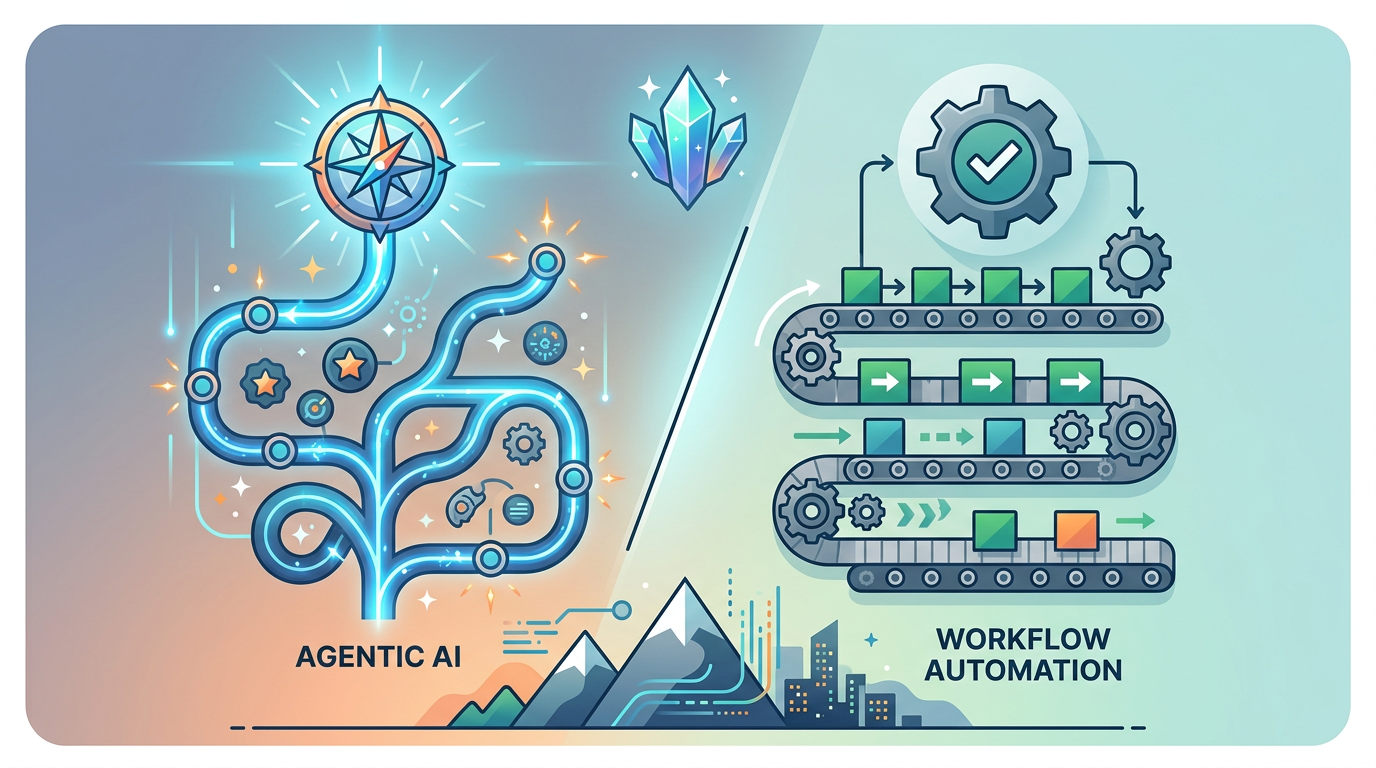
Workflow automation follows pre-written rules and sequences you define in advance; agentic AI makes real-time decisions based on data, adapts to new situations, and learns from outcomes without you reprogramming it. Choose workflow automation for repeatable, rule-based processes; choose agentic AI when outcomes depend on judgment and change.
Key Takeaways
Decision-making: Workflow automation executes rules; agentic AI makes independent decisions
Adaptation: Workflow automation handles exceptions with fallback rules; agentic AI adapts to new scenarios automatically
Learning: Workflow automation stays static; agentic AI improves based on performance data
Setup complexity: Workflow automation requires upfront rule definition; agentic AI learns through experience
Defining the Two Approaches
Workflow Automation
A system that executes a predefined sequence of actions triggered by specific conditions. If lead score exceeds 50, send email A. If reply within 24 hours, route to sales. If no response after 3 days, escalate. You write the rules; the system follows them consistently.
Predictable, reliable, and easy to audit. Works perfectly for processes with clear logic and few exceptions.
Agentic AI
An autonomous system that observes data, makes decisions about what action to take, takes that action, and evaluates the outcome then adjusts its approach based on what it learns. Rather than following a script, it reasons about the best next step given current context.
Flexible, adaptive, and improves over time. Handles exceptions and novel situations without explicit programming. McKinsey research shows agentic AI systems can accelerate marketing campaign creation and execution by 10–15x compared to traditional approaches.
Head-to-Head Comparison of Agentic AI and Workflow Automation
Dimension | Workflow Automation | Agentic AI |
|---|---|---|
Decision Logic | Predefined rules (if-then-else) | Context-aware reasoning per situation |
Adaptation | Only via programmed exceptions | Continuous, based on outcomes |
Handling New Scenarios | Falls back to default rule or fails | Reasons through novel situations |
Learning | Static until manually updated | Improves from performance data |
Setup Time | Fast (define rules upfront) | Slower (requires training data, goals) |
Transparency | Fully auditable (you see all rules) | Less transparent (model-based decisions) |
Consistency | 100% (same inputs = same output) | Variable (reasons differently per context) |
Handling Exceptions | Requires manual rule addition | Handles within learned parameters |
Response to Market Change | Requires rule update | Adapts autonomously |
Human Judgment | No (rules only) | Required (to set goals and verify) |
Configuration Burden | High upfront, low ongoing | Low upfront, requires monitoring |
Debugging | Straightforward (trace rule path) | Harder (complex decision chain) |
Scalability | Scales without logic changes | Scales with data quality |
Best for Judgment Calls | No | Yes |
Workflow Automation: When It Wins
Best suited for:
Lead nurturing sequences (specific email → wait 3 days → check engagement → route or resend)
Account scoring based on activity thresholds
Routine data cleansing and field mapping
Triggered notifications and alerts
Sequential task assignment (if industry = SaaS, assign to team A)
Gartner's Magic Quadrant for B2B Marketing Automation Platforms remains the industry standard for evaluating workflow automation tools, with key capabilities including lead nurturing, scoring, and multi-step campaign orchestration.
Example: A B2B SaaS company automates its MQL-to-SQL workflow: when a lead fills out a form (trigger), send welcome email (action 1) → wait 2 days → check email open (condition) → if opened, send product demo (action 2) → wait 5 days → check demo attendance (condition) → if attended, route to sales (action 3).
Agentic AI: When It Wins
Outbound targeting and account selection (which accounts to prioritize given market shifts)
Dynamic messaging based on real-time intent signals
Campaign optimization across channels with competing priorities
Resource allocation under uncertainty (where to spend budget when outcomes are unclear)
Handling edge cases and exceptions without manual intervention
Gartner predicts that 60% of brands will adopt agentic AI to deliver personalized, one-to-one interactions by 2028, signaling a shift away from channel-based marketing toward persistent, intelligent customer concierges.
Example: An enterprise software company deploys agentic AI to decide which accounts to target in a campaign. The AI observes industry changes, competitive activity, historical win rates by account type, and current budget then continuously adjusts which accounts it pursues and which messaging it tests. It learns which signals predict conversion and shifts focus autonomously.
Integration with B2B Marketing Stack
Where Workflow Automation Fits
Lead scoring systems
CRM workflow rules
Data enrichment pipelines
Task assignment and routing
Where Agentic AI Fits
Autonomous campaign orchestration (decide what to test, which audiences to target)
Intent-based account selection
Budget allocation across channels
Creative optimization and messaging decisions
Opportunity scoring and prioritization
Combining Both Approaches
Most sophisticated B2B marketing operations use both. Workflow automation handles routine, rule-based processes (email sequences, lead routing, data tasks). Agentic AI handles judgment calls and optimization (which accounts to pursue, how to allocate budget, what message resonates).
Example workflow: Automation routes leads to a pool → Agentic AI ranks the pool and decides priority order and outreach approach → Automation executes the outreach sequence → Agentic AI monitors outcome and adjusts priority rules.
Forrester's research on marketing orchestration highlights that best-in-class operations combine multiple tools and approaches—a hybrid model where workflow automation ensures consistent execution while intelligent systems make strategic decisions.
FAQs
Can workflow automation do what agentic AI does?
Yes, for simple and predictable tasks. But as workflows become more complex, rule-based automation becomes harder to maintain. Agentic AI can handle changing conditions and make context-based decisions without requiring a separate rule for every scenario.
How do I know if agentic AI is actually learning?
Look for measurable improvements over time, clear performance reporting, and visibility into how decisions change. If a vendor cannot explain how the system improves or adapts, be cautious about claims of “learning.”
Is agentic AI less reliable than workflow automation?
They are reliable in different ways. Workflow automation is predictable and consistent, while agentic AI can adapt its decisions based on context. For important workflows, agentic AI still needs monitoring and clear controls.
When should I upgrade from workflow automation to agentic AI?
Consider it when rules become difficult to manage, new scenarios regularly break workflows, or your team constantly adjusts rules based on performance. If your existing automation works well, there may be no reason to switch.
Practical Decision Framework
Start with workflow automation if:
Your process has clear logic and few exceptions
Rules rarely change
Auditability and transparency are critical
Your team lacks AI expertise
Start with agentic AI if:
Outcomes depend on judgment and context
Rules change frequently based on market conditions
You can tolerate some inconsistency for better adaptation
You need continuous learning from performance data
Use both if:
You have complex marketing operations with both routine and judgment-heavy work
You want to automate execution while AI makes strategic decisions
You can allocate resources to monitor agentic systems
Bottom Line
Workflow automation is about consistency and reliability executing a known process repeatedly without deviation. Agentic AI is about adaptation and learning making the right call in new situations.
Neither is universally better. Most B2B marketing teams benefit from both: automation for the routine work that follows rules, agentic AI for the decisions where judgment and adaptation create competitive advantage. Start by mapping your marketing processes which ones follow clear logic, and which ones require judgment? Automate the first category; consider agentic approaches for the second.
The future isn't automation versus agentic AI it's automation handling the execution while agentic AI handles the strategy.