Quick Answer
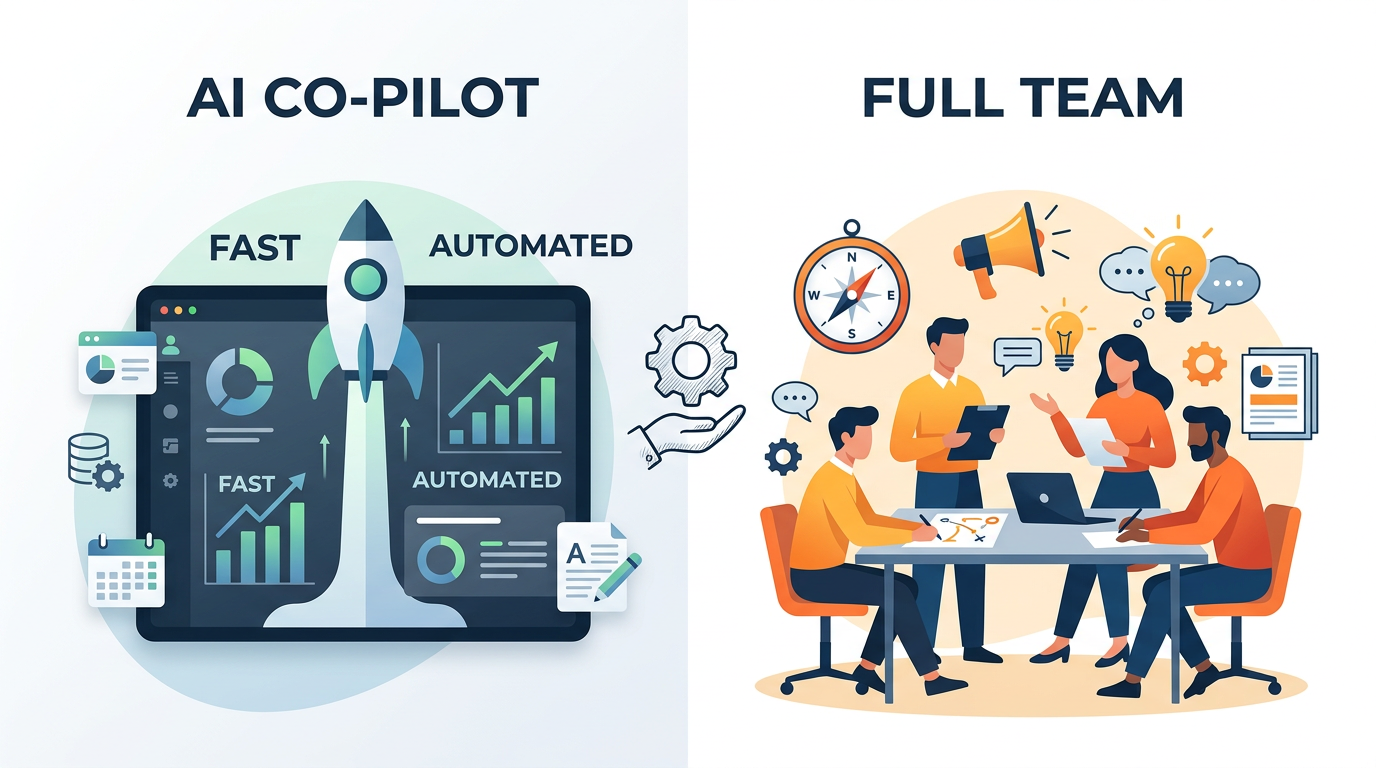
AI co-pilots handle repetitive work and speed up execution at a fraction of team cost, but a full marketing team brings strategic judgment, client relationships, and accountability that AI can't replace. Most growing companies use both , AI for leverage, humans for decisions.
Key Takeaways
Cost: AI co-pilots run $99–500/month; a marketing hire costs $50k–150k/year, plus overhead
Speed: AI executes faster but needs human direction; teams set strategy and catch mistakes
Scale: AI lets small teams do more; large teams use AI to focus on higher-value work
Risk: AI works best with oversight; unsupervised output can miss brand nuance and business context
Defining the Two Models
What is an AI Co-Pilot (Software Solution)
An AI marketing tool that automates campaign setup, generates copy and creative variations, manages bids, optimizes spend, pulls reports, and handles routine optimizations. You provide direction; the tool executes. Examples include autonomous campaign platforms and AI writing assistants.
No salary, no benefits, no PTO. Runs 24/7. Works on what you tell it to do, nothing more.
What is a Full Marketing Team (People)?
Typically 1–3+ people who set strategy, understand your business and market, pitch ideas, manage relationships, spot opportunities, handle edge cases, and take responsibility for outcomes. Teams make judgment calls AI can't make alone.
Costs $50k–150k+ per person annually, plus workspace, tools, taxes, and time to hire and onboard.
Head-to-Head Comparison
Dimension | AI Co-Pilot | Full Team |
|---|---|---|
Monthly Cost | $99–500 | $4,200–12,500+ (salary only) |
Setup Time | 1–2 days | 2–8 weeks (hiring) |
Campaign Speed | Hours to days | Days to weeks |
Strategy & Ideas | Executes your plan | Creates the plan |
Problem-Solving | Follows rules | Thinks creatively |
Client/Stakeholder Relationships | None | Direct relationships |
Accountability | Limited | Full responsibility |
Error Catching | Misses context | Catches nuance |
Flexibility | Good for repeatable tasks | Good for unexpected changes |
Learning Over Time | Only from data/feedback you give | Learns your business deeply |
24/7 Availability | Yes | No |
Reduces Workload | 30–60% (routine tasks) | 0% (frees team for strategy) |
When to Use AI Co-Pilots
Best fit:
You have marketing strategy but lack execution bandwidth
You run similar campaigns repeatedly (seasonal, product launches, lead gen)
Your team is small and you need to multiply productivity
You want faster testing and iteration cycles
Budget is tight and you need immediate results
Example: A D2C brand with solid positioning and product launches 4× per year. AI handles setup, bidding, creative variation, and daily optimization. Your team focuses on messaging strategy and audience research.
When to Use a Full Marketing Team
Best fit:
You need strategy and positioning from scratch
Your business is complex or competitive positioning matters
You manage high-stakes campaigns or big budgets
You need deep client or stakeholder relationships
You operate in regulated or sensitive industries
Example: An enterprise SaaS company entering a new market. You need a team to research competitors, craft positioning, manage sales relationships, and handle nuanced messaging across segments.
Hybrid Model (Most Common)
Many companies run both: AI co-pilots handle campaign execution and reporting, while your team focuses on strategy, creative direction, and high-value decisions. This approach lets a 2-person team manage the output of a 5-person team. Research shows teams using AI for routine tasks shift 30–50% more time toward strategic work.
Tools like NYX are built for this workflow AI handles bid management, budget allocation, and creative optimization across channels, while marketers spend time on audience insights and positioning instead of manual bid adjustments.
FAQs
Can an AI co-pilot completely replace a marketing team?
Not yet. AI excels at execution within defined constraints launching campaigns, testing variations, optimizing spend. It struggles with strategy, creative breakthroughs, client relationships, and judgment calls. You need at least one person to set direction and oversee the AI's work. Think of it as a very capable junior team member, not a replacement for leadership.
How much should I expect to save by using AI instead of hiring?
If you would otherwise hire someone at $70k/year, switching to a $300/month AI tool saves roughly $68k annually but you lose their strategic input and accountability. More realistic: use AI to get 30–40% more output from your existing team without hiring. A 2-person team with AI co-pilots can do what a 3-person team does manually.
What output does an AI co-pilot actually produce?
Typically: campaign setup and launch, ad copy and creative variations, bid and budget adjustments, daily optimization decisions, performance reporting, and A/B test recommendations. It doesn't do customer interviews, competitive analysis, or long-term strategy without your input.
What's the biggest risk of using only an AI co-pilot?
Executing the wrong strategy faster and cheaper. If your positioning, audience targeting, or campaign concept is flawed, AI amplifies the mistake at scale. AI co-pilots need human judgment on what to build before they can build it well. Without oversight, you can waste budget on campaigns that technically run but don't move the business.
Bottom Line
Use an AI co-pilot if you have a solid marketing strategy and need to scale execution on a lean budget. Hire a team if you need strategy, positioning, relationship management, or support for high-stakes marketing decisions. For most growing businesses, the practical approach is a hybrid model: start with a focused team to handle strategy, positioning, and key decisions, then use AI to increase execution capacity and automate routine work.
As the business grows, AI can take on more repetitive tasks while people focus on judgment, creativity, relationships, and accountability combining the speed and leverage of AI with the expertise and decision-making of a human team.