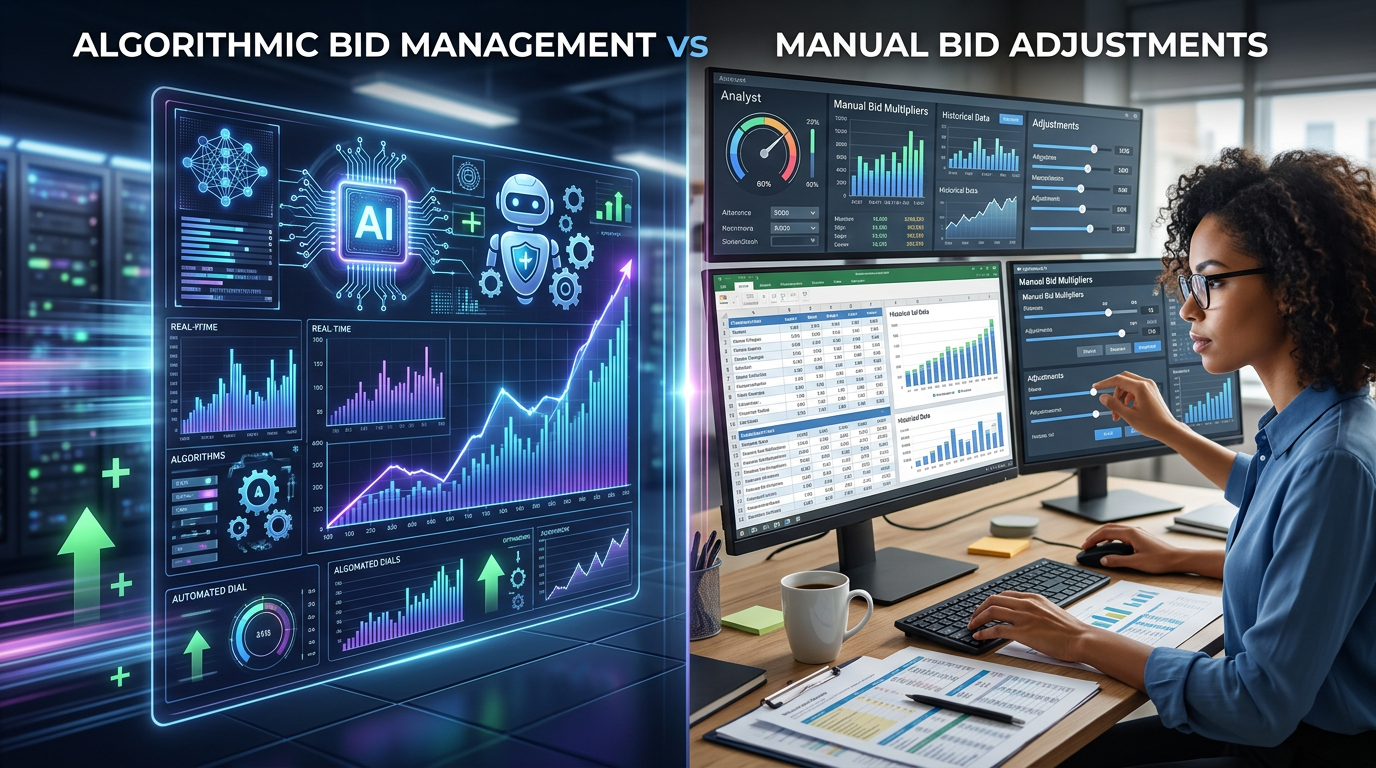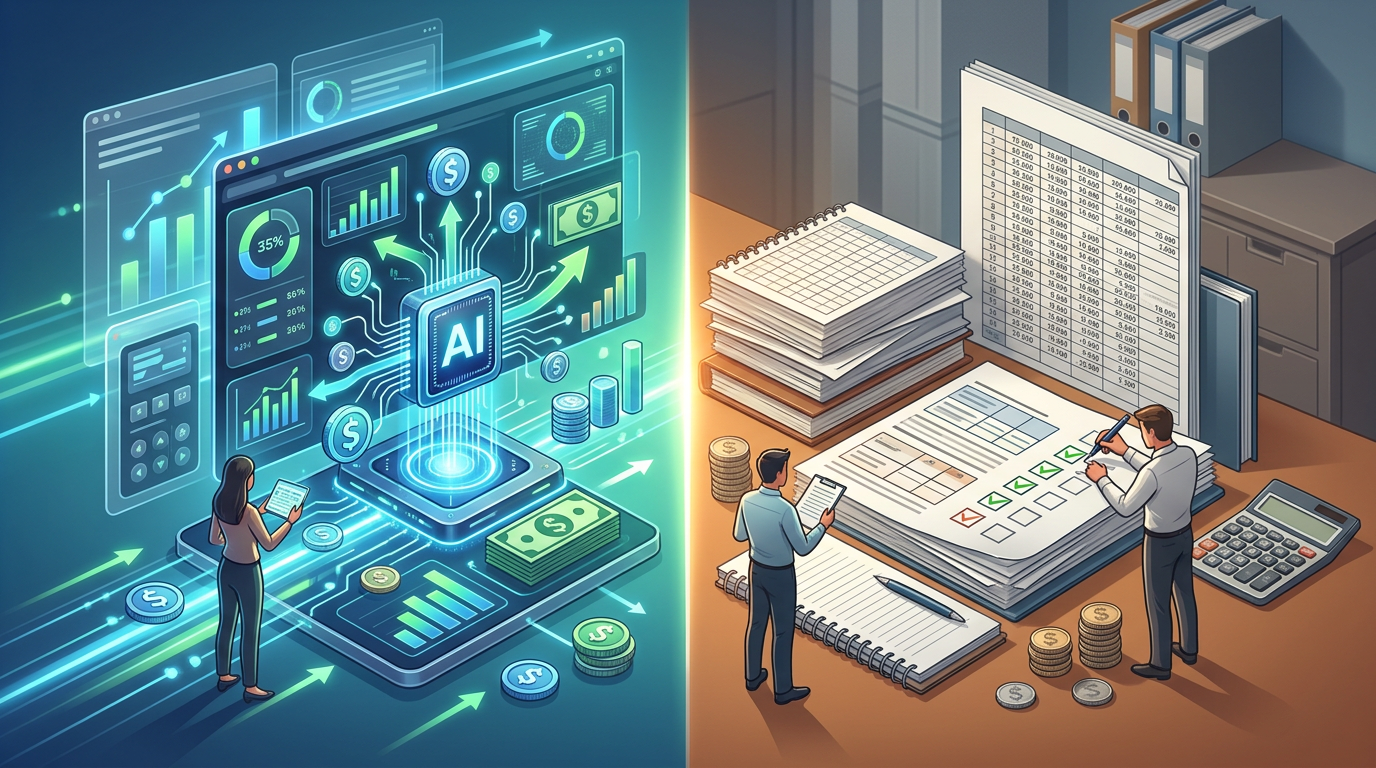
An AI marketing agent plans, executes, and adjusts marketing activities toward a defined goal. A marketing automation platform runs predefined workflows and rules that marketers configure and maintain.
Both help teams run campaigns at scale, but they differ in how much manual work they require and how quickly they can respond to changing conditions.
Quick Comparison
AI marketing agent: Plans, launches, and adjusts campaigns toward a defined goal with less manual rule-building.
Marketing automation platform: Executes predefined workflows and rules configured by a marketer.
Best for agility: AI marketing agents, because they can adapt to changing conditions without requiring a new workflow for every scenario.
Best for predictability: Marketing automation platforms, because actions follow rules that marketers define and approve.
Best approach for many B2B teams: Use automation for predictable processes and AI agents for continuous optimisation.
What Is an AI Marketing Agent?
An AI marketing agent is a system that takes a business goal, for example, more qualified leads at a target cost, and independently plans, executes, and adjusts marketing actions across channels to reach it, without every step being manually configured in advance.
Instead of requiring marketers to define every possible scenario in advance, an AI marketing agent can evaluate campaign performance, identify changes, and adjust its actions based on the goal and guardrails provided.
The key difference is goal-driven execution. You define what you want to achieve, while the agent determines how to respond as conditions change.
What Is a Marketing Automation Platform?
A marketing automation platform runs predefined workflows based on rules, triggers, and conditions configured by a marketer.
For example, when a lead fills out a form, the platform might automatically send an email, assign the lead to a salesperson, or add the contact to a nurture sequence.
This approach works particularly well when a process is predictable and the required actions are already known.
The key difference is rule-based execution. Marketers define the workflow, and the platform executes it when the specified conditions are met.
Pros and Cons of Marketing Automation Platforms
Pros:
Highly predictable, the same trigger always produces the same result
Full visibility into every rule and workflow, easy to audit
Mature category with broad third-party integrations
Cons:
Every scenario has to be manually anticipated and built as a rule
Rules go stale as market conditions change and need regular upkeep
Doesn't respond to anything outside its predefined logic
Pros and Cons of AI Marketing Agents
Pros:
Adapts to new conditions without a manual rebuild
Reduces the ongoing workload of maintaining rule logic
Evaluates performance continuously, not on a scheduled review
Cons:
Less immediately predictable than a fixed rule set
Requires clear goals and guardrails to avoid unwanted actions
Newer category, fewer established best practices than automation
AI Marketing Agent vs Marketing Automation Platform: Side-by-Side
Dimension | Marketing Automation Platform | AI Marketing Agent |
|---|---|---|
Logic | Predefined rules and workflows | Goal-driven, adapts on its own |
Setup effort | Manual, per scenario | Lower, goals replace rule-building |
Response to new conditions | None until a rule is added | Adapts automatically |
Predictability | High | Lower, bounded by guardrails |
Maintenance | Ongoing rule upkeep required | Lower ongoing maintenance |
Which Teams Should Consider Each Approach?
Different teams have different requirements. The right choice depends on how predictable their marketing processes are and how quickly those processes need to change.
Small and midsize businesses: Fewer people available to write and maintain rules, an agent reduces that burden.
Enterprises: Often keep automation for compliance-critical processes and add an agent for optimization work.
B2B SaaS companies: Longer buying cycles benefit from continuous adjustment rather than static rules.
Businesses running paid acquisition: Budget efficiency depends on how fast the system reacts to auction and market shifts, something campaign automation that plans and launches across channels is built to handle.
Marketing and SEO professionals, performance marketers, growth and analytics teams: Less time spent maintaining rule logic, more time on strategy and analysis.
Practical Use Case: Responding to a Sudden Cost-Per-Lead Spike
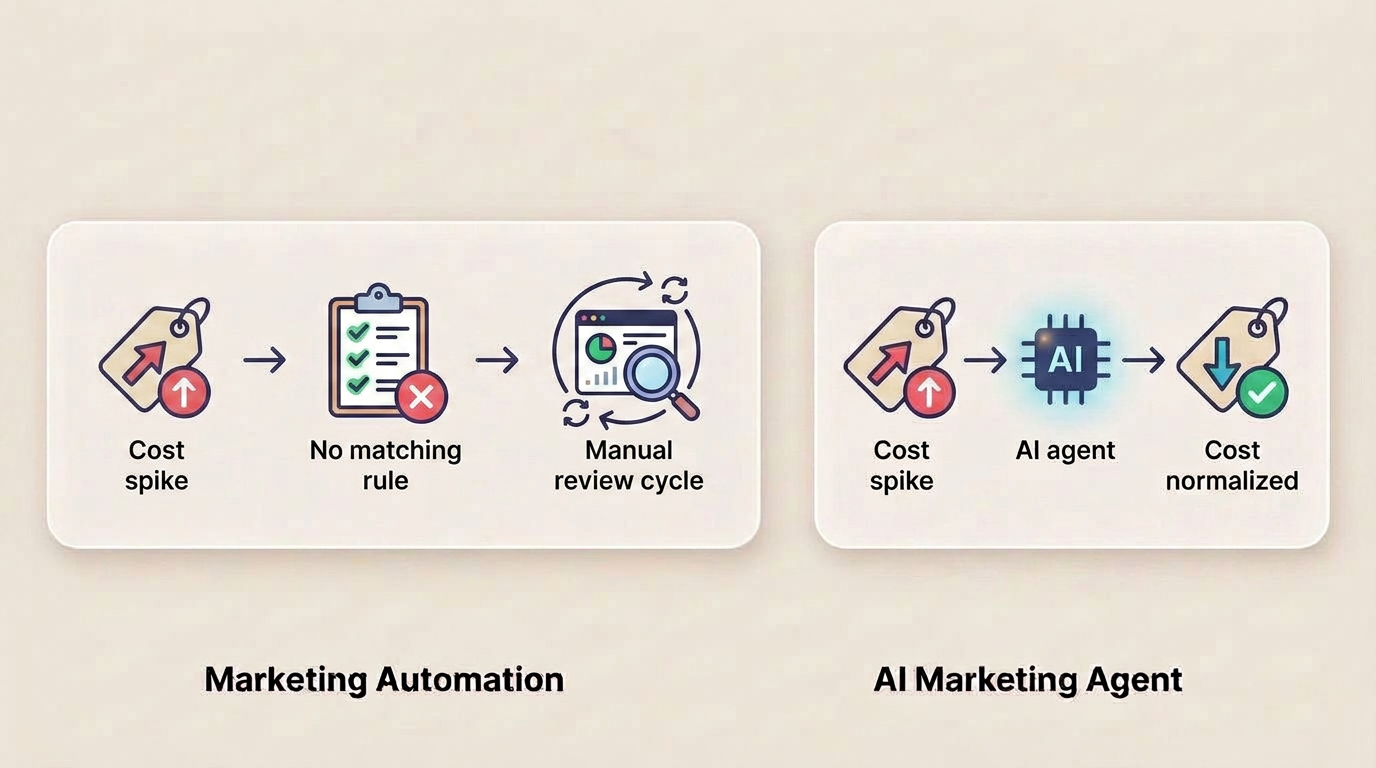
Imagine a competitor launches an unexpected promotion and the cost per lead for one of your campaigns increases by 40% overnight.
With a traditional rules-based system, nothing may happen unless an existing rule covers that situation. A marketer may need to review the dashboard, identify the problem, decide what action to take, and manually adjust the campaign.
An AI marketing agent can continuously evaluate campaign performance, identify a significant change, and take an appropriate action within the goals and guardrails it has been given.
The difference is not simply automation. Compare AI marketing agents and marketing automation to see how they differ in setup, adaptability, maintenance, and campaign optimization.
When to Choose a Marketing Automation Platform
Your processes are well understood and rarely change.
You need highly predictable and repeatable workflows.
Compliance or audit requirements require a fixed, documented process.
You want to review and approve every action before it occurs.
Your marketing workflows depend on clear triggers and predefined outcomes.
For example, lead routing, onboarding emails, notifications, and other repeatable processes can be well suited to traditional automation.
When to Choose an AI Marketing Agent
An AI marketing agent may be a better fit when:
Market conditions change faster than your team can update rules.
Your team spends significant time maintaining and expanding workflows.
Campaign performance requires frequent optimisation.
You want marketing systems to respond to changes rather than simply follow predefined sequences.
Your focus is on achieving a business goal rather than managing individual workflow branches.
This makes AI marketing agents particularly relevant for areas such as campaign planning, paid acquisition, budget optimisation, and performance-driven marketing.
Should You Choose One or Use Both?
The choice doesn't have to be either-or.
Marketing automation platforms remain valuable for processes that are predictable, repeatable, and compliance-sensitive. AI marketing agents are better suited to situations where conditions change and ongoing optimisation matters.
For many B2B teams, the practical approach is to use both side by side:
Automation handles defined processes.
AI agents handle adaptive optimisation.
Marketing teams set goals, provide guardrails, and oversee results.
This allows teams to keep the control and predictability of automation while reducing the manual effort involved in continuously optimising campaigns.
Our Recommendation
Neither approach is a universal replacement for the other.
Keep marketing automation for processes that are stable, predictable, or compliance-critical. Consider an AI marketing agent for optimisation work where changing conditions make fixed rules difficult to maintain.
The key question is not “Which technology is better?”
It is:
“Which parts of our marketing need predefined rules, and which parts need continuous adaptation?”
If your team is spending more time maintaining marketing workflows than improving campaign strategy, an AI marketing agent may be worth evaluating.
FAQs
Can an AI marketing agent replace a marketing automation platform entirely?
For most B2B teams, no. Automation still handles well-defined, compliance-sensitive processes well; an agent adds adaptive optimization on top.
Is an AI marketing agent harder to set up than automation?
Initial setup is usually simpler since you're defining goals rather than every possible workflow branch, but it requires more attention to guardrails.
Does Gartner track adoption of AI agents in marketing?
Yes. Gartner projects that 40% of enterprise applications will include task-specific AI agents by the end of 2026, up from under 5% in 2025.
Which is cheaper to run?
It depends on team size and process complexity. Automation has lower software cost but higher ongoing labor cost for maintenance; an agent shifts that balance the other way.
How NYX Helps
NYX helps marketing teams plan and launch campaigns across channels and continuously optimize them toward defined goals, reducing the manual rule maintenance associated with traditional marketing automation.
For campaign planning and execution specifically, Xeno provides the campaign automation layer within NYX.
If you're evaluating AI marketing agents against traditional automation approaches, compare the two based on the type of work you need to automate, how frequently conditions change, and how much ongoing manual optimization your team can support.
The goal isn't to automate more for the sake of automation. It's to give your marketing team more capacity to focus on strategy while technology handles the repetitive and adaptive work.