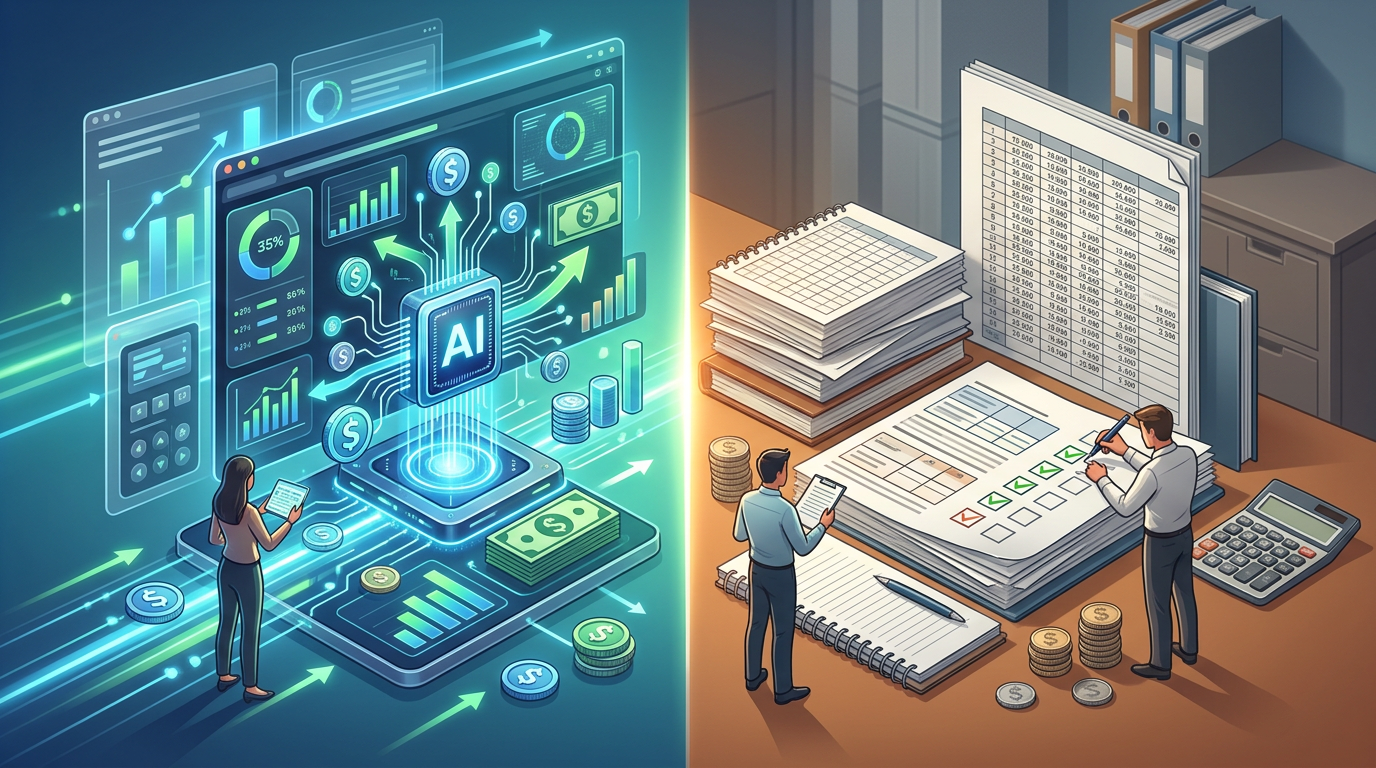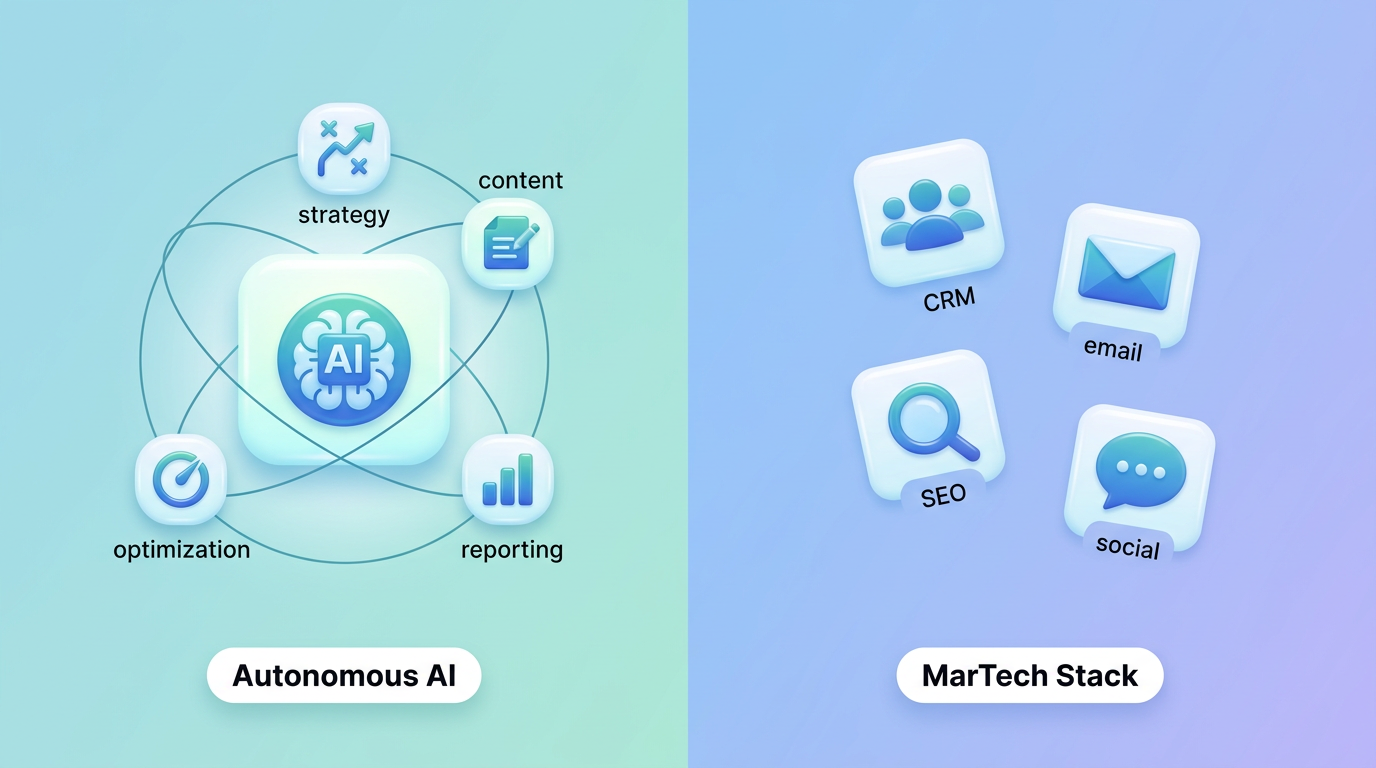
A traditional MarTech stack uses specialized tools for different marketing functions, with a team connecting, coordinating, and reconciling those systems. Autonomous AI marketing adds an AI-driven layer that can plan, execute, monitor, and optimize marketing activities across channels toward defined goals.
The key difference isn't simply the number of tools you use. It's how much manual coordination is required between them.
Quick Comparison
Traditional MarTech stack: Uses specialised tools for individual marketing functions, connected and managed by the team.
Autonomous AI marketing: Uses an AI layer to coordinate planning, execution, optimization, and reporting across channels.
Best for specialised capabilities: Traditional MarTech stacks, where teams can choose category-specific tools.
Best for coordination and speed: Autonomous AI marketing, where cross-channel activities need to work together.
Practical approach: Many teams can keep specialized tools while using an autonomous layer to reduce manual coordination.
What Is a Traditional MarTech Stack?
A traditional MarTech stack is a collection of specialized tools, a CRM, ad platforms, an email tool, an analytics dashboard, that a team connects through integrations and operates as separate systems.
These tools can be connected through integrations, but teams often still need to move between platforms, reconcile data, and coordinate actions across channels.
What Is Autonomous AI Marketing?
Autonomous AI marketing is a connected agent layer that plans, launches, and adjusts activity across channels directly, using one shared data model instead of a person moving data between disconnected tools.
Instead of relying on marketers to manually coordinate every step across multiple platforms, the AI layer can evaluate performance, identify changes, and coordinate actions across channels based on the goals and guardrails provided.
Pros and Cons of a Traditional MarTech Stack
Pros:
Best-in-class capability available for each specific function
Easy to swap one underperforming tool without replatforming everything
No single vendor dependency for the entire marketing motion
Cons:
Data is fragmented across tools, requiring manual reconciliation
Integration and maintenance work grows with every tool added
Cross-channel decisions are harder to make with a fragmented view
Pros and Cons of Autonomous AI Marketing
Pros:
One source of truth for performance data across channels
No integration maintenance between separate systems
Actions in one channel account for what's happening in others
Cons:
Less flexibility to pick a category-leading point solution for every function
Consolidating onto one layer is a bigger upfront decision than adding one more tool
More dependency on a single vendor's roadmap
Stack vs. Autonomous Layer: Side-by-Side
Dimension | Traditional MarTech Stack | Autonomous AI Marketing |
|---|---|---|
Data | Fragmented across tools | Shared across the whole layer |
Coordination | Manual, owned by the team | Handled by the agent layer |
Per-tool capability | Often best-in-class | Strong, not always category-leading |
Reporting | Assembled by hand | Unified by default |
Vendor risk | Spread across many vendors | Concentrated in one vendor |
Who Benefits Most From Autonomous AI Marketing?
Small and midsize businesses: Fewer logins and no need for a specialist per tool, which matters without dedicated ops headcount.
Enterprises: Value a governed, auditable coordination layer over tools that already exist.
Businesses running paid acquisition: Budget shifts happen with full visibility into every channel at once, a task autonomous campaign planning and execution is designed for.
Marketing and SEO professionals, analytics and growth teams: Less time reconciling reports, more time acting on them.
Practical Use Case: Reconciling a Multi-Channel Weekly Report
Imagine a marketing team that pulls numbers from four different platforms every Friday to answer one question:
Which channel is actually driving the most pipeline?
The numbers don't always match on the first pass. Someone has to export reports, reconcile attribution differences, check campaign data, and prepare a summary before the team can decide what to do next.
With an autonomous AI marketing layer, campaign planning, performance monitoring, and reporting can work from connected data throughout the week.
Instead of spending the first part of the meeting figuring out what happened, the team can spend more time deciding what to do next.
That's the practical difference: less manual coordination between tools and faster movement from insight to action.
When to Choose a Traditional MarTech Stack
A traditional MarTech stack may be the better choice when:
You need the strongest specialized tool for a specific marketing function.
Your team has the resources to manage multiple platforms and integrations.
Your marketing processes are already working well across the existing stack.
You want to avoid concentrating multiple functions with one vendor.
Different teams need specialized tools for their specific workflows.
For many businesses, a traditional stack remains a sensible choice when specialization is more important than centralized coordination.
When to Choose Autonomous AI Marketing
Autonomous AI marketing may be a better fit when:
Fragmented data is slowing down marketing decisions.
Your team spends significant time moving between platforms and reconciling reports.
Cross-channel campaign decisions need to happen faster.
You want continuous optimization rather than periodic manual analysis.
Your marketing team is too small to manage growing MarTech complexity efficiently.
The biggest opportunity is often not replacing every tool. It's reducing the manual work required to coordinate them.
FAQs
Does autonomous AI marketing mean giving up specialized tools?
Not usually. Most autonomous layers still integrate with specialized tools where needed.
Is a traditional stack always more expensive?
Not in license cost, but it often carries hidden costs in the headcount needed to manage integrations.
How fast can agent-run execution actually move?
McKinsey's research on agentic marketing workflows found that agentic systems can speed up campaign creation and execution by 10 to 15 times versus manually coordinated workflows.
How disruptive is switching from a stack to an autonomous layer?
Most teams migrate one function or channel at a time rather than switching everything at once.