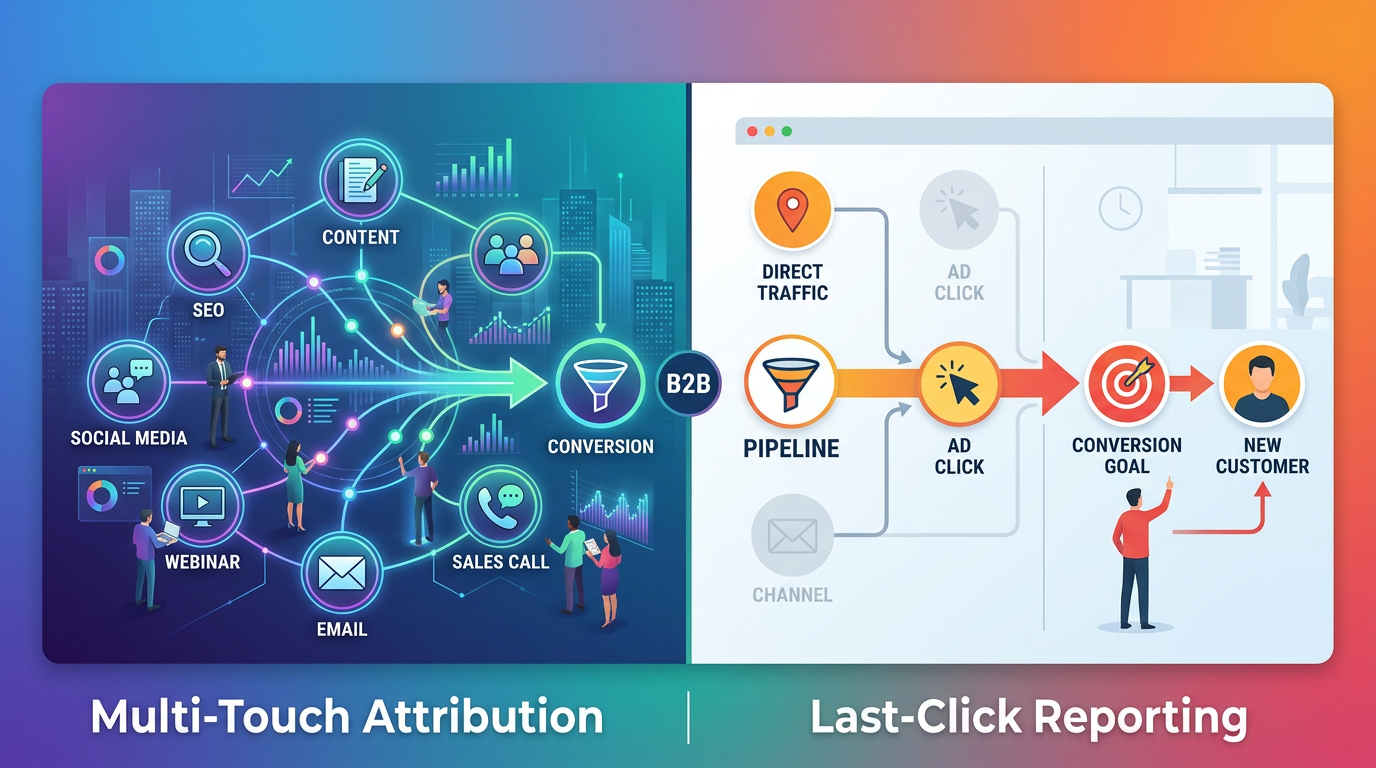
Multi-touch attribution and last-click reporting answer different questions about marketing performance. Last-click reporting gives full credit to the final tracked interaction before a conversion, while multi-touch models distribute credit across multiple interactions in the buyer journey.
For B2B pipeline, the distinction matters because a deal can involve multiple people, channels, and interactions before an opportunity is created or closed. A last-click view can show which interaction preceded the conversion, but it does not show the earlier marketing activity that may have influenced the account.
That does not make last-click reporting useless. It makes it a narrower lens. The practical choice is whether the business needs a simple view of the final conversion step, a broader view of touchpoint contribution, or both.
Why Last-Click Looks Clearer Than the Buyer Journey
Last-click reporting is attractive because the rule is easy to explain: assign 100% of the conversion credit to the final tracked interaction. That makes reports simple to read and quick to act on. Salesforce describes last-touch as a model suited to bottom-of-funnel performance and immediate conversion drivers.
For example, if an account reads a blog post, attends a webinar, returns through organic search, and then submits a demo request after clicking a paid ad, last-click reporting assigns the conversion to that final interaction.
The simplicity is useful when the business question is specifically about the interaction closest to conversion. It becomes limiting when teams use the same number to decide which programs created demand earlier in the journey.
How the Two Reporting Approaches Assign Credit
Last-click uses a single-touch rule. One interaction receives all of the reported credit.
Multi-touch attribution distributes credit across eligible interactions according to a selected model. Common approaches include linear attribution, time decay, position-based models, and data-driven approaches. Salesforce documents several of these model types and their different purposes.
The model therefore matters. A linear model treats eligible touches equally. A time-decay model gives greater weight to more recent interactions. A position-based model gives more weight to selected points in the journey.
Decision Criteria: Multi-Touch vs Last-Click Reporting
The following table summarizes the main reporting differences:
Criterion | Multi-Touch Attribution | Last-Click Reporting |
Credit assignment | Distributed across eligible interactions | 100% to final tracked interaction |
Primary use | Understand contribution across the journey | Evaluate the final conversion step |
B2B journey visibility | Broader | Narrower |
Reporting complexity | Higher | Lower |
Data requirements | Higher | Lower |
Budget decision context | Broader view of channel contribution | Strong bottom-of-funnel signal |
Main limitation | Model assumptions and incomplete journeys | Can understate earlier influence |
There is no universally correct allocation rule. Attribution models are decision-support frameworks, and the right choice depends on the business question, available data, sales cycle, and level of reporting maturity.
Why Last-Click Can Distort B2B Pipeline Decisions
Last-click can overstate the importance of the interaction that happened immediately before conversion while hiding earlier activity.
Consider a six-month B2B journey. A buying group may encounter a research article, attend a webinar, engage with a paid campaign, speak with sales, return to the website, and finally request a demo. If the demo request comes through paid search, a last-click report may make paid search appear to have created the entire conversion.
The report is not necessarily wrong about the final interaction. The problem arises when the same number is interpreted as a complete explanation of demand creation.
That can affect budget decisions. content performance and optimization if they rarely receive the final click, even though they may contribute to pipeline progression.
Research on complex B2B journeys similarly notes that multiple decision-makers and multi-channel interactions make attribution difficult, and that single-touch models can lead to incomplete resource-allocation decisions. citeturn0search35
What Multi-Touch Attribution Adds to the Picture
Multi-touch attribution provides a broader view by assigning credit across multiple visible interactions rather than selecting only the final touch.
This can help marketing performance measurement
Which channels appear across the full buyer journey.
Which programs are present earlier in journeys that eventually create pipeline.
Whether different attribution models materially change budget conclusions.
Which campaigns are associated with opportunity creation rather than only lead conversion.
Choosing an Attribution Model Without Overcomplicating Reporting
More sophisticated attribution does not automatically produce better decisions. The model should match the question the business needs to answer.
Use a simple model when the reporting objective is narrow and the data does not support more detailed analysis. Introduce more complex models when the organization has reliable journey data, sufficient volume, and a clear business reason to understand contribution across stages.
A practical framework is to start with a small number of questions:
Which channels influence pipeline creation?
Which programs help move accounts toward opportunity stages?
Which interactions are most visible at the point of conversion?
Does changing the attribution model materially change investment decisions?
From Lead Conversion to Pipeline and Revenue
Attribution becomes more useful when reporting moves beyond lead volume and connects marketing activity to pipeline stages and revenue outcomes.
Salesforce defines revenue attribution as connecting marketing activity directly to pipeline or bookings. Its documentation also distinguishes touch-based attribution, which examines marketing interactions, from funnel-based attribution, which focuses on progression through lifecycle stages.
For B2B teams, this means the reporting framework should distinguish between a conversion and a business outcome. A form submission may be useful, but it is not the same as a qualified opportunity, pipeline creation, or closed-won revenue.
Teams should therefore define the outcome before selecting the attribution model. Otherwise, a sophisticated model can produce a precise answer to the wrong question.
Data Quality Matters More Than Model Complexity
Attribution quality depends heavily on whether the underlying journey data is complete and consistently connected to CRM outcomes.
Common problems include missing campaign parameters, disconnected anonymous and known-user activity, inconsistent account identification, incomplete offline activity, duplicated records, and gaps between marketing automation and CRM systems.
These issues matter because multi-touch attribution can only distribute credit across interactions that the system can observe and connect.
First-party data is particularly important for revenue attribution. Salesforce notes that CRM records, form submissions, and email engagement provide an organization-owned foundation for attribution reporting.
Before investing in a more complex model, teams should validate tracking coverage, identity resolution, campaign taxonomy, lifecycle stages, opportunity linkage, and revenue data.
Where Multi-Touch Attribution Still Falls Short
Multi-touch attribution provides more context than last-click, but it is not a perfect measurement of causality.
A model can assign credit to an interaction because it occurred in a journey without proving that the interaction caused the buyer to progress. Highly engaged prospects may naturally generate more touches, creating correlation between activity and revenue without establishing incremental impact.
Dark social, offline conversations, untracked sales activity, multiple stakeholders, and incomplete account-level identity can also leave important parts of a B2B journey outside the model.
That is why attribution should be treated as one measurement layer rather than the sole source of truth. Controlled experiments, incrementality analysis, sales feedback, and pipeline quality can provide additional evidence when the decision requires stronger causal confidence.
When Last-Click Reporting Is Still Useful
Last-click remains useful when the business question is specifically about the final conversion step.
It can be appropriate when:
The buyer journey is relatively short.
The business needs a simple bottom-of-funnel performance signal.
The conversion event has a clear final action.
Data quality is not sufficient for reliable multi-touch reporting.
Teams use it alongside broader pipeline analysis rather than as the only measure of marketing influence.
How to Build a Practical B2B Attribution Workflow
A practical workflow does not require every team to implement a complex model immediately. It can develop in stages.
Start by defining the business outcomes that matter. Then establish consistent campaign and CRM data, connect multi-channel advertising where possible, and select a model that matches the available evidence.
Once reporting is stable, AI optimization vs manual approaches. If last-click and multi-touch reports produce materially different budget recommendations, investigate why the difference exists.
The goal is not to make every report more complicated. It is to make marketing and sales investment decisions AI-powered creative generation.
Define the pipeline or revenue outcome.
Standardize campaign naming and tracking.
Connect marketing activity to CRM records and opportunities.
Choose a model that fits the data and business question.
Compare attribution results with pipeline quality and sales feedback.
Review the model periodically as buying behavior and data coverage change.
Key Takeaways
Last-click reporting is useful for understanding the final conversion interaction, but it can underrepresent earlier activity in a complex B2B journey.
Multi-touch attribution provides broader visibility into the interactions associated with pipeline creation, but its results depend on the selected model and data quality.
Neither approach should be treated as a perfect measure of causality. Attribution is most useful when combined with pipeline quality, sales context, and experimentation where appropriate.
The best reporting framework connects marketing interactions to meaningful business outcomes such as qualified pipeline, opportunity creation, and revenue.