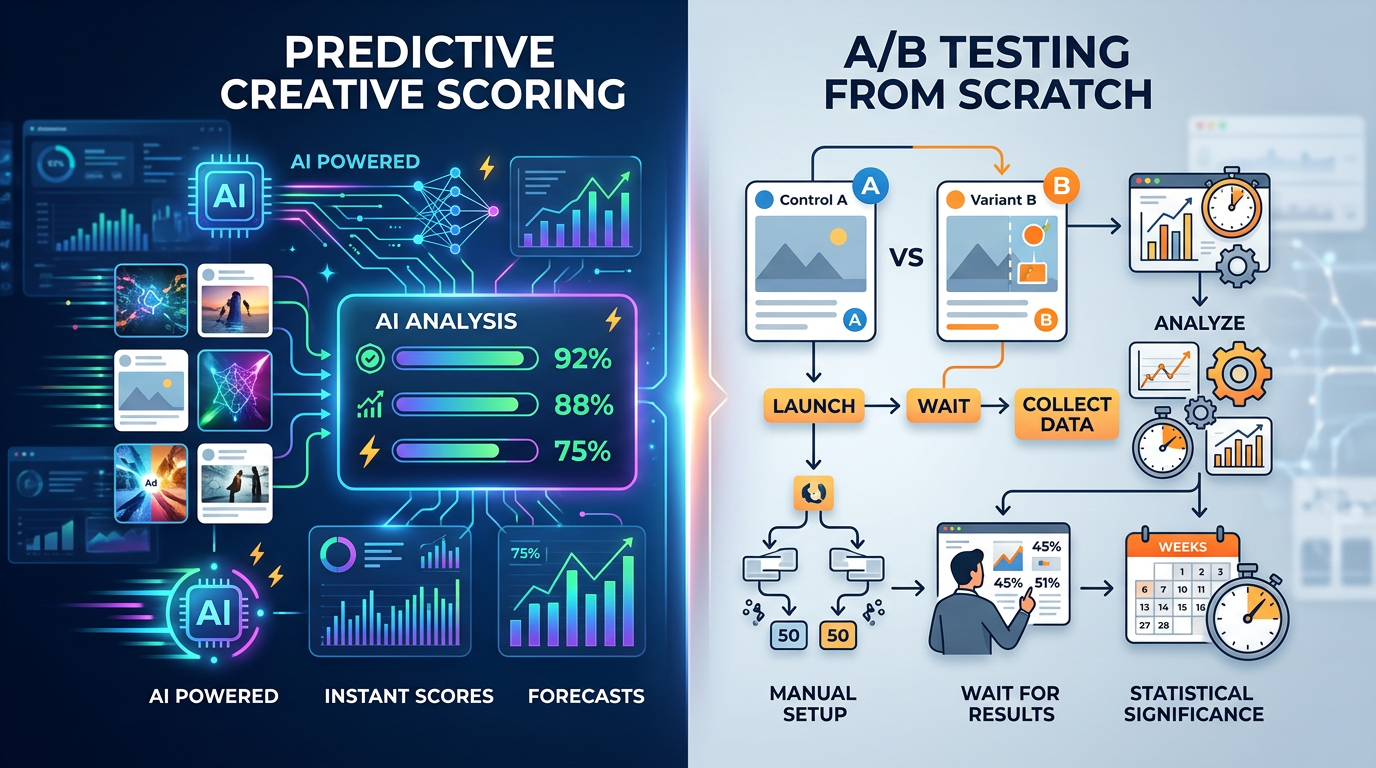
Predictive creative scoring and A/B testing answer different questions. Predictive scoring estimates how a creative is likely to perform before significant media spend, while A/B testing measures what happens when variants run in a live campaign.
That distinction matters when teams have more creative ideas than budget or testing capacity. Scoring can help narrow the field before launch. Testing can then provide evidence for decisions about which creative should receive more spend.
AI creative scoring It is a clear division of responsibility: use prediction to prioritize candidates and live testing to validate performance.
How Predictive Scoring and A/B Testing Differ
Predictive creative scoring evaluates attributes of an asset against patterns in historical performance. Depending on the scoring system, inputs can include format, layout, copy characteristics, visual elements, hook timing, offer placement, audience, and placement.
The result is a ranking or score that helps a team decide which creatives deserve further attention.
A/B testing starts with live variants. Budget and impressions are allocated across the variants, and performance is measured using a defined metric. The outcome is based on observed campaign data rather than a forecast.
The structural difference is simple: scoring is a pre-launch filter, while testing is a post-launch measurement method. A score can influence what enters a test, but it does not turn predicted performance into measured performance.
Why Testing Every Creative From Scratch Gets Expensive
Testing every idea may appear rigorous, but it can be inefficient when a large proportion of variants fail to outperform the existing baseline.
Large-scale experimentation research from Kohavi and Thomke has shown that many online experiments do not produce positive results. Their Harvard Business Review analysis reported that only about 10% to 20% of experiments at Google and Bing generated positive results, while Microsoft saw roughly one-third of experiments prove effective, one-third remain neutral, and one-third produce negative results.
The exact hit rate will vary by account and experiment design, so these figures should not be treated as a forecast for every advertising program. The broader lesson is more useful: testing produces learning, but not every tested idea will create a performance gain.
In paid media, those learning costs are real. Each variant consumes impressions and budget while the team waits for enough data to separate performance from normal variation.
creative optimization The value comes from concentrating available budget on a smaller set of qualified variants, not from eliminating experimentation.
What a Predictive Score Can Tell You
A predictive score is most useful when it is treated as an informed estimate rather than a final performance judgment.
It can help answer questions such as:
Whether a creative resembles assets that have historically performed well for a relevant audience or placement.
Which of several variants is more likely to generate early engagement.
Whether an asset resembles previous creative and may be exposed to creative fatigue.
Which candidates appear weak enough to deprioritize before they consume media budget.
When a Score Is Not Enough
A score cannot establish the true incremental effect of a creative on business outcomes. That requires an appropriate experiment or other causal measurement method.
Prediction also becomes less dependable when the creative is genuinely novel, the account has limited relevant history, or market conditions have changed significantly.
multi-channel advertising Competitor activity, seasonality, changes to landing pages, audience composition, platform algorithms, or changes in the offer can affect performance without being fully represented in the scoring model.
The practical rule is straightforward: use a score as a prior. It can change the starting odds, but it should not be presented as proof of future or incremental performance.
How the Two Approaches Differ on Time and Budget
Scoring can produce a ranking quickly because it does not need to wait for campaign conversions. That makes it useful when a team needs to reduce a large creative pool before launch.
A/B testing takes longer because the result depends on traffic, conversion volume, test design, and the amount of evidence required to make a decision.
optimize ad spend with AI If six variants share a fixed daily budget, each receives less spend than it would if the team tested only three qualified candidates. Reducing the number of variants can therefore increase the amount of data available to each surviving test arm.
The benefit is not that predictive scoring replaces statistical testing. It is that better candidate selection can make the testing budget more concentrated and the resulting evidence easier to obtain.
Which Method Fits Which Decision
Use predictive scoring when the team has a large pool of candidates and needs to prioritize quickly.
Use A/B testing when the decision requires evidence from actual campaign behavior.
Use both when the goal is to reduce wasted test spend without weakening the evidence used for final decisions.
Where Predictive Scoring Can Lose Accuracy
Four conditions deserve particular attention.
Cold starts: new accounts, markets, or products may have little relevant historical data.
Novel creative: concepts that have no close precedent can be scored conservatively because the model has limited evidence.
Distribution shifts: changes in audiences, platforms, competition, or market conditions can weaken historical relationships.
Metric mismatch: a model trained to predict engagement may not identify the assets most likely to improve revenue or return on ad spend.
Decision Criteria: Predictive Scoring vs A/B Testing
Criterion | Predictive Creative Scoring | A/B Testing From Scratch |
Primary output | Ranked forecast before significant spend | Measured outcome after live spend |
Time to initial answer | Fast; no conversion wait | Depends on traffic and conversion volume |
Budget required to learn | Low; filtering happens before launch | Higher; each test arm consumes media budget |
Evidence type | Historical correlation and prediction | Observed performance under test conditions |
Novel concepts | Less reliable when precedent is limited | Can evaluate them directly |
Low-volume accounts | Can prioritize without waiting for conversions | May struggle to reach a reliable result across many arms |
Best role | Shortlist candidates | Validate performance and guide scaling |
How to Check Whether a Score Deserves Trust
Predictive systems should be evaluated like other forecasting tools. Teams should test whether the score is useful for their own account rather than relying only on a vendor-level accuracy claim.
Backtesting is a practical starting point. Take creatives with known outcomes and compare their historical performance with the model's rankings. If actual winners consistently appear near the top, the score has evidence of predictive value in that environment.
A holdout can provide another check. Reserve a portion of the test population or budget for candidates the model ranks lower. If low-scored creatives repeatedly outperform their predicted position, the scoring model may need recalibration.
Finally, separate correlation from causation. data-driven marketing decisions When reporting results to senior stakeholders, predicted lift and measured lift should remain clearly separated.
How to Use Scoring and Testing in the Same Workflow
Generate a broad creative pool so there is enough variation to evaluate.
Score and shortlist the candidates worth testing, while retaining a small number of deliberate outliers.
Run a properly structured test with a clear primary metric and predefined decision criteria.
Feed the observed results back into the scoring process so future predictions reflect account-specific evidence.
Teams that need to create and evaluate a larger volume of ad variations can also use as part of the broader production workflow. Teams that need to scale the production side can also use AI-powered creative generation to support the testing workflow.
When A/B Testing Should Take the Lead
Some decisions should go directly to live testing because prediction is least reliable or because the decision requires stronger evidence.
Use A/B testing as the primary method when:
A new brand direction or campaign platform is being introduced.
The decision is high-stakes and controls a substantial amount of budget.
A performance claim will be reported as a measured fact to finance, leadership, or the board.
A major platform, audience, product, or market change has reduced the relevance of historical data.
Key Takeaways
Predictive scoring is most useful as a pre-launch prioritization layer; A/B testing remains the stronger method for validating live performance.
The main efficiency gain comes from testing fewer, better-qualified candidates and concentrating budget where there is a reasonable basis for comparison.
Scores can become less reliable with novel creative, limited relevant history, major market changes, or a mismatch between the model's objective and the business metric.