Quick Answer
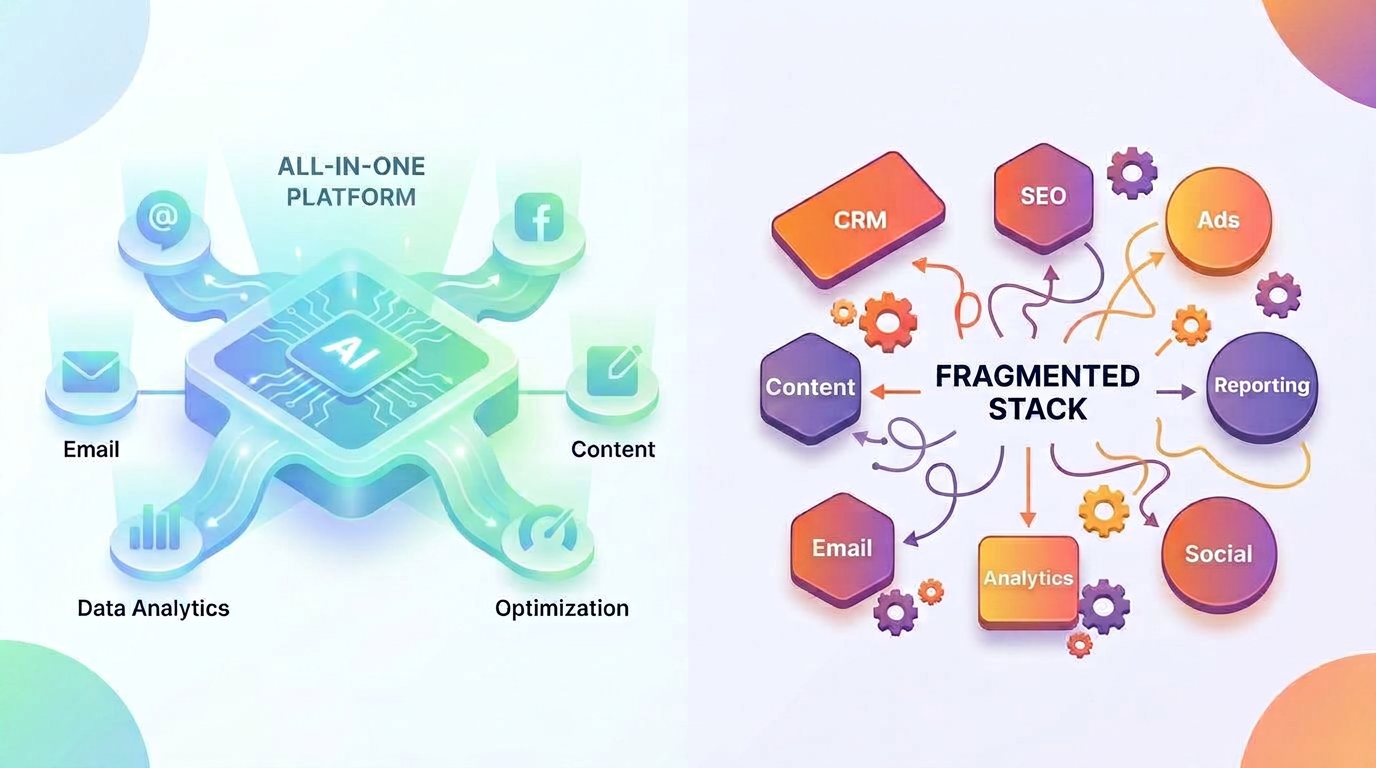
Unified AI marketing platforms consolidate campaigns, optimization, and reporting in one interface with built-in integrations; best-of-breed stacks piece together specialized tools for advanced control. Choose unified for simplicity and speed; choose best-of-breed for customization and channel-specific depth.
Key Takeaways
Integration: Unified platforms connect channels natively; best-of-breed requires API setup and data syncing
Speed to execution: Unified platforms launch campaigns faster; best-of-breed takes longer due to tool configuration
Customization: Unified platforms constrain you to their feature set; best-of-breed adapts to any workflow
Learning curve: Unified platforms are easier to onboard; best-of-breed requires tool-specific expertise
Defining the Two Approaches
Unified AI Marketing Platform
A single platform handling campaign management, budget allocation, creative optimization, multi-channel orchestration, and reporting from one dashboard. You set goals; the system manages execution across channels Google Ads, Meta, LinkedIn, TikTok, and others without toggling between platforms.
One interface, one login, one data model. Native API connections mean data flows seamlessly between functions.
Best-of-Breed Tool Stack
Piecing together specialized tools , one for bid management, one for creative testing, one for attribution, one for analytics each built for depth in a specific area. You own the integration layer and control how tools communicate.
Maximum control and specialized power. Higher complexity. Data lives in multiple places until you unify it.
Head-to-Head Comparison
Dimension | Unified Platform | Best-of-Breed Stack |
|---|---|---|
Data Consolidation | Native, automatic | Via API/webhooks/manual sync |
Channel Support | 5–8 standard channels | Unlimited (if tool exists) |
Depth per Channel | Good (generalist approach) | Excellent (specialist depth) |
Custom Workflows | Limited to platform design | Highly customizable |
Learning Curve | 1–2 weeks for full team | 2–4 weeks per tool |
Vendor Lock-In | Moderate-to-high | Low (tools are independent) |
Reporting & Dashboards | Unified by default | Manual consolidation or BI tool needed |
API Access | Limited | Full access across all tools |
Support & Onboarding | Centralized | Per-vendor (fragmented) |
Scalability | Built-in (handle more channels) | Scalable but adds complexity |
Feature Updates | Tied to vendor roadmap | Each tool evolves independently |
Integration Maintenance | Minimal | Ongoing (APIs change, break) |
Multi-Channel Orchestration | Native | Requires additional orchestration tool |
When to Use a Unified AI Platform
You run 3–5 channels and want to avoid tool sprawl
Speed to execution is critical (product launches, seasonal campaigns)
Your team is small and can't manage multiple vendor relationships
You prefer simplicity and ease of onboarding over maximum customization
You want unified reporting without manual data consolidation
Example: A D2C brand runs Meta, Google, and TikTok ads. A unified platform launches campaigns across all three in 2 days, automatically adjusts budgets, and pulls one ROI dashboard. No API setup, no manual syncing.
When to Use a Best-of-Breed Stack
You need specialized depth in specific channels (advanced LinkedIn segmentation, YouTube-specific optimization)
Your workflow demands custom automation rules or compliance requirements
You want vendor independence and the ability to swap tools without disruption
You have engineering or technical support to manage integrations
Your campaign complexity justifies the configuration overhead
Example: An enterprise B2B SaaS company runs LinkedIn, Google Search, and display with account-based marketing rules. They use a specialist LinkedIn tool, a dedicated search platform, a separate CDP, and an orchestration layer all connected via APIs.
Integration Reality: The Hidden Complexity
Unified platform integration:
Channels connect natively with minimal setup
Data flows automatically between campaign management and optimization
Onboarding is straightforward usually days to one week
Updates roll out automatically; no manual maintenance
Best-of-breed integration:
Each tool requires API configuration and authentication
Data syncing can be real-time (ideal) or batch (slower)
Integration breaks when vendor APIs change or deprecate
Requires ongoing monitoring and maintenance
May need a dedicated integration engineer or orchestration platform
Industry research shows integration work consumes significant team time
Flexibility vs. Simplicity Trade-Off
Unified platforms excel at:
Coordinating spend across channels based on real-time performance
Rapid testing and iteration without tool-switching overhead
Teams with limited technical resources
Organizations that want fast, proven workflows
Best-of-breed stacks excel at:
Custom rules and compliance-heavy workflows
Leveraging specialized features (e.g., LinkedIn's native account-based marketing)
Organizations with technical infrastructure to support integrations
Teams that need to customize every aspect of their workflow
Vendor Roadmap Risk
Unified platforms: Feature development depends entirely on the vendor. If you need a capability they haven't built and don't plan to build, you're stuck or forced to integrate a workaround tool.
Best-of-breed stacks: Each vendor evolves independently. You can upgrade, downgrade, or swap any single tool without touching the others but you also own the burden of managing multiple vendors.
FAQs
Can a unified platform truly replace a best-of-breed stack?
Yes, if your needs fit the platform's design. Many unified platforms handle 80–90% of standard marketing operations well. You'll lose depth in specialized channels and custom workflows, but gain speed and simplicity. The question isn't whether it's possible, it's whether the trade-off fits your business.
What's the best way to evaluate which approach fits our needs?
List your non-negotiables: required channels, must-have features, custom workflow needs, and team size. If more than two items depend on best-of-breed depth, a stack is justified. If most items are covered by standard platform features, unified wins. Try both; most platforms offer trials long enough to test your specific use case.
Do unified platforms actually coordinate better across channels than manual management?
Yes, in most cases. Unified platforms adjust spend and creative based on real-time performance across all channels simultaneously. A person managing separate tools can't match that speed. However, the benefit only applies to what the platform actually optimizes; if you need custom rules or channel-specific nuance, a best-of-breed stack with an orchestration layer may outperform.
How much technical support does a best-of-breed stack require?
Depends on your stack depth. A lightweight stack (2–3 tools) needs minimal ongoing work. A complex stack (6+ tools with custom APIs) requires someone with technical skills to manage integrations, monitor data flow, and handle API changes when vendors update. Budget for either a part-time technical hire or fractional engineering support.
Hybrid Approach (Most Common)
Many organizations don't choose sides they run both. A unified platform handles core campaigns and reporting, while specialist tools handle channels or functions requiring deeper control. This approach lets you get the speed benefit of unified tools while retaining flexibility where it matters most.
Bottom Line
Choose a unified platform if you want to move quickly, reduce tool sprawl, and prioritize simplicity over specialized channel depth. Choose a best-of-breed stack if you need advanced features, operate in complex environments, or require custom automation.
For many companies, a hybrid approach works best: start with a unified platform to establish workflows and understand your channel needs, then add specialist tools where deeper capabilities provide clear value. This gives teams centralized coordination without sacrificing the specialized functionality they need as they grow.