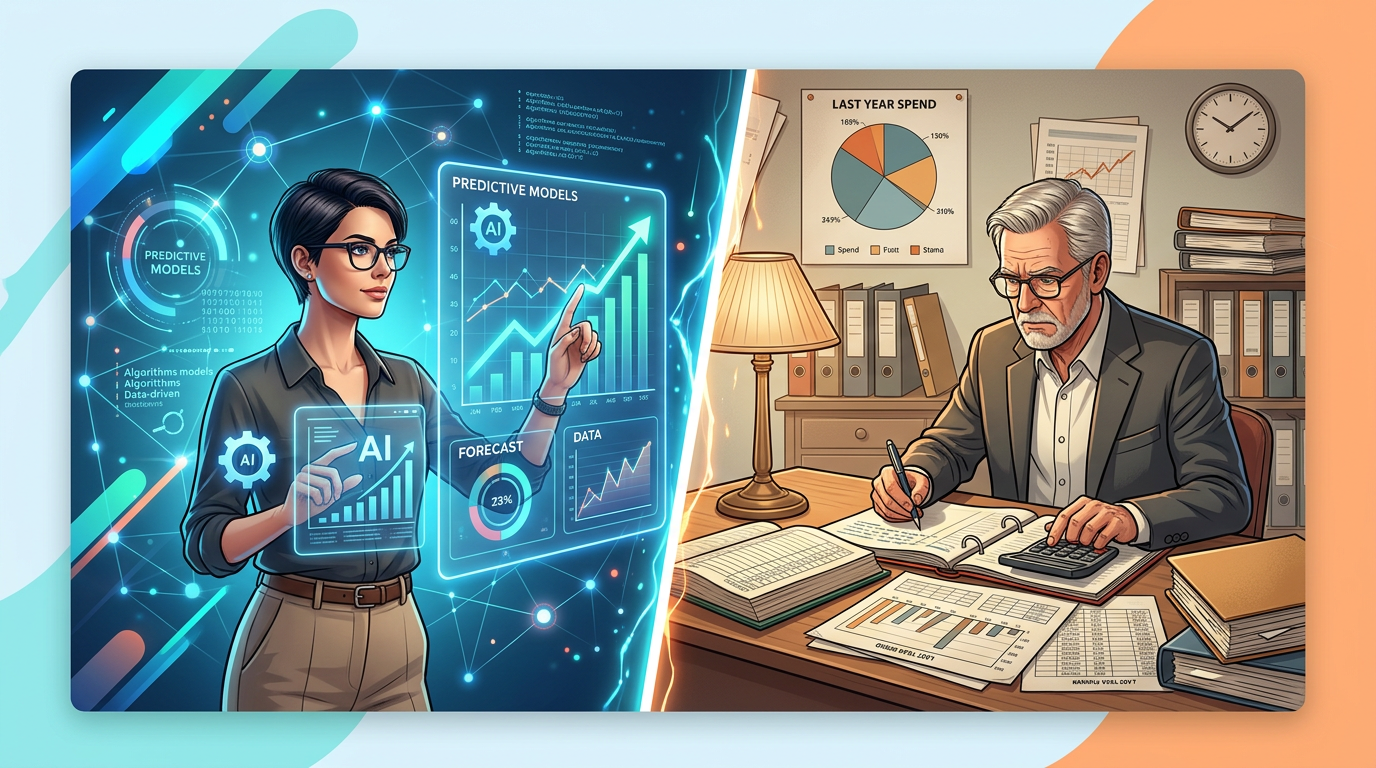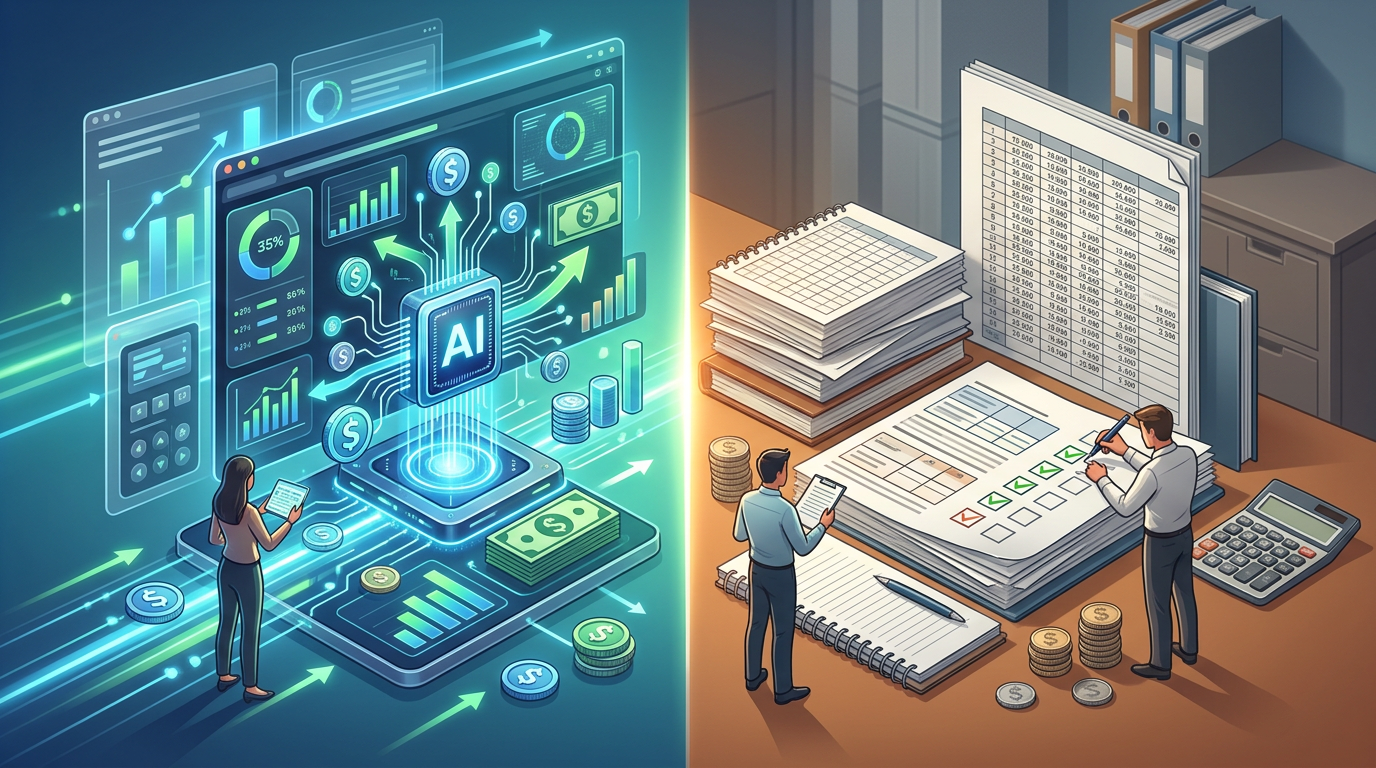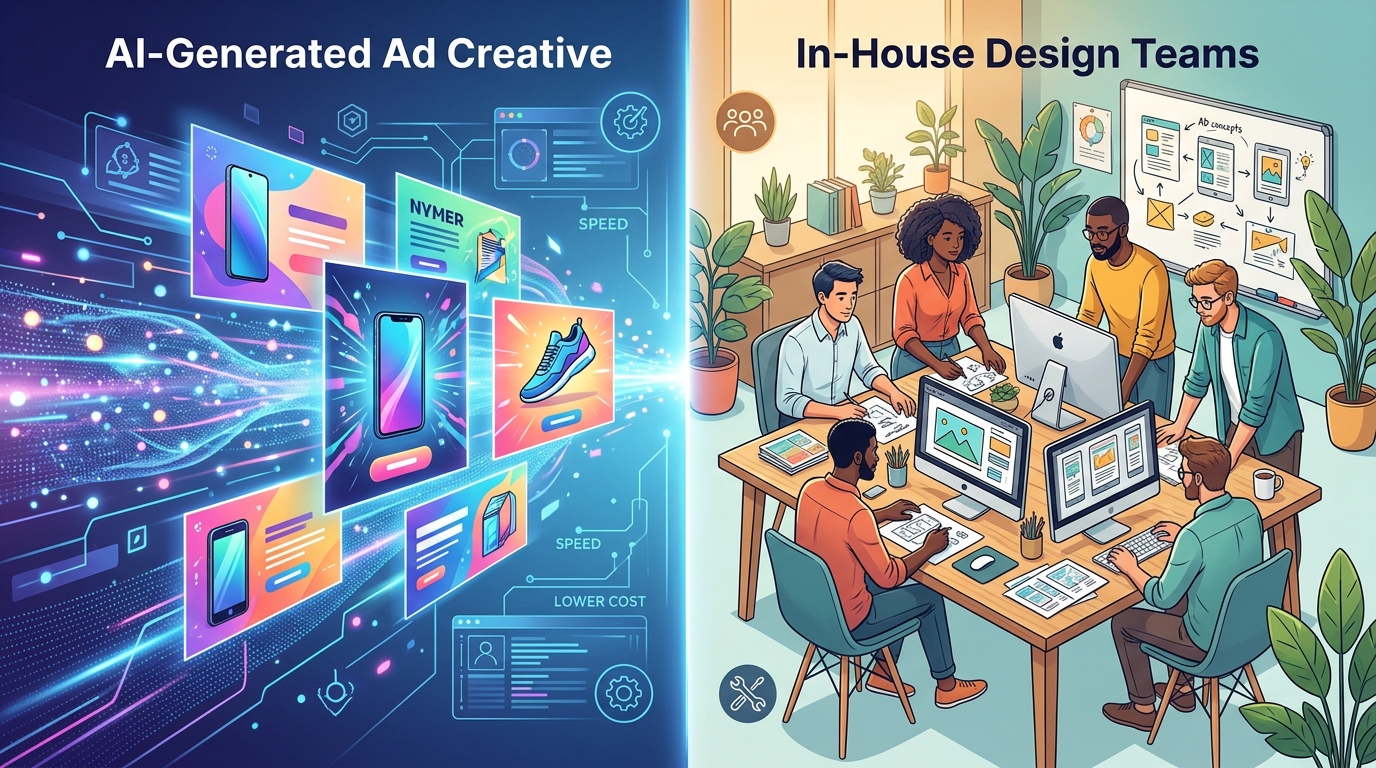
AI-generated ad creative and in-house design teams approach creative production from different starting points. An internal design team relies on people to develop, refine, and deliver each asset, while AI tools can automate parts of the process and generate variations from defined inputs.
The difference is most visible when creative volume increases. A small campaign may be manageable with an in-house team, but producing multiple formats, concepts, sizes, and variations can put pressure on design capacity. AI can reduce the time required for some production tasks, but it does not eliminate the need for creative direction, review, brand governance, or quality control. Teams evaluating a broader AI advertising platform can use the same principle to assess workflow scalability.
The practical question is not whether AI or designers are faster in isolation. It is how each model affects production time, cost per asset, creative capacity, and the amount of human work required to take an idea from brief to campaign-ready output.
What Changes When AI Enters the Creative Workflow
Traditional in-house design workflows typically move through briefing, concept development, design, feedback, revisions, approval, and delivery. Each additional asset generally requires some level of designer involvement.
AI-generated creative changes the production model by automating portions of that workflow. Depending on the tool, teams can generate initial concepts, adapt existing creative, resize assets, produce variations, or create new visual treatments from prompts and structured inputs.
The biggest change is not simply faster image generation. It is the ability to reduce manual production work for repetitive creative tasks.
For example, a campaign may require multiple ad sizes, several headline variations, different product images, audience-specific messaging, social and display formats, and multiple creative concepts. An in-house team can produce these assets, but the workload grows as the number of variations increases. AI can help generate or adapt some of those variations without requiring a separate design process for every asset.
Human oversight remains important. Someone still needs to determine which concepts are appropriate, check brand consistency, review outputs, and make final decisions.
Where In-House Design Time Actually Goes
The cost of an internal design team is not limited to the time spent creating the final image. Design capacity is distributed across the entire production process.
Common time requirements include:
Reviewing creative briefs
Researching visual directions
Developing concepts
Creating initial designs
Responding to feedback
Making revisions
Preparing multiple formats
Managing files and versions
Coordinating approvals
Making final production changes
How AI Changes the Cost of Creative Production
The cost comparison between AI-generated creative and in-house design should not be reduced to software subscription versus employee salary.
An in-house team has a broader cost structure that can include salaries and benefits, design software, hardware, training, management, recruitment, freelance support during capacity peaks, and time spent on repetitive production tasks.
AI introduces a different cost structure. Teams may pay for software or usage while spending less human time on certain production activities.
However, AI does not make creative production cost-free. Human review, creative strategy, prompt development, editing, brand checks, and approvals still require resources.
The more useful comparison is total cost per useful, approved, campaign-ready asset rather than cost per generated output. An AI system may generate dozens of options quickly, but if only a small number meet brand and quality requirements, the effective production cost needs to account for review and selection.
The Economics of Producing More Variations
Creative volume is where the difference between the two models becomes more pronounced.
An in-house team can efficiently produce a limited number of carefully developed assets. As the number of variations increases, designers spend more time adapting existing work rather than developing new creative ideas.
AI can make repetitive variation more efficient. Once the creative direction and inputs are established, teams can use the system to produce additional versions for different formats, messages, products, or audiences.
This does not mean every variation should be produced simply because it can be. More assets create business value when they support a clear purpose, such as testing different concepts, adapting creative to audiences, refreshing fatigued assets, supporting multiple placements, localizing campaigns, or expanding campaign coverage.
The objective should be useful creative scale, not maximum creative volume.
What You Gain and Give Up on Creative Control
In-house design provides direct control over the creative process. Designers can interpret a brief, make contextual decisions, and refine an asset based on brand standards and stakeholder feedback.
This can be especially important when the creative depends on a distinctive brand identity, complex visual storytelling, detailed product presentation, high-end art direction, sensitive messaging, or executive-level campaigns.
AI-generated creative can provide speed and variation, but outputs may require additional review to ensure that they accurately represent the brand.
Teams should establish clear rules around approved visual styles, brand elements, product representation, typography, messaging, image usage, and review and approval.
The trade-off is therefore not simply human control versus AI automation. It is a question of where creative decisions should sit in the workflow and which production tasks can safely be automated.
From First Concept to Campaign-Ready Asset
Speed should be measured across the entire workflow rather than the time required to generate an image.
An AI tool may produce an initial concept in seconds or minutes. The asset may still need creative review, brand validation, copy review, product or offer verification, format adaptation, stakeholder approval, and final export.
An in-house workflow may take longer to produce the first version, but the designer may already understand the brand system and stakeholder expectations.
This creates an important distinction between generation speed and production speed. AI can reduce the time required to create initial variations, but the overall campaign timeline depends on how quickly the organization can review, approve, and deploy those assets.
For teams with slow approval processes, reducing design time alone may not produce a proportional reduction in campaign delivery time.
How Each Model Handles Creative Testing
Creative testing requires enough variation to generate meaningful learning without creating unnecessary production complexity. A structured creative testing workflow can help connect production decisions with campaign measurement.
In-house teams can develop controlled variations based on specific hypotheses. For example, designers might create two visual concepts to test whether product-focused imagery performs better than lifestyle imagery.
AI can make it easier to produce more variations around a defined testing hypothesis. Teams can test differences in visual composition, background treatment, product positioning, headlines, calls to action, image styles, and layouts. Teams can also use AI-powered creative generation when they need to scale approved creative variations.
The important point is that AI-generated variation should still be guided by a testing strategy. Generating many versions without a clear hypothesis can make performance analysis more difficult.
The goal is not simply to create more ads; it is to create better opportunities to learn which creative elements influence performance.
The Hidden Work Behind AI-Generated Creative
AI can reduce production effort, but it introduces new types of work.
Teams may need to spend time on writing and refining prompts, creating reusable templates, establishing brand rules, selecting suitable outputs, correcting visual inconsistencies, reviewing generated text or imagery, checking product accuracy, managing versions, and maintaining approved creative libraries.
There can also be a learning curve when teams first introduce AI into their workflow.
This means organizations should compare total workflow effort rather than assuming that faster generation automatically means lower production cost.
The strongest use cases are usually those where AI removes repetitive work while designers retain responsibility for creative direction and quality. Teams can also compare this workflow with AI-generated creative and in-house design approaches when defining their production model.
When In-House Design Delivers More Value
An in-house team remains valuable when the work requires significant creative judgment, brand knowledge, or visual craftsmanship.
Consider an internal design workflow when the campaign depends on a distinctive creative concept, brand consistency is highly sensitive, the asset requires detailed art direction, the work involves complex visual storytelling, stakeholders require close collaboration, the number of assets is relatively small, or creative quality matters more than production volume.
When AI-Generated Creative Makes More Business Sense
AI-generated creative can become more valuable when production volume and turnaround time are major constraints.
It is particularly useful when teams need large numbers of creative variations, frequent campaign refreshes, multiple ad formats, faster concept exploration, audience-specific adaptations, localization across markets, or more creative options for testing.
The economics become more compelling when the same creative system needs to support many outputs. For example, a performance marketing team running multiple campaigns may benefit from using AI for routine adaptations while reserving designers for higher-value creative development and review. This is particularly relevant to multi-channel advertising programs where one creative system supports several placements.
This model can increase the team's effective creative capacity without assuming that every task should be automated.
How Teams Can Combine AI With In-House Design
AI and in-house design do not need to operate as competing production models.
A hybrid workflow can assign different responsibilities based on the type of work. Designers can develop the core creative direction, AI can generate routine variations, designers can review and refine selected outputs, performance teams can test approved variants, and AI can support rapid adaptation and refresh cycles.
This approach preserves human creative judgment while reducing the amount of manual production work.
It can also make better use of design capacity. Instead of spending significant time resizing, duplicating, and adapting assets, designers can focus more on concept development, visual systems, and high-impact creative decisions.
Key Takeaways
AI-generated creative can reduce production time, particularly for repetitive adaptations and high-volume variation.
In-house designers remain essential for creative direction, brand judgment, complex concepts, and quality control.
The most useful cost comparison is the total cost of producing approved, campaign-ready assets, not the cost of generating individual outputs.
A hybrid workflow can combine AI's production speed with the creative judgment and brand expertise of an in-house design team.