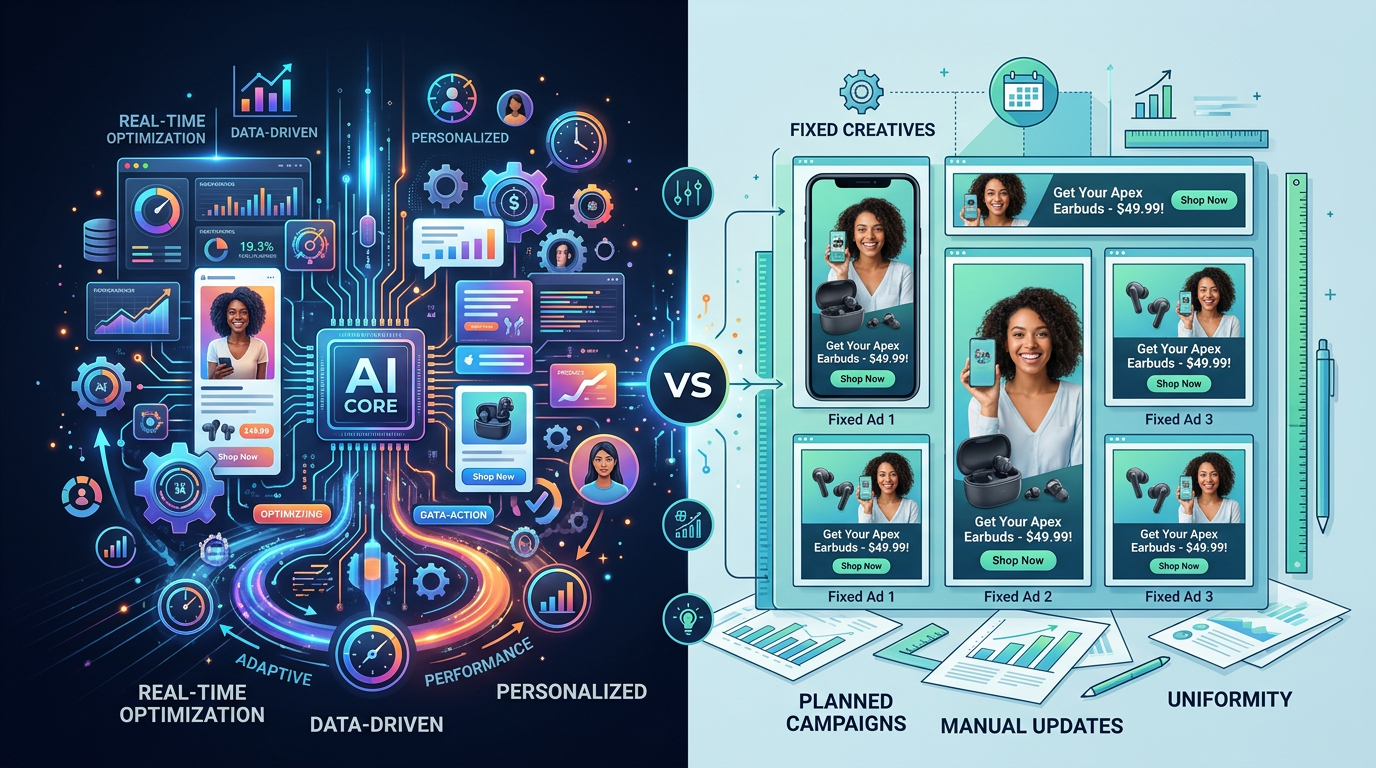
DCO and static creative sets use different approaches to delivering digital advertising. Static sets rely on predefined, finished assets, while the AI ad creative development uses multiple approved creative elements and campaign signals to determine which combinations are delivered.
Neither approach is universally better. Static creative provides greater control and consistency, while dynamic delivery supports personalization, variation, and scalable optimization. The right choice depends on the campaign objective, audience, creative volume, data availability, and operational requirements.
For performance teams, the distinction is important because creative production is only one part of NYX performance marketing workflows. The way assets are organized, delivered, tested, and refreshed can affect how efficiently a team responds to changing audience behavior.
How Dynamic Creative Optimization and Static Creative Sets Work
A static creative set consists of completed ads that are designed, reviewed, approved, and deployed as individual assets. The visual, headline, offer, and call to action remain fixed for each version.
This approach gives marketers direct control over the final creative experience. Each asset can be reviewed before launch, making it easier to confirm brand treatment, messaging, legal language, and campaign positioning.
DCO takes a component-based approach. Instead of treating each ad as one fixed asset, the system can combine approved elements such as images, videos, headlines, descriptions, calls to action, product information, and offers.
The system can then use campaign data, audience signals, or predefined rules to determine which combination is appropriate for a particular context. The specific capabilities depend on the advertising platform and implementation.
The key distinction is control versus adaptability. Static creative controls the finished asset, while dynamic optimization controls approved inputs and the logic used to assemble or prioritize variations.
Creative Control and Brand Consistency
Static creative provides strong control because every finished asset can be reviewed before it reaches the audience. This makes it useful for brand launches, major product campaigns, regulated messaging, and campaigns with strict approval processes.
With a predefined asset, the marketing team knows exactly which visual, message, offer, and call to action will appear together. This can simplify stakeholder approval and make brand consistency easier to maintain.
Dynamic delivery introduces more flexibility and therefore requires stronger governance. Teams need clear rules for approved components, messaging combinations, exclusions, and brand safeguards.
A well-managed dynamic system can maintain consistent visual guidelines while allowing different combinations of approved assets. The objective is not to remove creative control, but to move more of that control into templates, rules, and approved component libraries.
Teams should establish those controls before scaling dynamic delivery. Otherwise, increasing the number of combinations can create inconsistency rather than useful variation.
Personalization and Audience Relevance
Dynamic creative can adapt advertising to targeted advertising strategies using signals such as audience segments, previous interactions, product interests, location, product data, and offers.
For example, an ecommerce advertiser can use product data to show different products based on a customer's interests or previous interactions. A campaign can also adapt messaging to different audience segments while keeping the broader brand framework consistent.
Static creative can support segmentation as well, but each variation generally needs to be created and managed separately. That can work efficiently when the number of segments is small, but the production burden increases as the number of combinations grows.
Dynamic delivery can make more practical because approved components can be reused across multiple combinations.
Personalisation should remain relevant to the campaign objective. Adding more variables does not automatically improve performance. The most useful variations are those that create a meaningful difference in relevance for the intended audience.
Testing and Creative Optimization
Static creative makes creative testing and optimization straightforward. Marketers can compare predefined concepts, images, headlines, offers, or calls to action and measure their performance.
This structure is useful when the objective is to understand which complete creative concept performs better. It also makes the test setup easy to communicate because each variant is clearly defined before launch.
Dynamic delivery can expand the number of combinations available for optimization. Teams can provide approved components and allow the system to evaluate different combinations without manually producing every possible version. Teams that need to scale creative production can also consider AI-powered creative generation when the campaign requires a higher volume of variations.
However, more variation can make analysis more complex. When several elements change simultaneously, it can be harder to determine which element influenced the result.
For that reason, dynamic optimization should be supported by a clear measurement framework. Teams should define the primary business metric, understand what is changing between variants, and establish how performance will be interpreted before expanding the number of combinations.
A structured approach can use predefined static concepts for controlled learning and dynamic delivery for broader optimization once the campaign has sufficient inputs and data.
Scalability Across Campaigns and Markets
The operational difference becomes more significant as multi-channel advertising. A campaign with a few audiences and placements can usually be managed effectively with predefined assets.
As the number of markets, audiences, products, formats, and messages increases, the number of required creative combinations can grow quickly. Managing every combination manually can create additional production, approval, naming, trafficking, and reporting work.
Dynamic delivery can help manage this complexity through reusable components and structured rules. A single creative framework can support multiple combinations without requiring a separate production cycle for every variation.
This is especially useful for campaigns that require:
Multiple audience segments
Frequent creative variations
Product-level personalization
Multiple markets or languages
Numerous advertising placements
Frequent promotional updates
Production and Operational Requirements
Static creative generally has simpler technical requirements. The workflow involves developing the concept, producing assets, reviewing them, uploading them, monitoring performance, and replacing assets when required.
Dynamic systems require more structured preparation. Depending on the implementation, teams may need creative templates, structured components, product or content feeds, audience data, platform integrations, dynamic rules, naming conventions, and brand governance.
This can require greater upfront investment and compare broader platform approaches. The organisation also needs clear ownership for creative components, data quality, approvals, and performance monitoring.
Once the system is established, however, can require less manual effort than producing and managing every asset independently. This makes the model more useful as campaign complexity and creative volume increase.
Data Requirements and Campaign Dependencies
It has relatively low data dependency. A finished asset can run without requiring a product feed or real-time audience data.
Dynamic delivery depends more heavily on the dynamic campaign data. Product-based campaigns may rely on accurate product names, images, prices, availability, categories, and promotional information.
Audience signals and campaign data can also influence which creative combination is selected. If those inputs are incomplete, inaccurate, or outdated, the resulting creative experience may not reflect the intended campaign.
Data quality is therefore an important part of dynamic campaign governance. Teams should establish checks for feeds, creative components, audience inputs, and rules before campaigns are scaled.
When Static Creative Sets Are the Better Choice
It is often the better option when consistency and direct control are more important than creative variation.
Consider this approach when the campaign has a small number of required assets, the creative concept needs precise execution, brand guidelines require detailed asset-level approval, or the audience does not require extensive personalisation.
Static assets can also be appropriate when the team has limited technical infrastructure or when the additional setup required for dynamic delivery would not create enough operational value.
When Dynamic Creative Delivers More Value
It becomes more valuable when campaigns require scale, personalization, or frequent updates.
Consider it when multiple audience segments require different messaging, product catalogs contain many items, creative needs to adapt to user behavior or context, campaigns require frequent product or offer updates, or teams need to manage many creative combinations.
The approach is most effective when the organization has the data, creative components, governance, and technical infrastructure needed to support dynamic delivery.
Can Static and Dynamic Creative Be Used Together?
Yes. A hybrid approach can combine the control of static creative with the scalability of dynamic delivery.
For example, teams can use static assets for major campaign messages and high-priority brand executions, while using dynamic creative for product-level personalization, audience-specific variations, or ongoing campaign refreshes.
This approach allows teams to match the production method to the campaign requirement instead of applying one workflow to every creative need. It can also provide a practical transition path for organizations that are beginning to AI advertising platform capabilities.
Key Criteria for Choosing Between the Two Approaches
Decision Criterion | Dynamic Creative Optimization | Static Creative Sets |
Creative control | Controlled through approved components and rules | Direct control over each finished asset |
Personalization | Strong | Requires separate variants |
Scalability | Strong for high-volume campaigns | Requires additional asset production |
Data dependency | Higher | Lower |
Setup requirements | Higher | Lower |
Brand governance | Requires structured controls | Straightforward asset-level review |
Testing | Supports multiple combinations | Clearer for predefined concepts |
Best fit | Personalisation, scale, optimization, frequent variation | Brand consistency, launches, controlled campaigns |
Key Takeaways
Static creative sets provide stronger control, consistency, and simpler campaign management.
Dynamic Creative Optimization provides greater scalability, personalization, and flexibility when campaigns require multiple creative variations.
Dynamic campaigns require stronger data, technical infrastructure, and governance than static creative.
A hybrid model can combine static creative for controlled brand execution with dynamic delivery for personalization and scalable optimization.