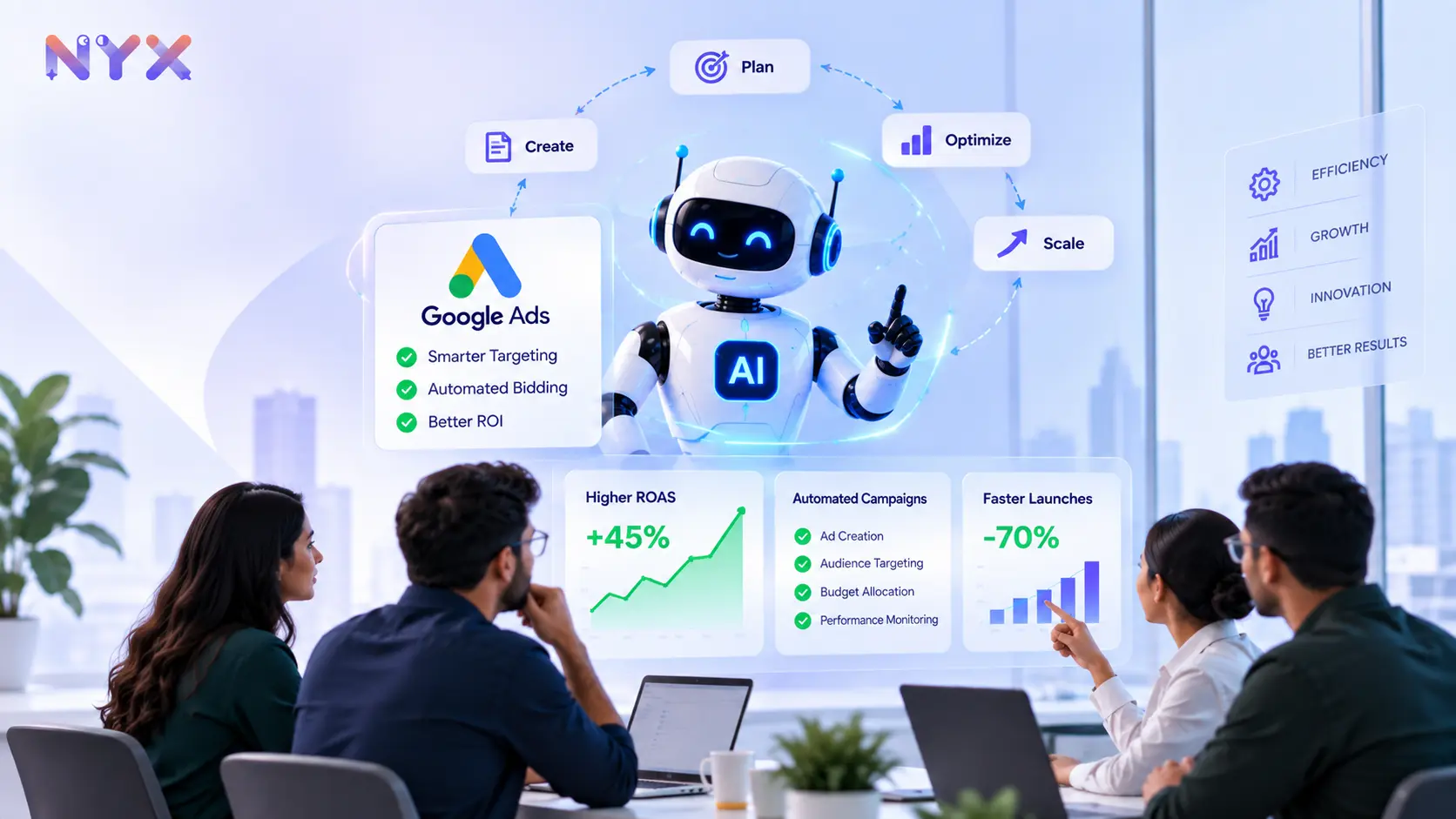
AI agents for Google and Meta Ads 2026 are reshaping enterprise marketing, from AI Max and Advantage+ to third-party agent stacks and governance gaps.
For most of the last decade, "automation" in digital advertising meant smart bidding inside guardrails a human set.n 2026, that relationship has flipped. AI agents for Google and Meta Ads can now plan campaigns, generate and refresh creative, shift budgets between ad sets, and flag anomalies before a human opens a dashboard. Enterprise marketing teams now face a bigger question: how much control should they hand over?
This is not a forecast anymore. Google's AI Max is out of beta and migrating legacy Search campaigns automatically. Meta's Advantage+ now runs a majority of e-commerce ad spend on the platform. And a fast-growing layer of third-party agents sits on top of both, promising cross-channel autonomy that neither platform offers natively.
For enterprise marketing organizations managing dozens of accounts, multiple brands, and strict compliance requirements, the question isn't whether to use AI agents. It's how to use them without losing control.
This article breaks down what has actually changed, how enterprise teams are using these agents in practice, and why governance, not capability, is the real bottleneck right now.
What "AI Agents" Actually Means in Ads Right Now
It's worth being precise here, because "AI agent" gets used loosely. The meaningful distinction enterprise teams are drawing in 2026 is between recommendation systems and autonomous agents:
A recommendation system (think: classic Smart Bidding, or a "suggested actions" panel) surfaces an insight and waits for a human to click approve.
An autonomous agent decides, acts, and reports, adjusting bids, pausing underperforming ads, reallocating budget, or launching new creative variants without a person in the loop for each individual action.
The distinction matters because it's exactly where enterprise risk lives. Google's own AI Max is described by Google not as a new campaign type but as "a continuous optimization layer" bolted onto existing Search campaigns, expanding keyword matching, rewriting ad copy, and rerouting traffic to the best-matching landing page automatically.
Meta's Advantage+ has gone further: in 2026, an advertiser can hand Meta a URL and a budget and let its Andromeda machine-learning system handle creative, targeting, placement, and bidding end to end, with no manual configuration required.
That's a fundamentally different operating model than the "automation" enterprise teams grew up on. And it's why the phrase AI agents for Google and Meta Ads 2026 increasingly refers to a stack, not a single feature: the platform-native agents (AI Max, Advantage+) plus a layer of third-party agents that orchestrate across both.
The Platform Shift: What Google and Meta Actually Shipped in 2026
Google: AI Max Moves From Beta to Default
Google's AI Max for Search campaigns exited beta in 2026 and is now being pushed into accounts whether advertisers opt in or not. Starting in September 2026, Google began automatically upgrading Search campaigns that use Dynamic Search Ads, Automatically Created Assets, or campaign-level broad match to AI Max, with the migration continuing into early 2027.
Google's own data puts the performance case plainly: advertisers using the full AI Max feature suite, search term matching, text customization, and final URL expansion, see an average of 7% more conversions or conversion value at a similar CPA or ROAS compared to using search term matching alone.
Under the hood, AI Max does three things an enterprise team used to do manually:
Search term matching uses keywordless technology to find relevant queries beyond an account's existing keyword list.
Text customization generates headlines and descriptions on the fly, pulled from ad assets, landing page copy, and generative AI.
Final URL expansion routes a click to whichever page on the advertiser's site best matches the searcher's intent, rather than the URL set at the ad level.
For enterprise accounts with strict brand-voice and compliance requirements, this is where friction shows up first. As of early 2026, Google requires ads containing AI-generated elements to carry a small disclosure label, and enterprise teams in regulated categories are treating every AI Max feature as something to test and approve individually rather than switch on wholesale.
Meta: Advantage+ Becomes the Default Operating Model
Meta's shift has been even more structural. Advantage+ campaigns now account for the majority of e-commerce ad spend on the platform, and Meta has consolidated what used to be separate manual controls, detailed targeting, placement selection, audience expansion, into one AI-first framework. Meta has also confirmed it is testing a fully automated system in which an advertiser supplies only a product URL and a budget, and Meta's AI (running on its Andromeda ML system) constructs the rest of the campaign, including creative.
Two 2026 developments matter specifically for enterprise teams:
Budget fluidity across ad sets. Even when advertisers set ad-set-level budgets, Meta's system can now shift a meaningful share of budget from an underperforming ad set to an outperforming one automatically, which changes how finance and marketing ops need to think about budget governance and reporting.
Signal expansion beyond the ad account. Meta now feeds conversational signals from Meta AI usage across WhatsApp, Messenger, Instagram, and Facebook into Advantage+ targeting, meaning the data informing an enterprise campaign extends well beyond the advertiser's own pixel and catalog data.
Meta has been explicit that opting out of Advantage+ features isn't penalized in isolation, but that campaigns with too many manual overrides can be flagged as "Advantage+ off," with the system prompting advertisers to re-enable automation. For enterprise teams that need auditable, explainable decisions, a hard requirement in finance, healthcare, and other regulated verticals, that push toward full automation is exactly the trade-off under debate internally right now.
Beyond the Platforms: The Third-Party Agent Layer
Neither AI Max nor Advantage+ solves the problem that most enterprise marketers actually have: Google and Meta do not talk to each other. That gap is where a fast-growing category of third-party AI agents has emerged in 2026, built specifically to operate across both platforms (and often TikTok, LinkedIn, and Amazon Ads as well).
These tools generally fall into two categories:
Cross-channel autonomous agents, which read account data, generate and launch creative variants, adjust bids and budgets, and pause underperformers across multiple platforms from a single interface, reporting a blended ROAS instead of a per-channel one.
Rules-based automation layers, which give marketers more deterministic, auditable "if this, then that" logic instead of full model-driven autonomy, a deliberate trade-off some enterprise teams make in exchange for predictability.
There's also a newer, more infrastructural layer emerging: agent-to-agent protocols that let an advertiser's own AI stack (built on models like Claude or GPT) connect directly into Google Ads or Meta's Marketing API. For example, Meta's April 2026 connector launch exposed dozens of Marketing API capabilities including reporting, campaign management, and catalog operations to external AI agents, without requiring a full developer app review process.
This is the layer enterprise teams with in-house AI or data science capability are watching most closely, because it means the "AI agent" does not have to be a vendor's product at all, it can be a team's own orchestration layer sitting on top of Google's and Meta's native APIs.
Approach | Who controls the logic | Best fit | Trade-off |
|---|---|---|---|
Platform-native (AI Max, Advantage+) | Google / Meta | Teams standardized on one platform's ecosystem | Least cross-channel visibility; "black box" decisioning |
Third-party autonomous agent | Vendor's model | Teams needing blended, cross-channel ROAS in one view | Vendor lock-in; autonomy claims need independent verification |
Rules-based automation | Marketer-defined logic | Teams that need deterministic, auditable actions | Less adaptive than model-driven agents |
Custom agent via platform APIs/connectors | In-house team | Enterprises with data science capability and compliance needs | Requires build and maintenance capacity |
How Enterprise Marketing Teams Are Actually Deploying AI Agents in 2026
Strip away the vendor claims, and enterprise adoption clusters around five concrete use cases:
1. Campaign auto-setup and budget pacing. Rather than manually building always-on and promotional campaigns, teams are letting agents handle initial setup across Meta and Google, with daily budget pacing constrained by ROAS safeguards rather than fixed caps, cutting campaign launch time from days to hours in accounts that previously required manual QA on every build.
2. Creative refresh at scale. Creative fatigue is a bigger constraint than targeting 2026's AI-managed accounts, and the emerging baseline for a brand with real spend is 15 to 30 fresh creative variants a month. AI agents are being used specifically to generate and rotate that volume, with recommendation engines flagging when a specific creative's CTR is dropping and needs replacement, rather than waiting for a scheduled review.
3. Unified, cross-channel analytics and anomaly detection. Because Google and Meta report performance differently, enterprise teams have historically relied on manually reconciled dashboards. AI agents are increasingly deployed specifically as an analytics layer, a single source of truth for CAC, ROAS, and revenue across channels, paired with a root-cause engine that automatically detects anomalies like a regional CAC spike, rather than surfacing it three weeks later in a QBR.
4. Customer- and SKU-level personalization. For catalog-heavy advertisers, agents are being used to prioritize which SKUs get ad spend based on stock levels, CTR, and average order value lift, and to power retargeting recommendation engines that personalize outreach to individual users rather than broad segments, directly addressing the "generic targeting" problem that plagued catalog advertisers under manual management.
5. Governed delegation of bidding and targeting. Rather than full autonomy, the more mature enterprise deployments are wrapping agent decisions in spend caps, approval gates for actions above a certain budget threshold, and an audit trail that logs every automated action with a timestamp and rationale, so a human can review or reverse a decision after the fact even if they didn't approve it beforehand.
Notably, none of these five use cases require ceding full control of an account. They're examples of what the industry has started calling governed autonomy, agents that act independently within boundaries a human explicitly set, rather than agents making unconstrained decisions.
The Governance Gap: Why "Autonomous" Doesn't Mean "Unsupervised"
Here's the uncomfortable part of the 2026 story: adoption is running well ahead of governance, and enterprise marketing is one of the functions most exposed to that gap.
A few data points make the scale of the problem clear:
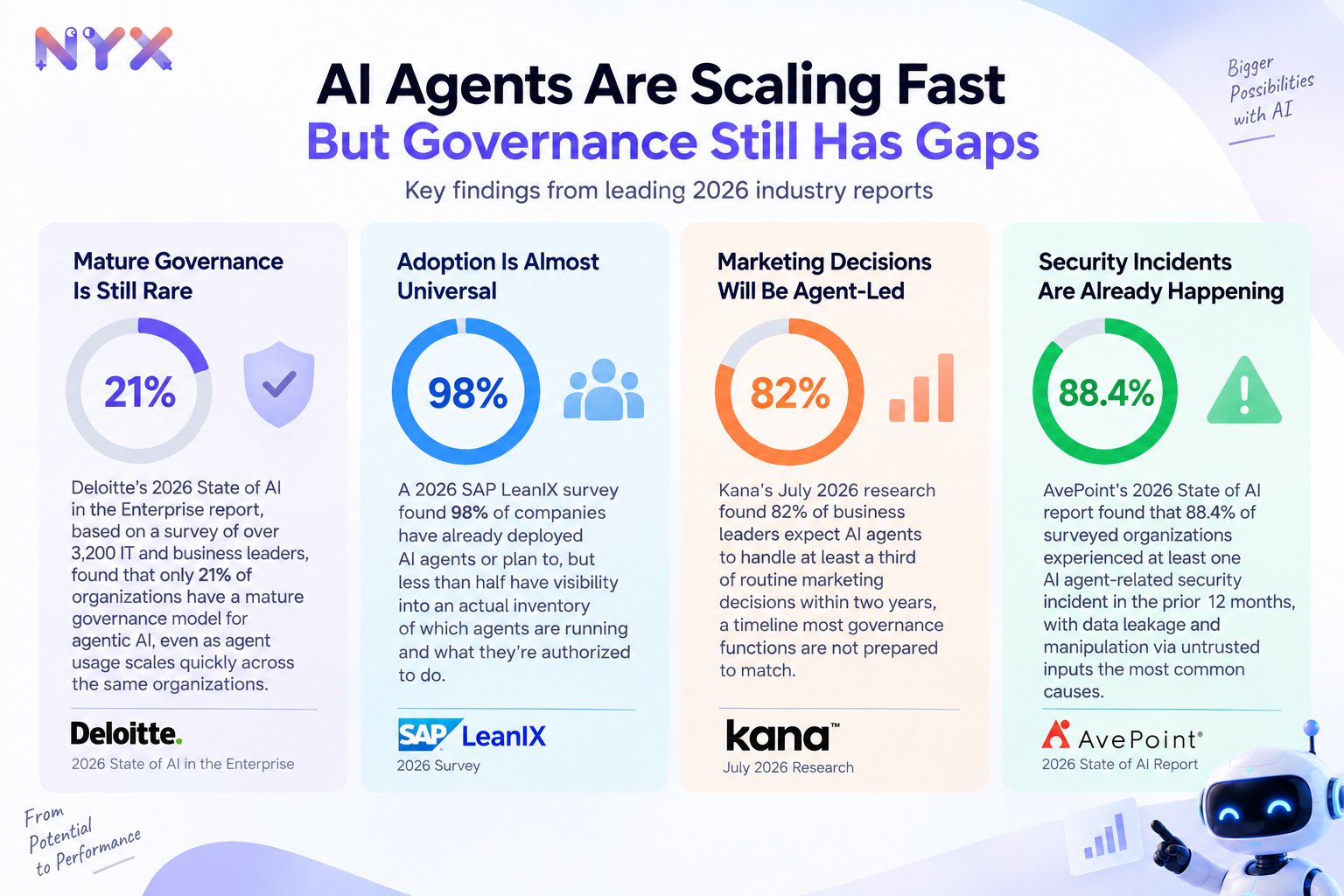
For enterprise marketing specifically, this shows up as a very practical risk: an agent with the authority to reallocate budget, pause campaigns, or auto-generate ad copy is also an agent that can make an expensive mistake at machine speed, with no human in the loop to catch it before the spend is gone.
The organizations doing this well are moving toward a “hub-and-spoke” model. A central team sets clear rules for ad spend, brand safety, and data access. These rules are built into the system, while individual campaign teams use AI agents within those limits.
Every AI agent action is logged, includes a confidence score, and can be reversed. Agents can only access the systems and budgets they are specifically allowed to use. This adds multiple layers of protection, similar to how enterprise security teams manage systems with access to critical infrastructure.
What This Means for Enterprise Marketing Teams Right Now
If you're leading a marketing organization deciding how far to extend AI agents into Google and Meta Ads management in 2026, the practical playbook looks like this:
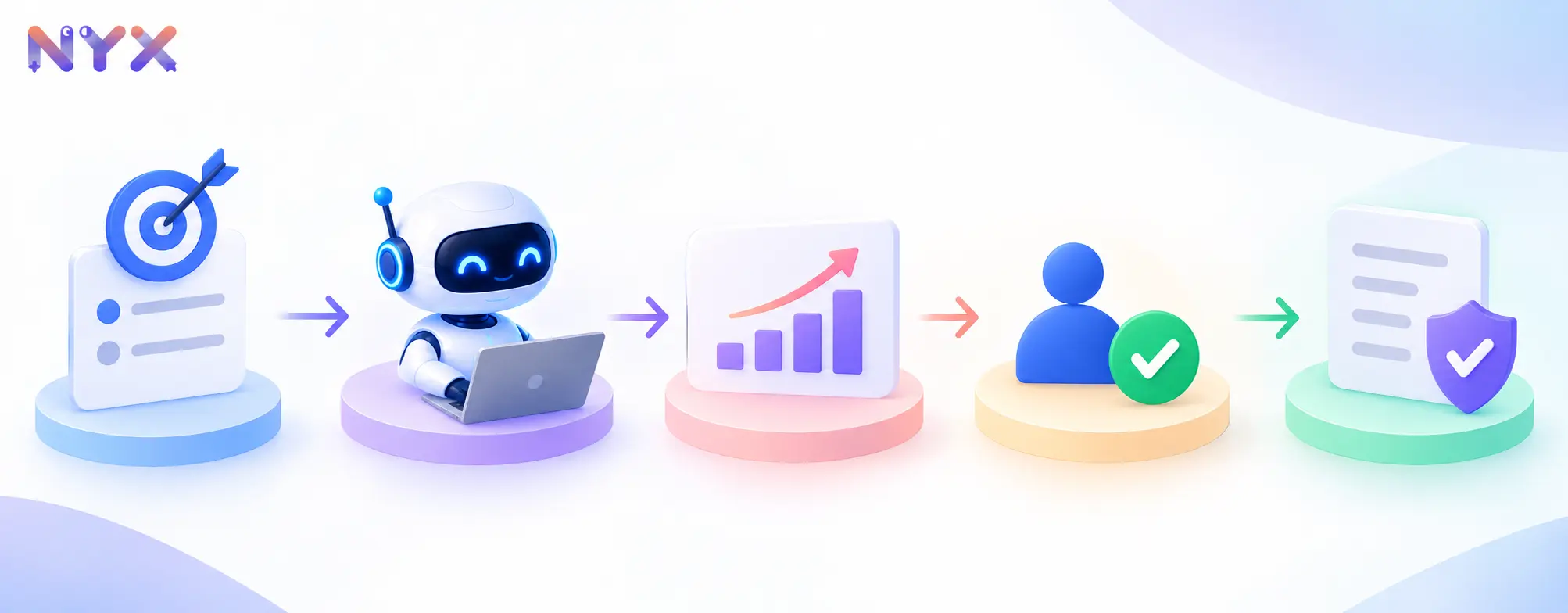
Start with one workflow, not five. The organizations with the best returns on agent deployments pick a single high-friction, high-frequency, clearly-owned workflow, creative refresh or budget pacing, for example, prove it out, and expand from there, rather than automating an entire account structure at once.
Put spend caps and approval gates in place before scaling, not after. Retrofitting governance onto an agent that already has broad permissions is measurably harder than designing the guardrails first.
Demand an audited proof period from any vendor claiming autonomous ROAS gains. Vendor-reported performance claims and independently verified results diverge sharply in 2026, treat every "X% ROAS improvement" claim as a hypothesis to test in your own account, not a guarantee.
Decide explicitly which decisions require a human sign-off. Not every action needs approval, but budget reallocation above a threshold, new audience creation, and any customer-facing creative claim are common lines enterprise teams are drawing today.
Build the audit trail into the workflow, not around it. Every automated action, bid change, budget shift, paused campaign, published creative, should be logged with what triggered it and be reversible, so oversight doesn't depend on someone remembering to check.
Choosing an Approach: Platform-Native, Third-Party, or Custom
There's no universally correct answer here, but the decision generally comes down to three questions:
Do you run primarily on one platform, or do you need a blended, cross-channel view?
If your spend is overwhelmingly on one platform, the native agent (AI Max or Advantage+) is usually the lower-friction starting point. If you need a single blended ROAS figure across Google, Meta, and other channels, a cross-channel third-party agent, or a custom layer built on both platforms' APIs, is the better fit.
How much explainability do you need?
Regulated industries, or any brand where a marketing decision might need to be defended to a regulator or auditor, should weight rules-based or explainable-decision agents over black-box, model-driven autonomy, even if the latter promises better raw performance.
Do you have the internal capability to build and maintain a custom agent layer?
Enterprises with strong data science and engineering capacity increasingly build directly on Google's and Meta's marketing APIs and the emerging agent-connector protocols, rather than relying entirely on a third-party vendor, trading build cost for long-term control.
The Bottom Line
AI agents for Google and Meta Ads in 2026 aren't a future capability enterprise marketing teams need to prepare for, they're already running a meaningful share of campaign decisions inside the platforms most teams use every day. Google's AI Max and Meta's Advantage+ have both moved from optional feature to default operating model, and a fast-maturing layer of third-party and custom agents now sits on top of both, offering the cross-channel view neither platform provides natively.
The teams pulling ahead in 2026 aren't the ones handing agents the most control. They're the ones treating governance as a design requirement from day one: spend caps, approval gates, audit trails, and a clear line between what an agent can decide autonomously and what still needs a human sign-off. Capability has stopped being the bottleneck. Trust, visibility, and governance are what separate enterprise teams getting real value from AI agents from the ones quietly accumulating risk they haven't measured yet.