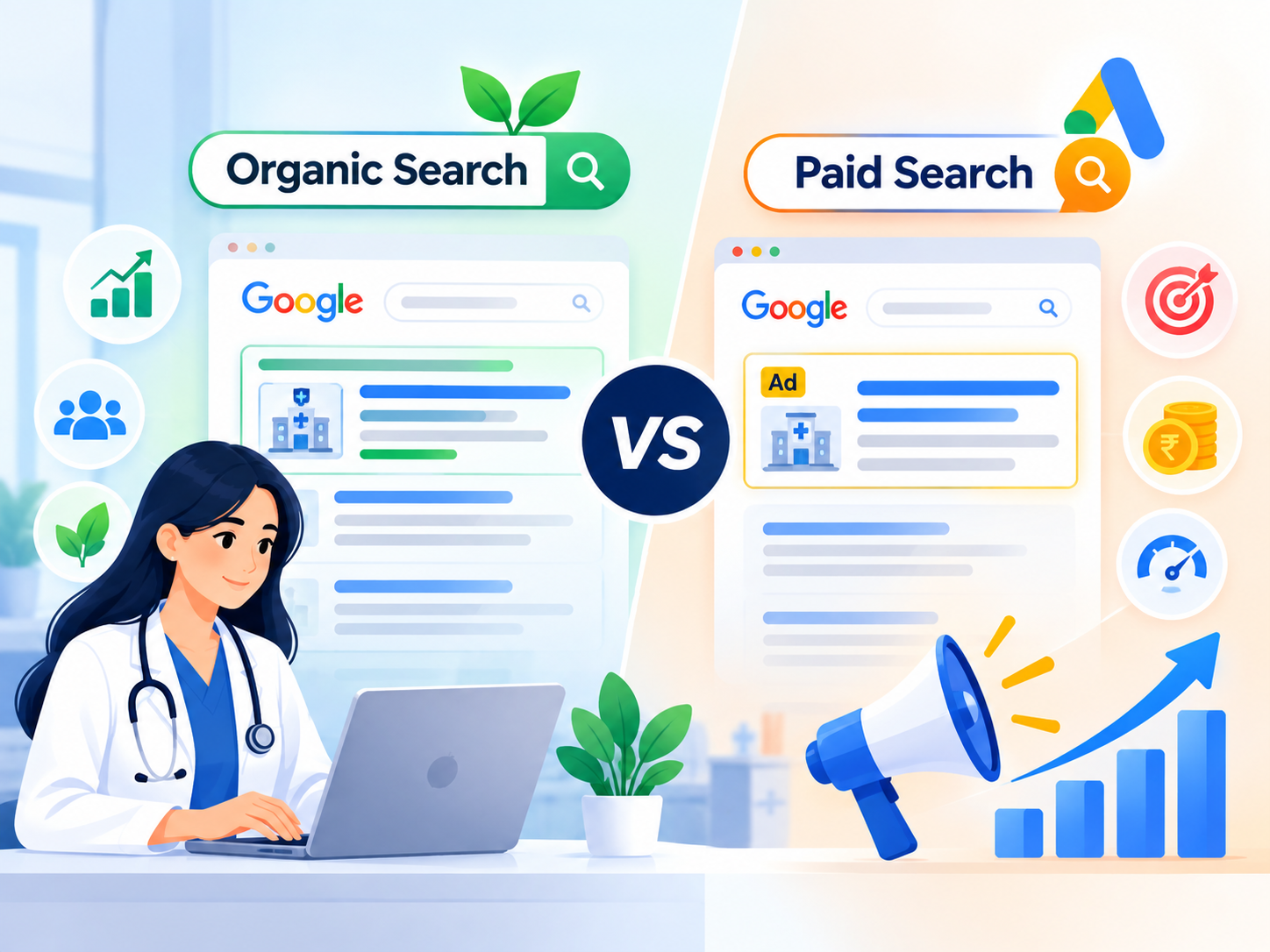
Your healthcare business is only as visible as the two search channels that get people to it. Organic search builds visibility patients trust over time. Paid search buys it instantly. This guide breaks down how each one works, what each one costs, which keywords fit which channel, and how healthcare businesses combine both without wasting budget.
What Organic Search Is
Organic search results are the unpaid listings Google shows when someone searches a term like "symptoms of thyroid problems" or "best cardiologist in Pune." No payment gets you a spot. Ranking is decided by relevance, content quality, and trust signals.
YMYL Standard
Google treats health content as Your Money or Your Life content, holding it to stricter accuracy standards than most topics.
E-E-A-T
Pages need to show Experience, Expertise, Authoritativeness, and Trustworthiness, shown through real medical reviewers, cited sources, and current information.
Technical Factors
Page speed, mobile usability, secure browsing (HTTPS), and clean site structure all influence ranking alongside content quality.
Backlinks
Links from credible medical sites, directories, and press mentions signal authority to Google's algorithm.
Timeline
Three to six months for moderate competition, longer for high-competition specialties like cosmetic surgery or fertility.
Durability
A page that ranks keeps bringing in patients with no added spend, for as long as it holds its position.
What is Paid Search?
Paid search places your business at the top of results instantly, through Google Ads. You bid on keywords, and you pay per click, not per impression.

Speed
A campaign can go live the same day and start generating clicks within hours.
Control
You choose the exact keywords, locations, budgets, and times you want to target.
Cost
You pay only when someone clicks, whether or not that click becomes a patient.
Ad Formats
Search ads, Local Service Ads (with a "Google Screened" badge for verified providers), and call-only ads all serve different healthcare use cases.
Extensions
Sitelinks, call buttons, and location extensions let a single ad show appointment links, phone numbers, and directions directly in the result.
AI-Powered Campaign Management
Platforms like NYX now automate much of this, launching campaigns, generating ad creatives, and adjusting bids using AI agents, so healthcare marketing teams spend less time managing platforms and more time on strategy.
Types of Healthcare Keywords and Which Channel Fits
Not every keyword deserves the same channel. Matching keyword type to channel is where most budget gets wasted or saved.
Branded Keywords
Your clinic's name — usually cheap to defend with paid search, and often already rank organically once your brand is established.
Informational Keywords
"Symptoms of," "causes of," "how to treat" — high volume, lower immediate intent, and better suited to organic content.
Transactional Keywords
"Book appointment," "consultation cost," a specific procedure name — high intent, faster conversion, and strong candidates for paid search.
Local Keywords
"Near me," a city or neighbourhood name — valuable in both channels: organic through Google Business Profile optimization, paid through location targeting.
Comparison Keywords
"Best hospital for X," "X vs Y treatment" — mid-funnel intent. Organic content works well here, though paid can supplement in highly competitive markets.
How to Measure Success in Each Channel
Tracking the wrong metric is a common reason healthcare teams misjudge which channel is working.
For Organic Search, Track:
Organic traffic growth, month over month, for your core service pages
Keyword rankings for the terms you're targeting, checked monthly
Backlinks earned from credible medical sites and directories
Time on page and bounce rate, as a signal of content relevance
For Paid Search, Track:
Click-through rate (CTR), to gauge ad relevance
Cost per click (CPC) and cost per lead (CPL), against your target margins
Conversion rate from click to booked appointment, not just click to form submission
Return on ad spend (ROAS), especially for high-value specialties like fertility or cosmetic care
Why Patient Search Behaviour Matters
Healthcare searches don't behave like retail searches. A Think with Google study on hospital selection found the following:
Key Findings
Patients visited 2 or more hospital sites before converting
Patients who booked appointments made roughly 3x more searches than those who didn't convert
Search-driven visitors were about 3x more likely to reach a hospital's site than visitors from other channels
44% of patients who researched hospitals on a mobile device went on to schedule an appointment
The Takeaway
Patients research in stages, not in one search. A healthcare business needs visibility at each stage: symptom research, provider comparison, and final booking, not just the last step.
The Cost Difference Between Organic and Paid Search
Paid Search Costs
According to Promodo's 2026 healthcare marketing benchmarks, average cost-per-click across healthcare sub-categories runs $3.16 to $6.69, with an average cost-per-lead of $53.53, rising to $134.29 for cosmetic surgery. Hospitals and clinics see the lowest cost-per-lead, around $32.14. Healthcare organizations spend an average of roughly $51,000 a month on paid search.
Higher-stakes specialties push further. WebFX reports legal and insurance-adjacent keywords running $50 to $100 or more per click, a range that overlaps with malpractice and health-insurance-related healthcare terms.
Organic Search Costs
No per-click fee, but real upfront investment: content creation, technical SEO, and medical review. The payoff compounds, since a ranking page keeps working after you stop paying for it.
The same Promodo report found 70% of healthcare marketers saw traffic growth they attributed to SEO, and 50% of healthcare organizations plan their SEO budget in advance.
Local Search Matters More in Healthcare
Most patients aren't searching for healthcare nationally. They're searching within a few kilometers of where they live or work. Local search sits at the intersection of organic and paid, and both channels rely on the same foundation: an accurate, complete Google Business Profile.

Google Business Profile
Keep hours, location, services, and photos current. This feeds both the local organic "map pack" and the trust signals patients check before clicking an ad.
Reviews
A steady flow of genuine patient reviews improves local ranking and reassures patients comparing providers, regardless of which channel brought them there.
Local Service Ads
For eligible categories, Google's "Google Screened" badge on paid local ads adds a trust signal that standard search ads don't have.
Location Pages
Multi-location healthcare businesses benefit from a dedicated organic page per location, each optimized for that area's search terms.
Trust and Patient Perception
Organic listings read as earned, not bought, which makes them feel more credible for research-heavy decisions such as choosing a specialist, understanding a diagnosis, or comparing treatments.
Paid ads work differently. For urgent searches like "emergency dental clinic open now," patients aren't weighing trust signals. They need help fast, and a well-placed ad gets them there.
Research-Stage Searches
Organic results and detailed content build more confidence.
Urgent or Transactional Searches
Paid ads win on speed, not trust.
Landing Page Quality
Credible content on the page an ad points to still shapes whether a paid click converts.
How Organic and Paid Search Work Together
The two channels connect through shared keyword data. Here's the mechanism:

Run paid search first on your highest-intent keywords, terms like "book appointment" or a specific procedure name.
Track which keywords actually convert into inquiries or bookings, not just clicks.
Feed the converting keywords into your organic content calendar, since these are proven demand, not guesses.
Build in-depth, credible pages around those same terms, with real doctor bios and cited sources.
Use those same pages as landing pages for paid campaigns. Stronger, more trustworthy landing pages improve Google's Quality Score, which lowers your cost per click.
Re-check rankings quarterly. As organic pages start ranking for a keyword, you can shift paid budget away from it and toward newer, unranked terms.
Paid search doesn't compete with organic here. It feeds it. Organic, in turn, makes paid campaigns cheaper to run.
A Simple Example
A multi-specialty clinic in Bengaluru launches a paid campaign for "IVF consultation cost." The keyword converts well, so the marketing team builds a detailed, doctor-reviewed page answering that exact question. Within four months, the page starts ranking organically. The clinic keeps the paid campaign running for immediate leads, while the organic page now brings in additional inquiries at no extra cost.
A Second Example
A dental chain runs a similar playbook with "root canal cost near me." Paid ads confirm the term converts at a healthy rate. The team publishes a cost-and-process guide, reviewed by a dentist on staff, and links it from every location page. Six months later, the guide ranks on page one in most of the chain's cities, and cost-per-lead for that keyword group drops by nearly a third because the ad account no longer needs to win every single click.
When to Prioritize Which Channel
Prioritize Paid Search When:
You're launching a new service, entering a new city, filling appointment slots fast, or testing an untested keyword.
Prioritize Organic Search When:
You're answering common patient questions, building authority for a specialty, or aiming for sustainable traffic that doesn't disappear when budget pauses.
Run Both When:
A keyword already converts well on paid and has enough search volume to justify a dedicated content page.
Benefits of Combining Both Channels
Faster keyword validation, since paid search shows what converts before you invest in content
Lower long-term cost per lead, since organic traffic keeps compounding without added spend
Wider coverage across the patient journey, since each channel serves a different search stage
Stronger paid performance, since credible organic content used as landing pages improves Quality Score
Better resilience, since a slow month in one channel doesn't take down your entire pipeline
Limitations to Keep in Mind
Paid search visibility disappears the moment you stop paying
Organic search takes three to six months or longer to show results
Competitive specialties (cosmetic surgery, fertility, cardiology) push costs and timelines higher on both sides
Neither channel works well alone for time-sensitive promotions without the other's support
Both require ongoing upkeep — paid campaigns need regular bid and creative review, and organic pages need periodic updates to stay accurate and ranked
Conclusion
Organic search builds visibility that lasts. Paid search buys visibility instantly. Healthcare businesses that treat them as connected, using paid data to guide organic content and organic content to strengthen paid campaigns, get more patients for less spend than businesses that pick just one.