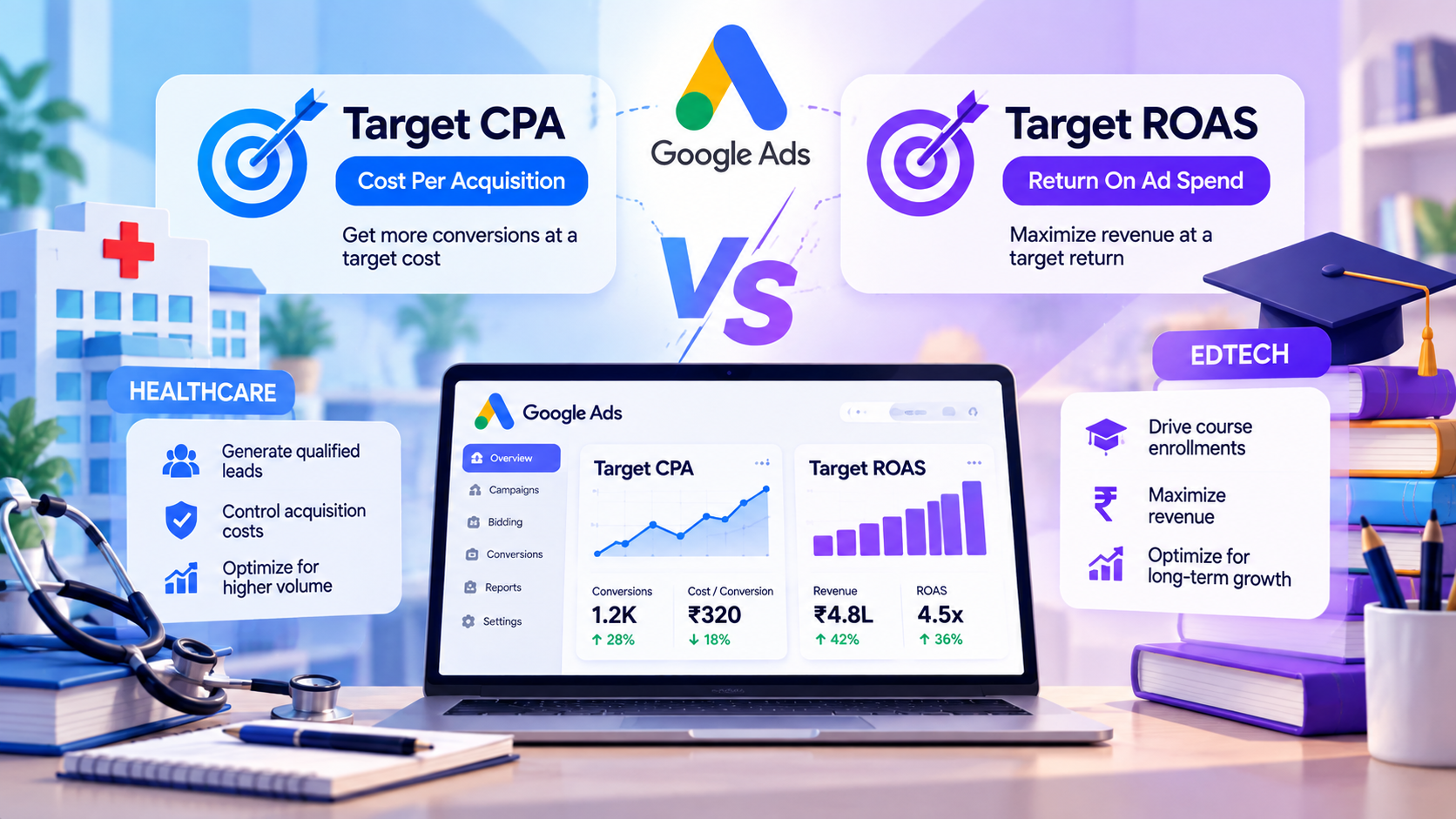
Target CPA and Target ROAS are Google Ads Smart Bidding strategies for different business questions. Target CPA aims to get conversions at an average cost per action near a chosen target. Target ROAS aims to get conversion value relative to ad spend near a chosen return target. The choice depends on what the advertiser can measure reliably. If every qualified lead is treated as roughly equal, a cost target may fit. If outcomes have materially different values and those values can be reported accurately, a value target may fit better.
For healthcare and EdTech, the hard part is often not bidding. It is defining a valuable conversion in a journey that may begin online and finish with a counsellor, admissions team, clinic or sales representative. A strategy optimising to raw forms can find cheap forms even when they do not become suitable for patients, learners or institutional buyers.
What Each Target Means
With Target CPA, the advertiser sets an average cost per chosen conversion. A ₹2,000 target for qualified leads is an objective across auctions, not a promise that each individual lead costs exactly ₹2,000. Actual results vary with demand, competition, eligibility, budget and measurement.
With Target ROAS, the advertiser sets a ratio between reported conversion value and ad cost. A 400% target means seeking ₹4 of attributed conversion value per ₹1 in advertising cost. It does not mean 400% profit. The reported value must reflect the business outcome chosen; assigning arbitrary high values to easy actions can make the ROAS number meaningless.
Google updated the naming of these strategies in 2026, so some interfaces or historical materials may use “Maximize conversions with a Target CPA” and “Maximize conversion value with a Target ROAS.” Confirm the current campaign UI rather than relying on older screenshots.
The Decision Table In Words
Choose Target CPA when the conversion is consistent, timely and well defined, such as a verified eligible consultation request or qualified programme application. Choose Target ROAS when a purchase or closed outcome carries reliable value and that value varies meaningfully, such as courses with different net tuition or enterprise contracts of different expected contribution. If the value data is sparse, delayed or speculative, establish reliable conversion tracking and often a volume-oriented stage first. Neither strategy repairs an incorrect conversion goal.
Do not choose ROAS simply because leadership cares about revenue. The platform needs usable conversion values connected to campaigns. Do not choose CPA simply because the CRM is not connected; doing so can encourage optimisation to low-quality raw leads.
An EdTech Example
Suppose a provider sells a ₹20,000 short course and a ₹2,00,000 career programme. If both form submissions count as one equal conversion, Target CPA has no way to distinguish their commercial value, and it may seek whichever forms are easiest. If paid enrolments and net values are reported accurately, a value-based strategy can account for the difference. However, an apparent ₹2,00,000 “value” entered when someone merely requests a brochure would overstate the result.
For a programme with a long admission cycle, an interim qualified application stage may be necessary. Define eligibility with the admissions team, pass later enrolments back where feasible, and use cohort reporting to see whether the interim stage predicts actual value. When value varies, a carefully estimated qualified-lead value may be tested, but it must be grounded in observed conversion rates and contribution, then recalibrated.
A Healthcare Example
A clinic might advertise appointment requests across services with different revenue and capacity. A generic “appointment form submitted” target can reward low-fit or duplicate requests. A qualified booked consultation may be a better CPA signal if it is recorded promptly and consistently. If the organisation can lawfully and reliably report appropriate value for completed services, value-based bidding may become useful. The relevant objective may instead be capacity utilisation or contribution, so the value model needs a business owner.
Healthcare advertising requires additional care. Google restricts certain healthcare and medicines promotions and targeting based on sensitive health interests. The exact rules depend on product, geography and campaign method. Do not infer or target a person's sensitive condition from a customer list or page visit without checking current policy and applicable law. Bidding strategy choice does not override these restrictions.
How To Choose And Implement Step By Step
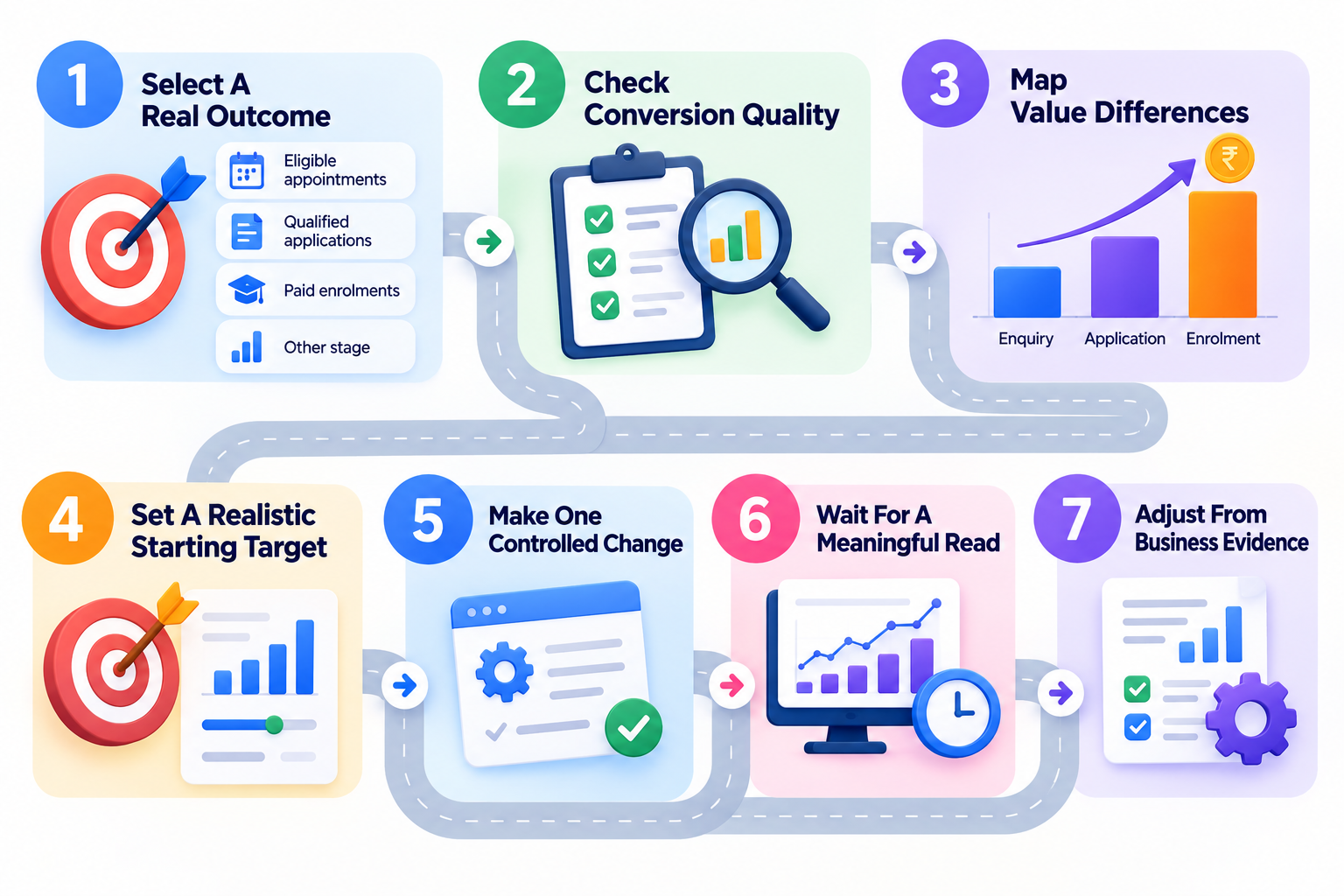
1. Select A Real Outcome
Decide whether the campaign should drive eligible appointments, qualified applications, paid enrolments or another stage. Exclude accidental clicks and invalid forms from the primary goal.
2. Check Conversion Quality
Confirm deduplication, correct stage timing, attribution and any offline import. Review whether the reported result is both frequent enough and predictive of business value.
3. Map Value Differences
Do outcomes vary meaningfully in net revenue or contribution? Can those differences be recorded accurately? If not, a CPA target may be easier to manage while data improves.
4. Set A Realistic Starting Target
Use recent actual results, allowing for lag and change in mix. An aggressive CPA below observed economics or ROAS above demonstrated value may constrain delivery. Targets should express the real business tolerance.
5. Make One Controlled Change
Apply to a suitable campaign or run an experiment where feasible. Record the date, conversion action, budget, target and other changes. Avoid restructuring everything at once.
6. Wait For A Meaningful Read
Monitor spend, conversion volume, cost, value, lead quality and late outcomes. Review by cohort and service or programme. Do not interpret one day's deviation as failure.
7. Adjust From Business Evidence
If a campaign underspends after a tighter target, review conversion data, eligibility, competition and target realism. If it spends but quality falls, correct the signal before making only bid changes.
How To Calculate The Financial Guardrail
For a CPA goal, estimate the maximum ad cost per outcome after accounting for downstream conversion. Example: if one in five qualified applications enrols and the allowable ad cost per enrolment is ₹15,000, the implied allowable cost per qualified application is ₹3,000. This is an illustrative calculation: ₹15,000 × 20%. If the rate varies by programme, use programme-level estimates.
For a ROAS goal, decide whether value means gross tuition, net collected revenue or contribution after variable costs and refunds. A 400% revenue ROAS does not establish profitability if service delivery and sales costs are high. For a course with ₹1,00,000 net collected revenue and ₹40,000 allowable ad spend, the revenue ROAS guardrail is 250%. If the allowable spend is ₹20,000, it is 500%. Actual target selection also depends on how much volume the business wants at the margin.
Avoid putting protected health details or unnecessary personal information into conversion values or platform uploads. A privacy and compliance review should define what can be passed back.
Common Mistakes
Mixing raw leads and paid purchases as equally weighted primary conversions, using an invented value for every form, changing targets repeatedly during a short period, ignoring refunds, applying one target across different programme economics and diagnosing underspend solely from the “Eligible” status all produce weak decisions. A campaign can be eligible to serve while a restrictive target or narrow demand limits spend.
NYX's integrated reporting can help compare media spend with qualified stages and programme value, but the recommendation is only as reliable as the CRM mapping. Leadership should see the assumptions behind any value model and when they were last updated.
When Values Are Estimated Rather Than Observed
Many organisations do not have enough closed outcomes to send actual revenue promptly. An interim value model can assign expected value to a qualified stage: estimated probability of closure multiplied by expected net contribution. For example, if a qualified application historically has a 20% chance of enrolment and an enrolled learner yields ₹50,000 in contribution before acquisition, its indicative value is ₹10,000. This is an illustrative expected value, not collected revenue.
Segment the estimate where conversion rates genuinely differ by programme, cohort or service. Recalculate it as more outcomes mature. Do not use a value model that simply labels expensive services “high value” without accounting for capacity, eligibility, refunds and margin. Keep actual revenue and modelled value in separate reports so leadership cannot confuse them.
A Sensible Migration Path
First, verify form and CRM stages and select a qualified primary conversion. Second, run a stable bidding period and check whether that stage predicts actual customers. Third, capture or estimate values under a documented method. Fourth, test value-based bidding on a suitable campaign, monitoring volume, value distribution and downstream outcomes. Finally, review whether the new strategy improves contribution or another agreed objective, not only platform ROAS. If data quality deteriorates, return to the last reliable stage while fixing the feed.
For healthcare, the measurement team should determine what can be shared under platform policy and applicable privacy law before implementing value passback. A numeric value need not expose a diagnosis, but the surrounding audience and event design can still be sensitive. The same business test applies: a more sophisticated bid strategy is useful only when the signal is trustworthy.
Review Targets As Portfolio Decisions
Targets should reflect capacity and margin by service or programme. A healthcare practice with a fully booked service may not want more appointments at any cost, while a new location may accept a different acquisition ceiling. An EdTech provider may have limited cohort seats or counsellor capacity. Grouping all offers under one average value can hide these constraints. Review spend and incremental qualified outcomes by offer, and decide whether the next rupee should go to the campaign with the most attractive marginal contribution rather than the best historical ROAS.
What Should Be Agreed Before A Bid Change?
Finance and marketing should agree on the outcome that creates value and the allowable cost of acquiring it. The account team then checks whether that outcome is recorded accurately and often enough to guide bidding. When values differ, document how values are assigned and how they will be revised when actual enrolments, appointments or revenue mature. Make one controlled change, note the date and target, and review volume as well as efficiency. A target that looks attractive in a dashboard is not useful if it removes too much qualified demand.