For years, D2C brands treated their Shopping ad titles and descriptions as owned creative, copy they wrote, tested, and controlled down to the word. That's starting to change. Since July 2026, Google has been spotted testing AI-generated descriptions directly on Shopping and Product ads, adding synthesized context beneath listings that merchants didn't write. It's a small, unconfirmed experiment for now, but it sits alongside a much bigger shift Google announced the same season: AI-written Shopping ads that build a custom explainer for every single shopper query, generated live from your Merchant Center feed.
Put simply: Google is moving toward a world where the words shoppers see next to your product aren't always your words. For D2C brands, that changes what "good ad copy" even means, the job shifts from writing the perfect description to feeding the algorithm accurate, complete product data it can synthesize responsibly.
Here's what's actually confirmed, what's still speculation, and what to do about it either way.

What Did Google Actually Announce or Test?
Two related but distinct things happened in mid-2026, and it's worth separating them because they carry different levels of certainty.
The Shopping ads AI-description sighting (July 30, 2026)
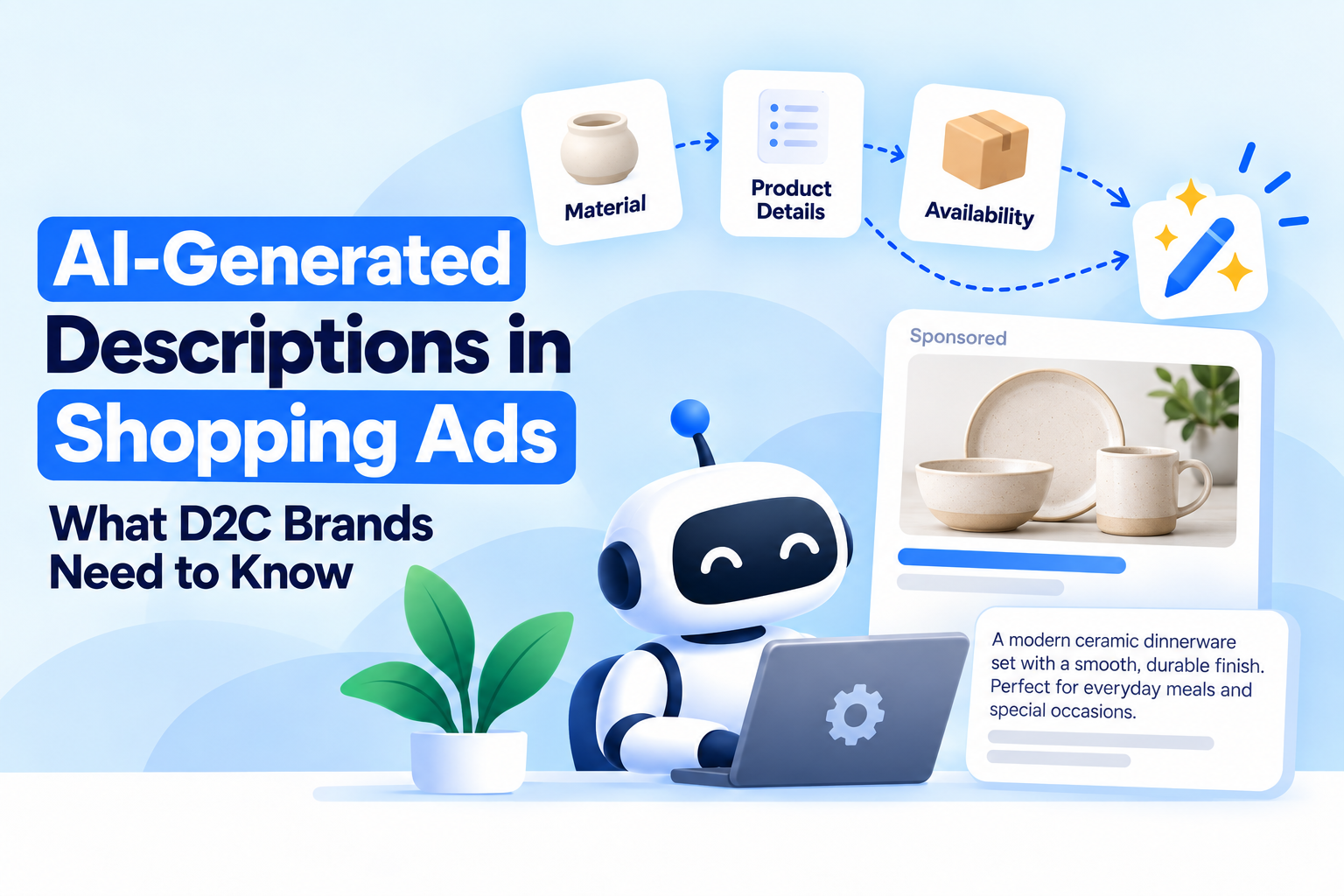
PPC researcher Brodie Clark spotted AI-generated descriptions appearing alongside Shopping and Product ads, extending a similar test Google had confirmed earlier in July on standard Search ads. A Google spokesperson confirmed the underlying mechanism exists, describing it as "a small experiment to see if adding AI-generated context to Search ads helps people make more informed decisions." Google has not confirmed the scope, what share of Shopping traffic is affected, which countries, which campaign types, or whether descriptions are generated live or cached are all still unconfirmed.
AI-written Shopping ads at Google Marketing Live (May 20, 2026)
This one is a confirmed product direction, not just a sighting. Google previewed a format where Gemini reads a retailer's Merchant Center feed and writes a custom explainer per query, not per campaign, describing why a specific product matches what the shopper asked. This shipped alongside AI Max for Shopping, which extends AI Max's text customization and automatic format selection (choosing between a text ad and a Shopping ad, whichever better fits the query) to Shopping campaigns.
The common thread: both rely entirely on your Merchant Center feed as the raw material. Neither invents information from nowhere, they synthesize from what's already in your product data. That's the detail that matters most for how you respond.
Why Is Google Doing This?
Google's own explanation is about buyer decision-making, not merchant convenience: helping people make more informed decisions by adding context Google judges the original ad copy doesn't fully cover. The Marketing Live framing goes further, Gemini reads feed attributes like fabric softness, material durability, and fit to answer long-tail, conversational queries that standard Shopping campaigns typically miss entirely, because no merchant writes ad copy anticipating every possible phrasing a shopper might use.
There's also a structural reason: Google's Shopping Graph refreshes roughly 2 billion listings per hour, and the broader push toward AI Mode and conversational shopping depends on having enough structured, current product data to generate accurate answers on the fly. AI-written descriptions are a natural extension of a system already built to synthesize product information at scale.
What Does This Mean for D2C Brand Control?

This is the part causing the most concern among Shopping advertisers, and the concern is legitimate. D2C merchants invest heavily in titles, descriptions, and images specifically to influence click-through rate and conversion, that's core brand and performance work. AI-generated context sitting alongside or replacing part of that copy introduces a layer merchants didn't write and can't directly edit.
Two things temper that concern without eliminating it:
The output is grounded in your own feed data, not invented
Both the description test and the AI-written Shopping ad format read from Merchant Center attributes you control, title, description, material, fit, pattern, and other structured fields. Bad AI-generated copy is far more often a symptom of a thin or vague feed than a system fabricating claims about your product.
You still control the inputs, even if not the exact final phrasing
The practical response isn't to fight the mechanism, it's a feed-hygiene audit that tightens the raw material any AI system, Google's included, has available to synthesize from. Vague titles and stuffed, keyword-heavy descriptions are exactly what produces low-quality AI-generated summaries. Specific, accurate, attribute-rich data produces specific, accurate AI-generated context.
What Should D2C Brands Do About Their Product Feed Right Now?

1.Audit for soft attribute completion
Google's guidance specifically calls out material, fit, pattern, and product_highlight fields as inputs AI Max and AI-written descriptions read beyond the basic title and description. Gaps here are gaps in what any AI system can accurately say about your product.
2.Remove keyword stuffing from titles and descriptions.
Titles written for old-style keyword matching read poorly to a system trying to extract genuine product facts, and can produce awkward or inaccurate AI-generated summaries as a result.
3.Check for contradictions between your feed and your website's schema markup.
When Schema.org markup on the product page conflicts with the Merchant Center feed, different price, different availability, different rating, Google deprioritizes both rather than picking one to trust.
4.Write factual, structured descriptions rather than purely promotional copy.
Gemini-written ad copy performs best against factual, structured product detail rather than marketing language alone, since the system is trying to extract verifiable claims it can safely restate.
5.Enable and check free Shopping listings separately from paid Shopping campaigns.
AI Mode surfaces read from free Shopping listings, not paid Shopping ads, so a brand only running paid campaigns may be invisible in AI Mode entirely regardless of feed quality.
6.Monitor which campaign types show the behavior.
Because scope is still unconfirmed for the Shopping-ads description test, check performance data across your standalone Shopping and Performance Max campaigns separately rather than assuming uniform impact.
Feed Attribute Priorities: What Matters Most for AI Systems
Feed Element | Why It Matters to AI-Generated Descriptions |
|---|---|
Title | First signal any system reads; vague or stuffed titles produce vague or inaccurate AI summaries |
Description | Primary source text for synthesis; factual and specific beats promotional and generic |
Material / fabric attributes | Directly cited by Google as an input AI Max reads to answer conversational queries |
Fit / pattern | Same, used to match long-tail queries standard Shopping campaigns miss |
product_highlight | A structured field Google calls out specifically for AI Max for Shopping |
Price and availability | Must match your website's schema markup exactly, or both get deprioritized |
Free listings enrollment | Required for AI Mode visibility; separate from paid Shopping campaign setup |
How Does This Fit Into the Bigger Shift Toward Agentic Commerce?
AI-generated descriptions aren't an isolated experiment, they're one piece of a broader move toward what Google is calling agentic and conversational commerce. The Universal Commerce Protocol, introduced at Google Marketing Live 2026, extends Merchant Center into a full conversational and checkout layer, covering cart management and structured onboarding through a new native_commerce attribute.
Setting up Merchant Center correctly for AI Mode is a genuinely different exercise from setting it up purely for traditional Shopping ads, and D2C brands treating the two as the same task are likely to fall behind on the AI Mode side without realizing it.
For D2C teams running Shopping campaigns alongside other paid channels, this is where feed management starts to overlap directly with performance reporting: a weak product attribute isn't just an SEO or organic-visibility problem anymore, it's now a paid-performance problem too, since Gemini-written Shopping ads and AI Max both draw on the same feed.
A platform like NYX, built to connect creative and campaign performance to the underlying data driving it, is useful precisely because it treats feed quality and paid Shopping performance as one connected workflow rather than something a separate team owns in isolation.
A Simple Example (Illustrative Scenario)
A D2C home goods brand selling ceramic dinnerware had Shopping ad titles built around broad keyword phrases like "ceramic dinner set 12 piece modern" with thin, generic descriptions. After Google's Marketing Live announcement, the brand audited its feed against the material, fit, and product_highlight fields Google specifically named, rewriting descriptions to include glaze type, dishwasher and microwave safety, and exact dimensions.
Within a few weeks of the update propagating, the brand noticed AI Mode surfacing its products for long-tail, conversational queries like "dinnerware set safe for microwave that won't chip easily", queries its original keyword-driven titles had never matched at all.
Whether or not the Shopping-ads description test becomes permanent, the direction is clear: Google is building systems that read your product feed and speak on your behalf. The brands that come out ahead won't be the ones fighting that shift, they'll be the ones who made sure their feed had something accurate and specific to say in the first place.