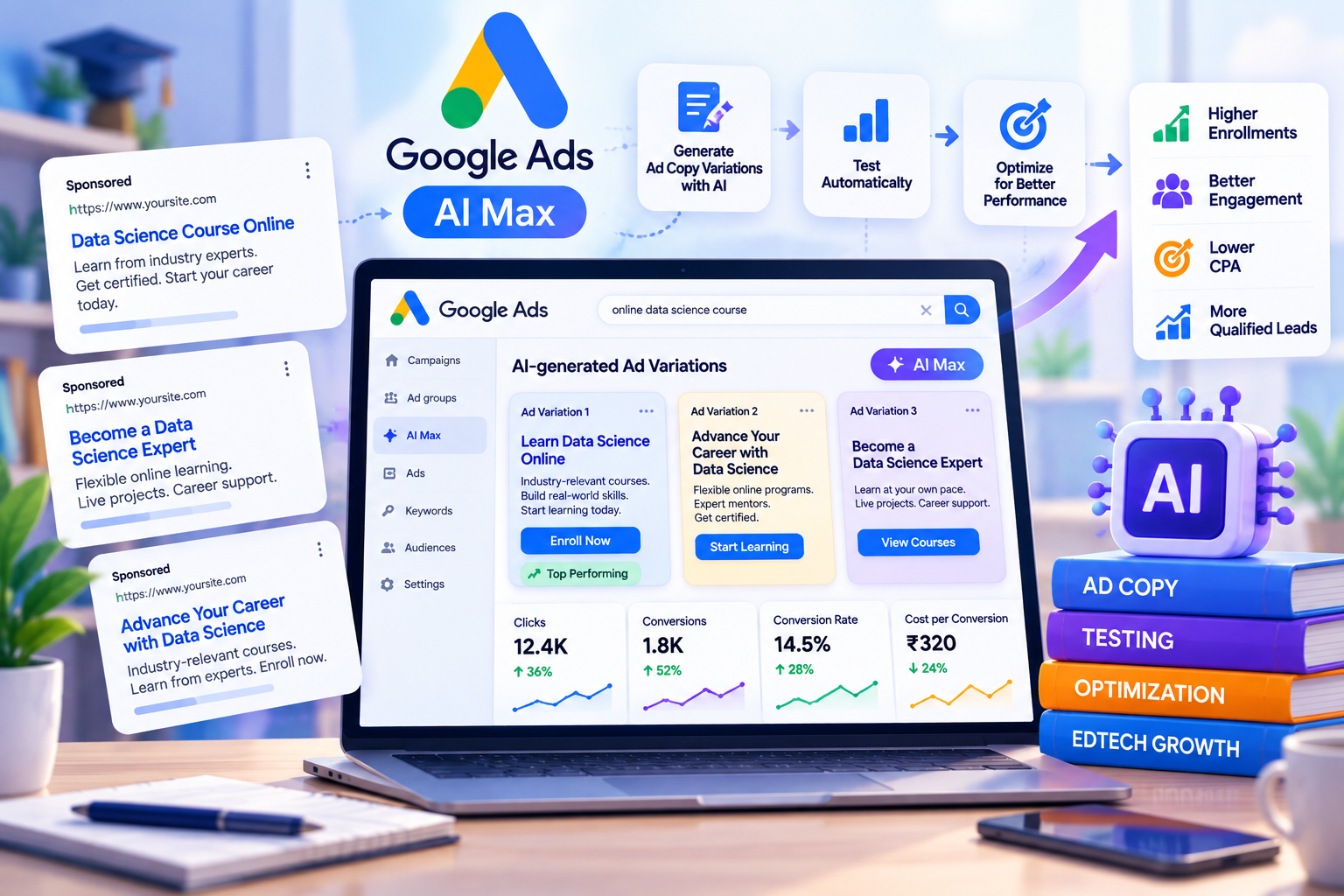
AI Max for Search is an optimisation layer within Google Ads Search campaigns. Its capabilities include search term matching, text customisation and final URL expansion. Text customisation can use an advertiser's existing ads, landing pages and assets, along with generative AI, to create query-relevant ad text. For an EdTech advertiser, the question is whether that added reach and copy flexibility bring more qualified applications or enrolments without introducing inaccurate course claims.
It is misleading to describe AI Max as only an “automated ad copy test.” Turning on the full suite can also change which searches are reached and which landing page receives the visitor. An experiment needs to account for those changes, otherwise a lift or decline cannot be attributed solely to generated headlines.
What The Features Do

Search term matching can expand reach beyond the advertiser's specified keywords based on the campaign's context and intent signals. Text customisation adds Google-generated text assets to the eligible pool alongside advertiser-written assets. Final URL expansion can select a more relevant landing page on the site. Google describes AI Max as a layer for existing Search campaigns, not a replacement for the need to set goals, maintain accurate pages or inspect results.
Feature availability, defaults and controls change. Check current account settings and Google documentation at launch. Google says AI Max experiments can split traffic and budget within an existing campaign; the treatment defaults to activating search term matching, text customisation and final URL expansion. A clean test of copy alone therefore requires deliberately checking and isolating feature settings where available.
Why EdTech Teams Need Extra Care
Course pages often contain dates, fees, prerequisites, certification details and career-outcome claims. A generated ad that sounds persuasive but says “guaranteed placement” when the actual offer is placement support can mislead a learner. Final URL expansion can send a person searching for a specific programme to a broader page that does not answer the question. Search expansion can bring informational traffic that fills forms but never becomes eligible.
These are manageable risks if the site has accurate, distinct programme pages; claims are documented; conversion goals reflect applicant quality; and the team reviews queries, assets and landing pages. They are larger risks for a site with stale intake dates, thin pages or one generic lead form.
How To Run A Useful Experiment
1. Establish A Baseline
Use a stable Search campaign with known programme, geography, budget, search themes and conversion tracking. Note the recent qualified lead and enrolment results, not just CPL.
2. Audit The Destination
Correct fees, intake dates, eligibility, accreditation and outcome wording. Decide which pages should be eligible and which should be excluded from expansion.
3. Choose The Question
If evaluating all of AI Max, state that. If evaluating text customisation specifically, check whether the experiment permits the other features to be controlled. Do not call a full-suite test a copy-only result.
4. Set The Experiment
Use Google Ads' AI Max experiment where available. Confirm traffic split, budget, duration, target and selected settings in both arms. Record any simultaneous changes.
5. Define Success In Advance
Primary outcome might be cost per qualified applicant or enrolment value. Secondary measures include lead volume, cost, search relevance, landing-page mix and approved-claim compliance.
6. Monitor During The Test
Inspect generated assets, search term insights or available search terms, destination URLs and lead feedback. Remove or restrict inaccurate claims promptly. Keep a log of interventions.
7. Assess After Enough Data And Lag
Compare volume and quality, account for conversion delay and avoid treating a small difference as certain. Make the adoption decision at the programme or campaign level.
An experiment does not excuse a bad measurement setup. If every form submission is counted as valuable regardless of fit, automation can optimise toward the easiest forms.
What To Review In Automated Copy

Check the programme name, delivery mode, city, tuition, intake, eligibility, certification, financing, career support and promised outcomes. A short headline may omit a condition that the landing page explains, yet still create the wrong impression. Maintain a dated list of approved claims and prohibited phrasing. Use appropriate disclaimers and platform controls where available. Have a person responsible for reviewing changed assets after the experiment starts, not just on launch day.
Google reported average improvements in its own product announcements, but those aggregates are not a forecast for an individual account. The more useful question is whether the specific course and measurement setup benefit after qualification is included. Treat vendor-reported averages as context, not a client performance promise.
Example For A Course Provider
A bootcamp has three accurate programme pages: full-time online, part-time online and classroom Bengaluru. Its standard Search campaign targets programme-specific queries. AI Max may identify related searches and tailor text, but the team must check that a part-time query does not produce a full-time promise or lead to the wrong page. In the experiment, the CRM distinguishes eligible part-time applicants from general enquiries. The adoption decision uses cost per eligible applicant and subsequent enrolment, while reviewing whether additional reach has compromised message accuracy.
NYX may discuss the result as part of a broader paid-media audit: query relevance, generated claims, destination fit and qualified outcomes are the four checks that make an AI Max recommendation useful. A simple “turn it on” recommendation would skip the most important business context.
When To Delay The Test
Fix tracking first if the conversion action is a mere button click or cannot separate invalid enquiries. Update pages first if deadlines or fees are stale. Clarify the programme architecture if several courses share a generic page. Resolve claim approvals before exposing automated copy to high-stakes offers. A limited, monitored pilot is more informative than changing every campaign at once.
Reading The Experiment Without Over claiming
Begin with delivery: did both arms receive traffic as intended, and were budgets or targets altered? Next compare the primary conversion and cost with uncertainty appropriate to the sample. Then inspect composition. A treatment may add many generic search terms, or shift visitors to a broader page, while leaving the headline unchanged. Review available search-term, asset and landing-page reports and the CRM reasons for disqualification.
If the treatment raises valid leads but not qualified applicants, it may have broadened reach beyond the programme's eligibility. If qualified applications rise but cost also rises, compare the allowable acquisition cost and later enrolment value. If results are similar, weigh any operational benefit against additional review burden. A small early lift is a reason to continue learning, not a permanent guarantee.
A Practical Review Cadence
Before launch, capture the approved-claims list and a screenshot of settings. During the first week, check destinations, generated assets and obvious query mismatch frequently enough to catch errors. At a regular weekly review, inspect lead quality and explain any changes made to assets or exclusions. At the end, wait for the normal application or admissions lag before choosing a winner. Preserve a log of what AI Max created and what the team removed.
If the advertiser offers multiple programmes with substantially different eligibility or value, test on a clearly bounded campaign first. This makes both creative review and interpretation easier. An EdTech team should also check current platform rules for personalised targeting and claims relevant to its market; automation does not transfer accountability to Google.
A Sample Experiment Brief
Write the question as: “Will AI Max increase qualified applications for the part-time analytics programme within our allowable cost, without producing inaccurate claims or irrelevant destinations?” Identify a specific existing Search campaign as the control context. Record budget, geography, audience exclusions, current conversion action, CRM qualification criteria and expected lag. List approved pages and the exact claims that must remain true, including schedule, fee, prerequisites and support.
Predefine decisions. Adopt if the treatment produces a credible gain in qualified outcomes or value with acceptable cost and no unresolved claim issue. Continue testing if the difference is too small or outcomes are immature. Stop or restrict the feature if inaccurate assets appear, destination mismatch persists or qualification deteriorates materially. The actual thresholds should come from business economics and available volume; a universal percentage would be misleading.
Separating The Three Sources Of Change
If the full suite is enabled, search expansion changes who arrives, text customisation changes what they see, and URL expansion changes where they land. A combined treatment measures their joint effect. To learn about one component, use available feature controls or a separate controlled test, taking care not to conflate periods with different demand. Examine the query-to-ad-to-page path, not just aggregate campaign results.
For example, a new query may be relevant but the selected page may be a general course catalogue. The issue may be destination routing rather than copy. Another query may reach the correct page but trigger an overly broad headline. The corrective action differs. Preserve examples of problematic paths so the account team can adjust pages, exclusions or assets and explain the decision.
Leadership Decision After The Test
Summarise spend, qualified applications, cost per qualified application, observed enrolments, search relevance, destination fit and review effort for each arm. Include confidence limits informally if volume is small, and note changes made during the test. Decide whether to keep all features, restrict a component, run a longer pilot or revert. An AI feature is successful only if it improves the business result while staying within the brand's evidence and review standards.
What Should The Pilot Decision Include?
The final review should show the control and treatment settings, spend, valid leads, qualified applications, cost and any matured enrolments. Include examples of generated claims and the pages selected for real queries. If the treatment improved applications but required frequent manual corrections, record that operating cost. If it performed similarly, identify whether the account learned anything useful about search reach, copy or routing. Make a specific decision for the tested programme and keep the settings log so the next experiment can build on the result.