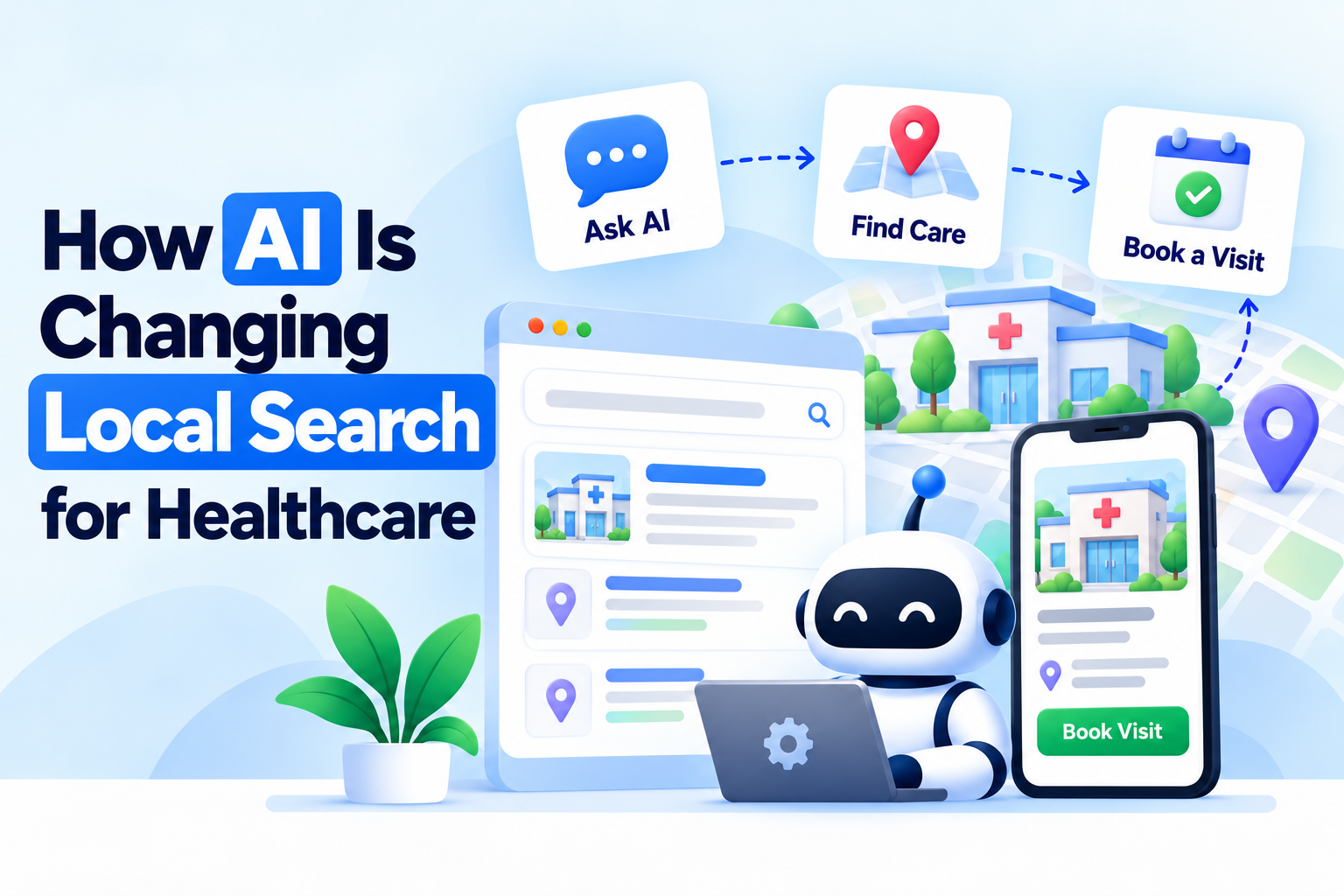
A patient with a toothache no longer types "dentist near me" and scrolls through ten blue links. They ask ChatGPT, Gemini, or Google's AI Mode a full question, "which dentist near me takes emergency same-day appointments", and get a single, conversational answer. If your practice isn't the one named in that answer, you don't just rank lower. You disappear from the decision entirely.
That's the real shift AI has brought to local search for healthcare businesses. It isn't a new ranking factor bolted onto old SEO. It's a new layer of discovery sitting on top of Google, Maps, and the web, and it rewards a different set of signals: structured data, consistent listings, fresh reviews, and content written to directly answer patient questions. The businesses winning right now are the ones treating AI visibility as its own discipline, with its own tools, rather than assuming good SEO automatically carries over.
This guide breaks down exactly how AI is reshaping local search for hospitals, clinics, dental practices, and specialty providers, and which tools actually help you track and improve where you show up.
How Is AI Actually Changing Local Search for Healthcare?
Three things have changed at once, and healthcare feels all three harder than most industries.
Search results are answers, not links. Google's AI Overviews and AI Mode now generate a direct response to a query instead of just listing pages. Health-related queries trigger AI Overviews at some of the highest rates of any category, Ahrefs data shows AI Overviews appear on roughly 43% of health-related queries, among the most affected sectors alongside science. Some analyses put healthcare's AI Overview exposure even higher, in the high 80s percent range for specific query types.
Fewer clicks reach your website. Pew Research found that when an AI Overview appeared, users clicked through to a traditional result only 8% of the time, roughly half the 15% click rate on pages without one, and just 1% clicked a link inside the AI summary itself. For a specialty clinic that used to rely on informational blog content to bring in new patients, that traffic is quietly drying up even if rankings look unchanged
Conversational assistants are becoming a discovery channel of their own. Roughly 35% of consumers already use tools like ChatGPT or Gemini to find local services, yet 88% of local businesses have no active strategy to appear in AI search results at all. That gap is the opportunity: most competitors haven't adapted yet.
The good news for healthcare specifically: not every query has gone this way. There are two parallel search ecosystems now, informational, symptom-and-treatment queries are increasingly AI territory, while high-intent local queries like "urgent care near me" or a branded practice search still reliably drive clicks and calls. Local intent is your strongest ground. The tools and tactics below exist to help you hold it.
Why Does This Matter More for Healthcare Than Other Industries?
Healthcare decisions carry higher stakes, more research behavior, and stricter trust requirements than most local categories, which is exactly what AI models are tuned to weigh.
Accuracy is a ranking signal, not just a compliance concern. AI systems favor content that's current, consistent, and verifiable, because getting health information wrong carries real risk. Outdated hours, an old address, or conflicting provider bios across directories can quietly disqualify you from being cited.
Reviews carry outsized weight. AI tools increasingly summarize patient sentiment before a patient ever reaches your site, so review volume, recency, and how you respond all function as trust signals feeding the answer a patient sees.
Being cited pays off disproportionately. Healthcare brands cited within AI Overviews earn 35% more organic clicks and 91% more paid clicks than brands appearing on
the same page without a citation. In other words, showing up in the AI answer doesn't just replace a click, it multiplies the value of the clicks you still get.
Multi-location practices face a harder version of the problem. A health system's flagship location might be well optimized while five satellite clinics are invisible in AI answers because their listings are thin or inconsistent. That's a location-by-location problem, not a brand-wide one.
What Are the Biggest AI Visibility Gaps in Healthcare Right Now?
Across all industries, one 2026 benchmark study found businesses appear in Google's local 3-Pack 35.9% of the time on average, but only 1.2% are recommended by ChatGPT and 11.0% by Gemini. That gap between traditional local ranking and AI recommendation is the single biggest opportunity in healthcare local marketing today, and it comes down to a handful of recurring gaps:
Inconsistent provider and location data. Different names, phone numbers, or specialties listed across your website, Google Business Profile, and third-party directories confuse the entity-matching AI models rely on.
Thin or outdated service-line pages. A one-paragraph page for "cardiology" with no FAQs, no locations, and no recent updates gives an AI model almost nothing to cite.
Low review velocity. Practices with a trickle of reviews every few months look less current, and less trustworthy, than ones with steady, recent feedback.
No structured data or schema. Without markup for medical business type, services, hours, and provider credentials, AI systems have to guess at facts they'd otherwise pull with confidence.
No monitoring at all. Most practices have no visibility into what ChatGPT or AI Mode actually say about them, so problems go unnoticed until a patient mentions it.
What Tools Actually Help Healthcare Businesses Win in AI Local Search?
This is where the tooling has genuinely evolved over the past year. AI visibility platforms now sit alongside traditional local SEO tools, and the best setups use both.
Local Listing and Entity Management Platforms
These keep your core business data consistent everywhere an AI model might pull from.
Yext, built around keeping provider and location data consistent across a publisher network that includes ChatGPT, Google, WebMD, and Vitals, which matters because AI answers lean heavily on entity consistency.
BirdEye Search AI, designed for healthcare groups with many local practices or departments, connecting AI visibility, sentiment, and citation sources down to the individual location level, useful when one clinic shows up in AI answers and a sister location doesn't.
Reputation, a fit for multi-location healthcare organizations that need one platform for reviews, listings, surveys, and AI findability signals together.
AI Visibility and Monitoring Tools
These tell you what's actually happening in AI answers, not just traditional rankings.
Semrush AI Toolkit - tracks how often a business is mentioned and cited across ChatGPT, Gemini, Perplexity, and Google's AI Mode and AI Overviews, integrated alongside traditional SEO metrics like visibility scores and cited pages.
BrightLocal's Local AI Visibility tools, differentiated by tracking AI visibility at the individual location level rather than just brand-wide, which suits multi-clinic operators.
SOCi's Local Visibility Index, benchmarks healthcare organizations across AI, search, reputation, and social, spanning tens of thousands of locations, so a practice can see where it stands against category averages.

Content and Schema Tools
Since AI models summarize rather than link, your service-line and location pages need to be structured for extraction, not just readability. Tools that help here include schema markup generators, structured FAQ builders, and content platforms that flag pages missing the freshness signals AI models reward.
Where a Platform Like NYX Fits In
Most of the tools above solve one piece of the puzzle: listings, monitoring, or content. For healthcare marketing teams running paid local campaigns alongside all of this, the harder problem is connecting AI visibility work to actual patient acquisition spend, knowing which locations, service lines, or campaigns need attention based on where AI-driven demand is actually showing up. A platform like NYX, built for teams running performance campaigns across channels, is useful here because it ties creative and budget decisions to real conversion data rather than treating AI visibility and paid search as two separate workstreams.
How Do You Actually Improve AI Local Search Visibility? A Step-by-Step Approach
1. Audit your current AI visibility first.
Before changing anything, ask ChatGPT, Gemini, and Google AI Mode the actual questions patients would ask about your specialty and location. Note what's wrong, missing, or belongs to a competitor.
2.Fix entity consistency everywhere.
Make sure your practice name, address, phone number, provider names, and specialties match exactly across your website, Google Business Profile, and every directory you appear in.
3.Add structured data to every service and location page.
Schema markup for medical organizations, individual providers, services, and FAQs gives AI models a clean, verifiable source to pull from.
4.Rebuild thin service-line pages around real patient questions.
Structure content the way patients ask it, "what does a first cardiology visit involve", and answer directly near the top of the page.
5.Build a review response cadence.
Businesses that publish new, structured content weekly and respond consistently to reviews maintain stronger AI search visibility than those updating quarterly.
6.Set a monitoring rhythm.
Check AI visibility tools monthly at minimum, and treat any location falling behind as its own project rather than waiting for the whole system to catch up.

A Simple Example (Illustrative Scenario)
A five-location dermatology group noticed one clinic consistently appeared when patients asked ChatGPT about acne treatment nearby, while two other locations never came up at all. An audit found the underperforming locations had outdated Google Business Profile hours, a shared generic "our services" page instead of location-specific content, and a review count under 20 compared to 200+ at the flagship location.
After standardizing listings, publishing location-specific FAQ content, and running a review-generation push at both clinics, both began appearing in AI Mode answers for local dermatology queries within about six weeks, matching the pattern SOCi and BrightLocal data shows across the industry, where consistent, current, well-reviewed locations get recommended and thin ones don't.
AI hasn't replaced local search for healthcare businesses, it's added a new front door, and most practices haven't walked through it yet. The ones treating AI visibility as seriously as they treat their Google Business Profile today will be the ones patients actually find tomorrow.