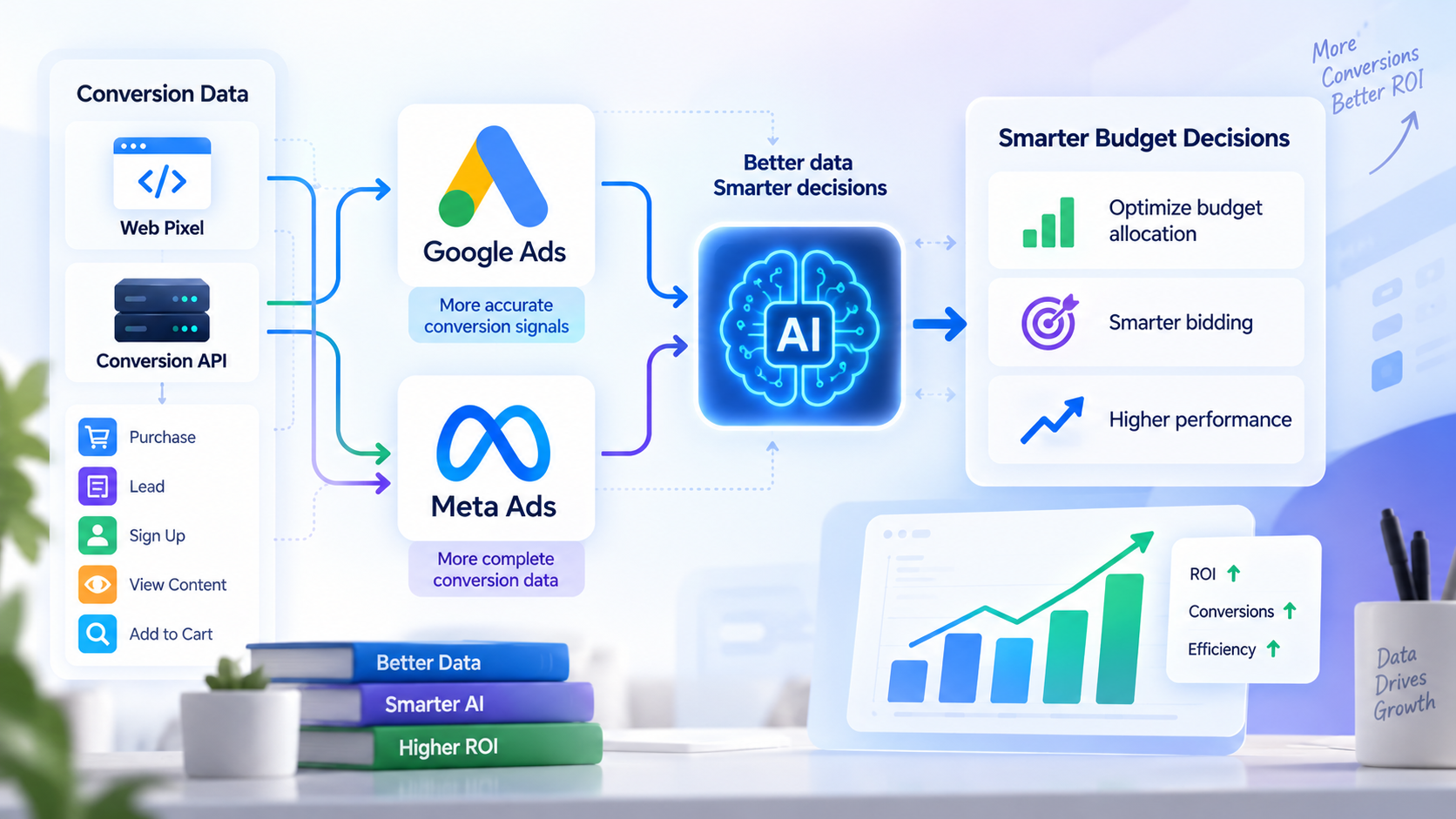
Conversion APIs make ad budget decisions smarter by fixing the input, not the algorithm. Google's Smart Bidding and Meta's Advantage+ already run sophisticated AI to decide where your budget goes; what most accounts get wrong is assuming the algorithm is the bottleneck. It usually isn't. Both systems allocate spend based on conversion signals, and a Conversions API (CAPI) is how you make sure the signal reaching the algorithm actually matches what happened in your business.
This post walks through why AI budget allocation is only as good as its input data, how Google's and Meta's systems specifically consume conversion signals, and what changes in practice, with real numbers, when a Conversions API closes the gap that browser-only tracking leaves behind.
Why AI Budget Decisions Are Only as Good as the Data Behind Them
Google's Smart Bidding evaluates more than 3,800 auction-time signals in roughly 100 milliseconds per auction, adjusting bids based on device, location, time of day, audience, and dozens of other variables no human team could process in real time. Meta's Advantage+ campaigns run a comparable automated campaign type, consolidating budget into one campaign and letting machine learning decide audience, placement, and creative delivery rather than a media buyer setting each lever manually.
Both systems share the same dependency: they can only optimize toward the conversion events they actually receive. A campaign manager's real leverage in 2026 sits upstream of the algorithm, in conversion data quality, targets, budgets, and the signals fed into the system, not in manual bid adjustments the algorithm now handles automatically. When the data going in is incomplete, the AI budget decision coming out is confidently wrong, not cautiously wrong. It still spends with full conviction. It is just spending against the wrong picture of what is converting.
What Breaks the Data Before It Reaches the Algorithm
Browser-based tracking has degraded steadily since Apple's App Tracking Transparency framework and Intelligent Tracking Prevention changes reshaped what a website can see about a visitor. By 2026, roughly 25 to 40% of desktop users run an ad blocker, Safari blocks third-party cookies by default, and Firefox blocks trackers out of the box. None of that stops a purchase from happening. It stops a browser-only pixel from reporting it.
A three-day tracking outage without a data exclusion can depress bid accuracy for two weeks or more, since the algorithm keeps processing the false signal and only gradually recalibrates once clean data returns. The lesson generalizes past outages: any persistent gap between real conversions and reported conversions, not just a one-time break, quietly steers automated budget decisions in the wrong direction every day it goes uncorrected.
How Conversion API Data Feeds Google's Budget Algorithm
Signal volume thresholds
Smart Bidding needs a minimum volume of conversions to work with before it can identify meaningful patterns across devices, times, and audience segments. The commonly used thresholds are 30 conversions per month for Target CPA and 50 per month for Target ROAS. Below those numbers, the algorithm shifts into exploratory mode, spending budget on low-probability clicks trying to find conversions rather than confidently targeting the placements that already work. A Conversions API that recovers conversions a pixel-only setup was silently dropping can be the difference between an account sitting under threshold and one with enough signal to bid properly.
Journey Aware Bidding and post-conversion signal quality
Google announced journey-aware bidding around Google Marketing Live 2026. It is currently a beta, limited to Search campaigns using Target CPA and aimed first at lead generation accounts, and it lets the bidding system learn from the full lead-to-sale journey rather than only front-end conversion actions like form fills.
A campaign running it reads downstream conversion stages, marketing qualified lead, sales qualified lead, closed deal, as supplementary input to its bid predictions. If the conversion data feeding that decision is incomplete, delayed, or tracking the wrong events, the algorithm is budgeting against a distorted picture, and accounts with enhanced conversions and offline conversion import properly configured are explicitly the ones positioned to run this cleanly.
Enhanced conversions and offline conversion import as Google's CAPI equivalent
Google does not use the name Conversions API, but enhanced conversions (hashed first-party data supplementing standard tag events) and offline conversion import (CRM-driven events matched to the original click) serve the identical purpose: giving Smart Bidding a server-verified conversion signal that browser restrictions cannot degrade. Accounts that treat these as core measurement infrastructure, not optional add-ons, are the ones whose budget allocation reflects reality rather than a static monthly plan set in advance.
How Conversion API Data Feeds Meta's Budget Algorithm
Event Match Quality and Advantage+ allocation
Meta's Advantage+ campaigns consolidate budget into a single automated pool and rely far more heavily on the quality of incoming conversion signal than a manually structured campaign would. Meta scores every Conversions API setup with an Event Match Quality (EMQ) rating based on how much verified first-party data, hashed email, phone, and other identifiers, accompanies each event. A higher EMQ generally means the algorithm can match a reported conversion to a real user with more confidence, which directly improves how Advantage+ allocates budget toward the audiences most likely to convert again.
What changes when the data gets cleaner: Frankie Shop
Fashion retailer Frankie Shop ran Meta's Advantage+ Shopping campaigns and saw an approximately 30% ROAS improvement, not from a creative change, but from completing a full server-side tracking integration. Meta's automated budget allocation can only find high-value customers as well as the conversion data it receives, and server-side tracking closed gaps left by ad blockers, cookie restrictions, and browser privacy settings. The AI budget decision did not get smarter on its own. It got better data to decide with.
NYX Neo exists for exactly this gap, giving you one view of what is actually converting across channels instead of trusting each platform's own count.
Two Case Studies: Same Lesson, Different Platforms
Frankie Shop's result is easier to trust once you see it is not an isolated pattern. Two other documented cases point at the same mechanism from different angles: a properly fed AI budget system outperforms a starved one, regardless of which platform is running it. Both are covered in more depth in our breakdown of real AI campaign results.
The Ascott Limited, a global serviced residence operator, restructured its Google Performance Max campaigns around broader, intent-based search themes rather than narrow, feature-by-feature targeting, effectively giving Smart Bidding a wider set of signals to learn from instead of forcing it to optimize dozens of hyper-specific ad groups. Google featured the result directly: a 41% increase in brand-led revenue and a 51% uplift in brand return on ad spend. The lever pulled was breadth of signal, not a new creative or a new offer, which is the same principle behind feeding Smart Bidding clean, complete conversion data rather than a fragmented pixel-only feed.
Lingerie brand Cosabella went further and handed budget allocation to Albert, an autonomous execution platform that analyzed paid search and social performance data and executed media buying without a human approving each shift. In its first month, the vendor reported that Albert cut overall ad spend by around 12% while lifting ROAS by roughly 50%. Cosabella never disclosed its pre-Albert spend baseline, so the size of the lift should be read with that caveat, and the larger quarter-level percentages circulating from this engagement come from vendor marketing material rather than an independently verified source. What the case still demonstrates cleanly is the same underlying point: an autonomous budget system is only as trustworthy as the data pipeline feeding it, and every one of these results traces back to giving an AI system a more complete, more current picture of what is actually converting.
How AI Budget Algorithms Behave With Better vs Worse Conversion Data
The table below is worth reading alongside the broader question of predictive spend allocation versus historical average budgeting, since signal quality is what separates the two in practice.
Signal Condition | Google Smart Bidding Behavior | Meta Advantage+ Behavior |
|---|---|---|
Conversions below volume threshold | Exploratory bidding; spends on low-probability clicks searching for signal | Struggles to identify high-value audience patterns; less stable delivery |
Pixel-only, no server-side backup | Missing conversions understate true performance; targets set too aggressively | Lower Event Match Quality; algorithm matches fewer conversions to real users |
Pixel plus Conversions API, deduplicated | Fuller signal supports Target CPA / Target ROAS with more stable bids | Higher EMQ; Advantage+ allocates budget with more confidence toward converters |
Tracking outage, uncorrected | Bid accuracy depressed for two or more weeks as algorithm recalibrates | Budget continues flowing on stale patterns until signal is restored |
Branded queries uncontrolled | Smart Bidding over-allocates to easy, already-happening conversions, inflating reported ROAS | Not directly applicable; Meta's exposure is more to weak audience signal than branded cannibalization |
How to Feed Your Budget Algorithm Better Conversion Data
Fix tracking before you touch bid strategy. If the conversion action feeding your automated bidding is not firing cleanly, no amount of target adjustment fixes the underlying problem. Fix tracking first.
Install a Conversions API alongside every browser pixel. Both Meta and Google need server-side backup to recover conversions that ad blockers, ITP, and iOS privacy restrictions hide from browser-only tracking.
Deduplicate with a shared event ID. Pass the same event_id (or GCLID, for Google) from both the browser call and the server-side call so the platform counts each conversion once instead of double- or under-counting.
Check volume against the platform's learning thresholds. Roughly 30 conversions a month for Target CPA and 50 for Target ROAS on Google; confirm your recovered CAPI data is enough to clear the threshold that determines whether the algorithm can learn properly at all.
Exclude a tracking outage from the learning window. A known bad data window should be excluded rather than left in, or the algorithm keeps learning from a false signal for weeks after the outage ends.
Control brand query cannibalization on Google. Without brand exclusions, Smart Bidding will allocate budget toward easy branded conversions that were happening anyway, inflating reported ROAS while masking the incremental impact of the rest of the account.
Recheck EMQ and match rate on a schedule. Meta's Event Match Quality and Google's diagnostics match rate both drift as identifiers age out or a checkout flow changes; a clean setup in January is not a guarantee it is still clean in June.
When More Conversion Data Doesn't Help
Volume below the learning threshold. Below roughly 15 to 30 conversions a month, Smart Bidding does not have enough data to learn effectively regardless of how clean the tracking is; the fix is budget or offer, not measurement.
Targets set before the algorithm has stabilized. Setting a cost or ROAS target too early forces the system to reject auctions it would otherwise win, starving the learning phase of volume even with perfect tracking underneath it.
Uncontrolled branded traffic. Extra conversion volume from branded queries can look like more signal while actually just inflating reported performance without adding real incremental revenue.
New campaigns with zero history. Manual CPC remains the right choice for brand-new campaigns and small test budgets, since Smart Bidding with no conversion history produces erratic, not smarter, bids.
Bottom Line
Conversion apis for smarter ad budget decisions are not a separate optimization from Smart Bidding or Advantage+, they are the input those systems depend on to work as designed. Google evaluates thousands of signals per auction and Meta consolidates budget through Advantage+, but both are only as accurate as the conversion data reaching them, and browser-only tracking now misses a meaningful share of that data by default. Fix measurement first: install the Conversions API alongside every pixel, deduplicate properly, clear the platform's learning thresholds, and exclude known bad data windows. Frankie Shop's roughly 30% ROAS improvement came entirely from that sequence, no creative change, no new targeting, just better data reaching an algorithm that was already capable of using it well.