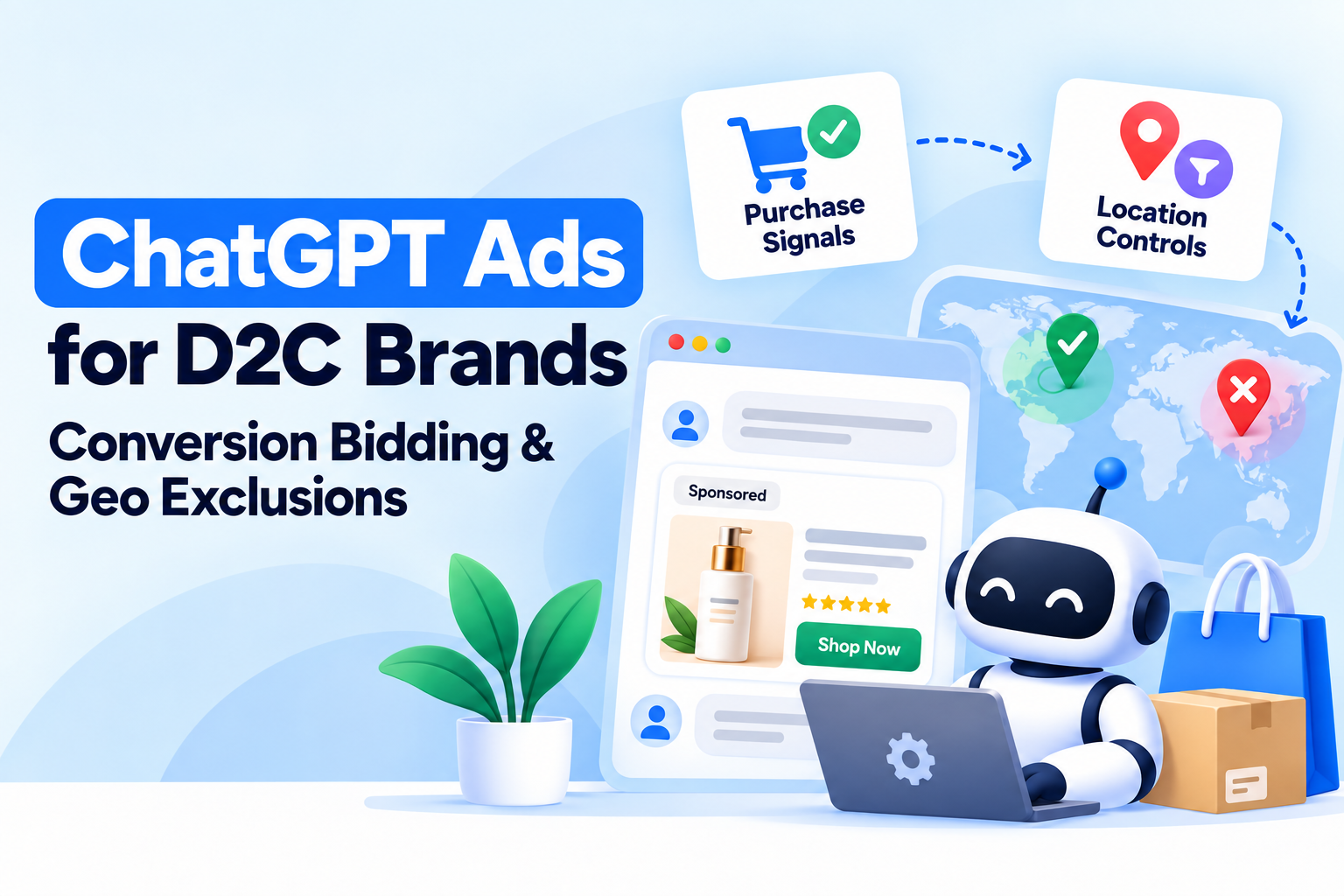
On July 24, 2026, OpenAI shipped the update that ChatGPT Ads needed to be taken seriously by performance marketers: conversion-optimized bidding, geographic exclusions, mobile measurement partner integrations, and bulk campaign tools, all in one release. For D2C brands that had been treating ChatGPT Ads as an interesting side experiment, this is the update that changes the calculation. You can now optimize toward an actual purchase instead of a raw click, and you can stop paying to reach regions you don't ship to or don't want to serve.
In short: conversion bidding lets ChatGPT push your ad delivery toward users more likely to complete a purchase or signup, while still billing you per click, and geo exclusions let you remove specific countries, states, or metro areas from targeting entirely. Together, they bring ChatGPT Ads a lot closer to the toolkit D2C teams already use on Google and Meta, and they're the clearest signal yet that OpenAI is building a durable advertising platform, not running a short-lived pilot.
Here's what actually changed, what it means for a D2C media plan, and how to test it without overcommitting budget to a channel that's still less than a year old.

What Exactly Did OpenAI Announce?
The July 24 release included eight capabilities across bidding, measurement, budgeting, and campaign management. The two most consequential for D2C brands:
Conversion-optimized bidding (oCPC)
Advertisers can now select a conversion objective, and ChatGPT's delivery algorithm pushes impressions toward users statistically more likely to complete that action, while advertisers still pay on a per-click basis. This is a shift from pure click-volume optimization to outcome optimization, a standard capability on Google and Meta that ChatGPT Ads has not offered until now.
Geographic exclusions
Advertisers can now remove specific locations from targeting instead of only being able to include regions. For a D2C brand that ships to 30 states or a handful of countries, this closes a real gap, before this update, there was no way to stop wasted spend on traffic from places you can't fulfill orders to.
The same release added mobile measurement partner integrations with AppsFlyer and Adjust, Automatic Advanced Matching using hashed customer data for stronger website conversion attribution, average daily budgets calculated over a rolling seven-day window, automatic spend pacing, a Bulk API for asynchronous campaign edits, and a refreshed product card format.
Why Does Conversion Bidding Matter So Much for D2C Specifically?
D2C media plans live and die by cost per acquisition and return on ad spend, not clicks. Before oCPC, a D2C brand running ChatGPT Ads was buying clicks and hoping they converted at a reasonable rate, with no way to tell the algorithm which clicks actually mattered. That's a real handicap compared to Google's Smart Bidding or Meta's value-based optimization, both of which have optimized toward purchase events for years.
With oCPC, if you select "purchase" as your event, ChatGPT Ads tries to find more people likely to buy, not just more people likely to click. This is meaningfully different from CPC bidding alone, where a high click-through, low-converting audience can quietly drain budget for weeks before anyone notices.
It's worth being precise about what this is and isn't. It's still a CPC billing model with conversion-informed delivery, not full conversion-based bidding where you set a target CPA or ROAS and let the algorithm bid the auction for you. Google's Target ROAS and Meta's value optimization go a step further. ChatGPT Ads is closing the gap, not matching it yet.
What Do Geo Exclusions Actually Solve?
For a D2C brand, geographic exclusions solve three concrete problems:
Fulfillment mismatch.
If you only ship within the continental US, or only to a handful of international markets, you can now exclude everywhere else instead of paying for clicks you can never convert into a shipped order.
Regulatory and category restrictions.
Some product categories face regional legal restrictions. Exclusions let you stay compliant without manually filtering traffic after the fact.
Protecting margin in known low performers.
As one industry guide put it plainly, exclusions let advertisers remove locations with a pattern of high clicks but low conversion rates, the geographic equivalent of pausing a keyword that spends without producing sales.
Previously, ChatGPT Ads only supported inclusion-based location targeting, which meant advertisers had to guess a list of "good" regions upfront rather than starting broad and trimming based on real performance data. Exclusions flip that to a more familiar workflow: launch, watch conversion data accumulate by region, cut what isn't working.

How Does This Compare to Google Ads and Meta Ads?
Capability | ChatGPT Ads (post–July 2026) | Google Ads | Meta Ads |
|---|---|---|---|
Bidding model | oCPC, CPC billing, conversion-informed delivery | Full range: Manual CPC to Target ROAS/CPA Smart Bidding | Value-based optimization, CBO, Advantage+ |
Geo targeting | Include and exclude by location (new) | Granular include/exclude down to radius targeting | Include/exclude by country, region, custom radius |
App attribution | AppsFlyer and Adjust integrations (new) | Native + third-party MMP support | Native + third-party MMP support |
Web conversion tracking | Pixel + Conversions API + Automatic Advanced Matching (new) | Full tag + Enhanced Conversions | Pixel + Conversions API + Advanced Matching |
Campaign management | Bulk API for async edits (new) | Mature bulk editing, scripts, automated rules | Mature bulk editing, automated rules |
Reporting depth | Still limited, no audience insight, no placement breakdown | Extensive segmentation and attribution reporting | Extensive segmentation and attribution reporting |
Auction transparency | Opaque, ranking factors not fully documented | Documented Ad Rank formula | Documented auction mechanics |
The gap is closing on bidding and measurement. It hasn't closed on reporting depth or auction transparency, both of which matter for D2C teams used to granular optimization on the other two platforms.
What Does ChatGPT Ads Actually Cost for a D2C Brand?
Pricing has moved fast and dropped sharply since the February 2026 launch, when OpenAI charged a flat $60 CPM with a $200,000 minimum spend for pilot participants.
Metric | Current Range (2026) | Notes |
|---|---|---|
CPC, e-commerce & retail | $3–$6 | Recommended starting bid $3–$5; a hard floor around $3 applies |
CPM, typical | $25–$60 | Higher than Meta's $14–$20 CPM range, comparable to premium Google placements |
CPC, SaaS/software | $8–$18 | For context on cross-category variation |
CPC, finance | $15–$25 | Highest-cost vertical currently |
Bids under the platform floor frequently fail to deliver impressions at all, so there's little room to bid your way to a bargain rate the way you sometimes can on newer ad inventory elsewhere.
What Ad Formats Are Available for D2C Brands?
Two formats matter most for e-commerce right now:
Sponsored product cards
These appear below ChatGPT's response as a carousel, pulling brand logo, product name, price, availability, and a direct link straight from your product feed. Shopify and Etsy merchants have native catalog integrations, so an existing feed used for Google Shopping or Meta dynamic ads can power this with minimal extra setup.
Conversational sponsored banners
A recommendation with a built-in call-to-action that lets the user keep asking questions about the product inside the chat. This format tends to suit considered-purchase categories better than visually-driven ones.
Text-heavy carousel formats put visually distinctive categories, fashion, food, home decor, at a relative disadvantage compared to how those brands perform on Instagram or TikTok, so creative and feed quality matter more here than on visual-first platforms.
Step-by-Step: How Should a D2C Brand Test ChatGPT Ads Now?

Audit and enrich your product feed first.
The ad format pulls everything directly from your Shopify or Merchant Center feed, no data, no relevance, no impressions.
Connect measurement before spending meaningfully.
Set up the OAIQ pixel and Conversions API, and enable Automatic Advanced Matching so conversion data is accurate from day one.
Pick one conversion event and commit to it.
Choose purchase (or a qualifying add-to-cart for longer sales cycles) rather than splitting optimization across multiple events too early.
Set geo exclusions before you launch, not after.
Exclude regions you can't fulfill or don't want to serve immediately, rather than discovering wasted spend in a report two weeks later.
Start with a bounded test budget and a defined loss limit.
Treat it as a new, additive channel worth testing at low risk, not a replacement for proven Google or Meta budget.
Review by category fit, not just blended ROAS.
Research-heavy, higher-consideration D2C categories (skincare, home goods, wellness) tend to fit the conversational format better than impulse-purchase categories.
Reassess monthly.
Given how quickly OpenAI has changed pricing and features this year, a media plan built on July 2026 numbers may already look different by the time you scale.
For D2C teams already managing budget across Google, Meta, and now testing ChatGPT Ads, the operational challenge isn't any single platform's learning curve, it's keeping creative, budget, and conversion data connected across all of them without adding headcount for every new channel. That's the kind of cross-channel coordination a platform like NYX is built to handle, letting a team fold an emerging channel like ChatGPT Ads into the same reporting and budget-shifting logic they already use for search and social, rather than running it as an isolated experiment in a spreadsheet.
A Simple Example (Illustrative Scenario)
A DTC skincare brand running Google Shopping and Meta dynamic ads added a small ChatGPT Ads test in August 2026, syncing its existing
Shopify feed and setting a $3.50 starting CPC bid with a purchase conversion objective. In the first two weeks, clicks from three states with no fulfillment coverage accounted for roughly 12% of spend with zero conversions. Adding geo exclusions for those states, combined with the new oCPC bidding pushing delivery toward likelier buyers, cut effective cost per purchase by close to a third over the following month, without changing creative or increasing budget.
ChatGPT Ads spent most of 2026 catching up to table-stakes advertiser features. Conversion bidding and geo exclusions are the update that makes it worth a real test line in a D2C media plan, not because the channel is mature, but because the two biggest gaps that made it hard to run responsibly are now closed.