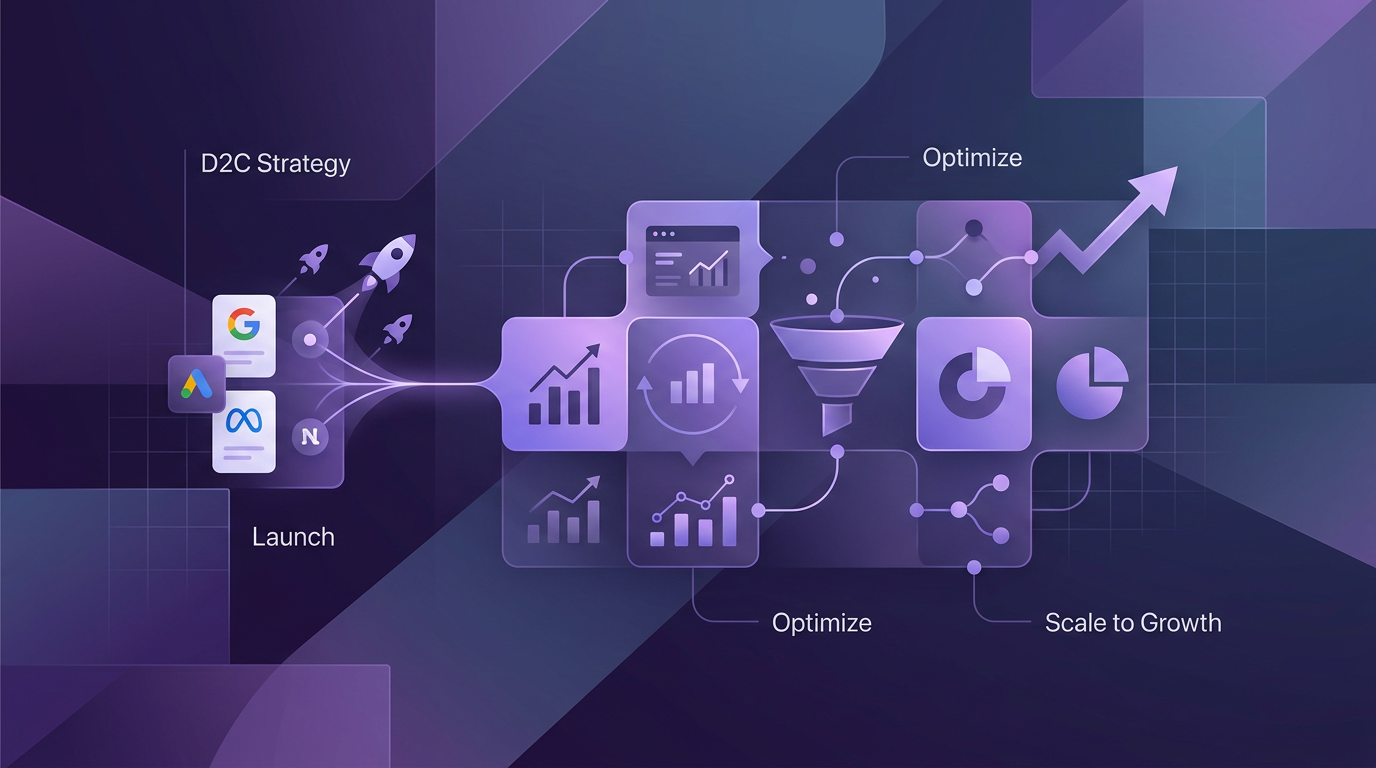
Most D2C brands treat paid acquisition as a single ongoing campaign rather than a structure that needs to evolve. That’s usually where the spend efficiency breaks down. A brand running its first campaigns has almost no historical data to work with, so the account needs to be built around learning, not scale. A brand with months of conversion history is sitting on a completely different asset, and running it the same way as day one wastes that asset.
This is the core idea behind a structured paid acquisition strategy: the campaign mix, the algorithms you lean on, and the budget split between Meta and Google should all shift as conversion volume increases. The initial acquisition phase is about generating enough signal for the platforms to work with. The scaling and remarketing phase is about using that signal to lower cost per acquisition and extract more value from every visitor, not just new ones. Treating both phases the same way is the single most common reason D2C ad accounts plateau.
1. Start With a 60:40 Meta-Google Budget Split
At launch, a sensible starting allocation is:
60% Meta
40% Google
Meta is useful in the early stage because it can generate demand that doesn’t yet exist as a search query. A new brand or a new product often has zero search volume, so Meta’s ability to interrupt and introduce is what gets the funnel moving. Google, on the other hand, captures intent that already exists, whether that’s a branded search after someone has seen the product on Instagram, or a category search from someone actively shopping.
This 60:40 split isn’t a fixed rule. It’s a starting point that should move based on actual performance. If Google is converting at a noticeably lower cost per acquisition once branded search volume builds, budget should shift toward Google. If Meta continues to outperform on new customer acquisition, it should keep the larger share. The split is a hypothesis to test, not a formula to defend.
2. Meta Strategy: Start With Advantage+ and Catalog
Advantage+ Campaigns
In the early phase, Advantage+ should be the default acquisition structure. Meta’s algorithm needs conversion events to learn from, and heavily segmented, manually targeted ad sets split that signal into pieces too small for the algorithm to optimize against. Advantage+ campaigns let Meta search broadly for high-intent audiences instead of restricting it to assumptions about who the customer is.
This means resisting the instinct to build ten narrow interest-based ad sets in month one. Broad, algorithm-led targeting almost always outperforms manual segmentation in the early stage, simply because it gives Meta more data to work with per ad set.
Catalog Campaigns
Alongside Advantage+, catalog-based promotion should be introduced early for any D2C brand with more than a handful of SKUs. Catalog AB or catalog acquisition campaigns let Meta test which products resonate with which audiences at the product level, rather than the campaign level.
This matters specifically for D2C product businesses because performance often varies significantly between SKUs. A catalog structure surfaces that variance automatically, so budget naturally gravitates toward the products that convert, without a media buyer manually reallocating spend across dozens of single-product campaigns.
3. Google Strategy: Start With Search + Shopping
Search Campaigns
Search should be built to capture the highest-intent traffic available: people actively typing in what they want. This is also where the account starts accumulating real keyword and conversion data, which becomes the foundation for every automated campaign type introduced later.
Where the account has enough volume to justify it, brand and non-brand intent should be separated into different campaigns. Brand traffic converts differently and at a different cost than non-brand traffic, and blending the two makes it harder to read true acquisition efficiency.
Shopping Campaigns
Shopping campaigns build acquisition at the product level, similar in spirit to Meta’s catalog structure. Performance here depends heavily on the Merchant Center feed: product titles, images, pricing accuracy, and category mapping directly affect impression share and click quality.
Beyond driving early sales, Shopping campaigns exist in this phase to establish product and conversion signals. That data becomes essential input once the account is ready to move toward automated, product-agnostic campaign types like Performance Max.
4. The Conversion Threshold: When Should You Launch PMax?
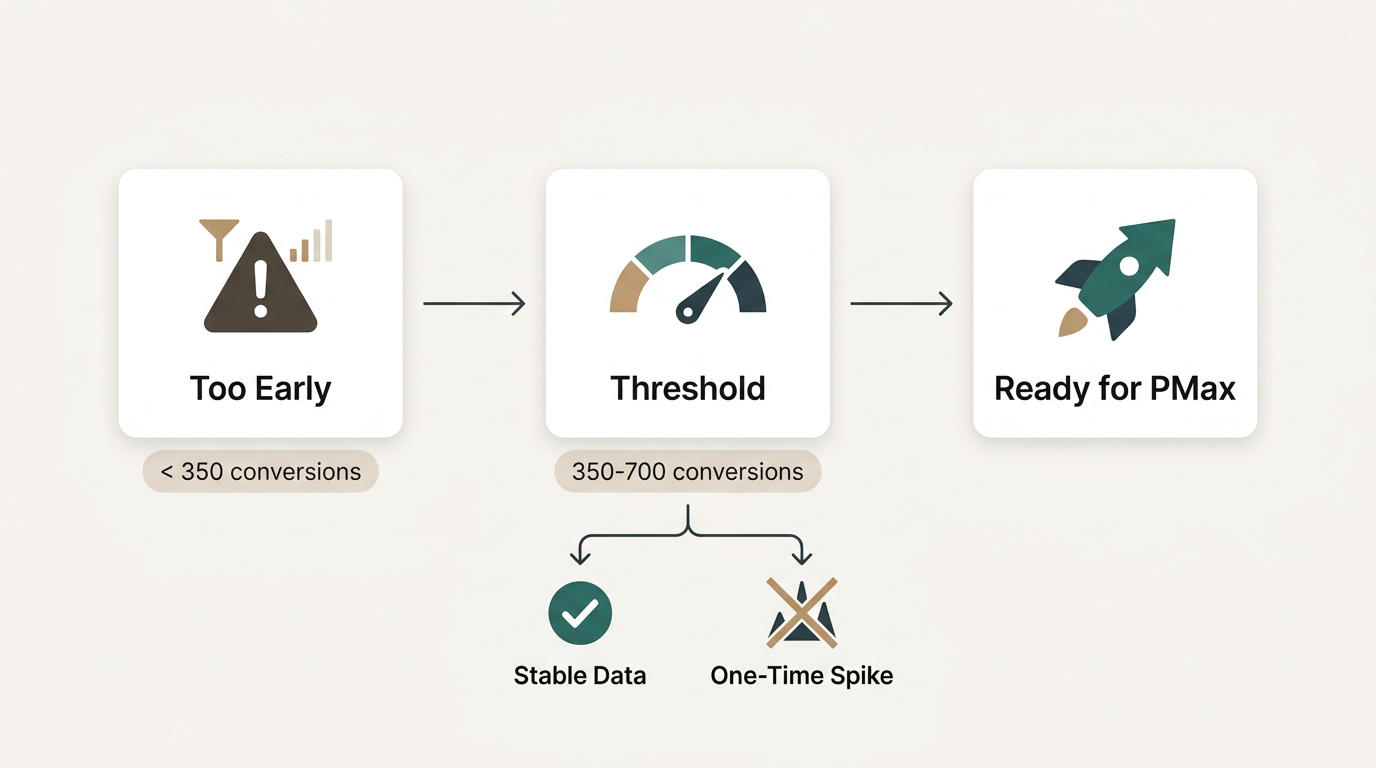
One of the most common mistakes in D2C paid media is launching Performance Max too early. PMax is a machine-learning campaign type, and machine learning needs a meaningful volume of conversion events before it can optimize reliably.
As a general threshold, an account should have roughly 350 to 700 conversions accumulated across Search and Shopping before making the transition to PMax. Below that range, the algorithm doesn’t have enough stable signal to distinguish a good customer from a lucky click, and performance tends to be volatile and expensive.
Before transitioning, it’s worth evaluating whether those conversions are stable and consistent, not just a one-time spike from a promotion or influencer push. A campaign built on a temporary conversion surge will mislead the algorithm just as much as one built on too little data.
5. Move Toward PMax for Scale
Once the conversion threshold is met, PMax can be introduced as the primary growth lever. A reasonable initial shift is:
60% toward PMax
40% toward regular Search and Shopping campaigns
From there, budget should move gradually toward whichever campaign type demonstrates better incremental performance, rather than shifting all at once. Incrementality matters more than raw conversion count here: PMax can sometimes claim conversions that regular Search or Shopping would have captured anyway, so it’s worth watching total account performance, not just PMax’s own reported numbers, before committing further budget.
Search and Shopping shouldn’t be switched off the moment PMax launches. Keeping them running, even at a reduced budget, continues to protect high-intent terms and product data that PMax draws from, and it gives you a comparison baseline to judge whether PMax is actually adding incremental value.
6. Evolve Meta From Acquisition to Remarketing
As the account accumulates a meaningful audience base, Meta’s role should shift from a pure acquisition channel to a blended funnel that includes remarketing. A workable structure at this stage looks like:
50-60% acquisition
40-50% remarketing
Remarketing works because it targets people who have already shown intent, whether that’s a site visit, an add-to-cart, or a product view. That intent signal makes remarketing audiences convert at a meaningfully lower cost than cold acquisition audiences, but only once the pool is large enough to support consistent delivery.
Launching remarketing too early, before the site has enough traffic to build a meaningful audience, tends to produce small, expensive, fatigued audiences that underperform. Remarketing should be introduced once acquisition has generated enough volume to sustain it, not on a fixed calendar timeline.
7. Build Remarketing Audiences
Site Visitors Who Didn’t Purchase
The broadest remarketing layer targets recent website visitors who haven’t converted, with purchasers excluded from the audience. Segmenting by recency, for example separating 7-day visitors from 30-day visitors, allows messaging and creative to be tailored to how warm the audience actually is.
Customers/Users Who Didn’t Convert
A tighter layer focuses on users who showed high purchase intent but stopped short of converting, such as add-to-cart or checkout-initiated events. These users respond well to product- or category-specific messaging that addresses the likely reason they didn’t complete the purchase, rather than generic brand messaging.
Collection-Based Remarketing
The most granular layer builds remarketing around specific product collections, matching creative and product selection to what the user actually browsed. Someone who viewed Collection A should be remarketed with Collection A, not a generic catalog feed. This alignment between browsing behavior and remarketing creative is what separates high-performing remarketing from generic retargeting.
8. The Mature D2C Paid Media Structure
At maturity, a well-built D2C paid media account looks like this:
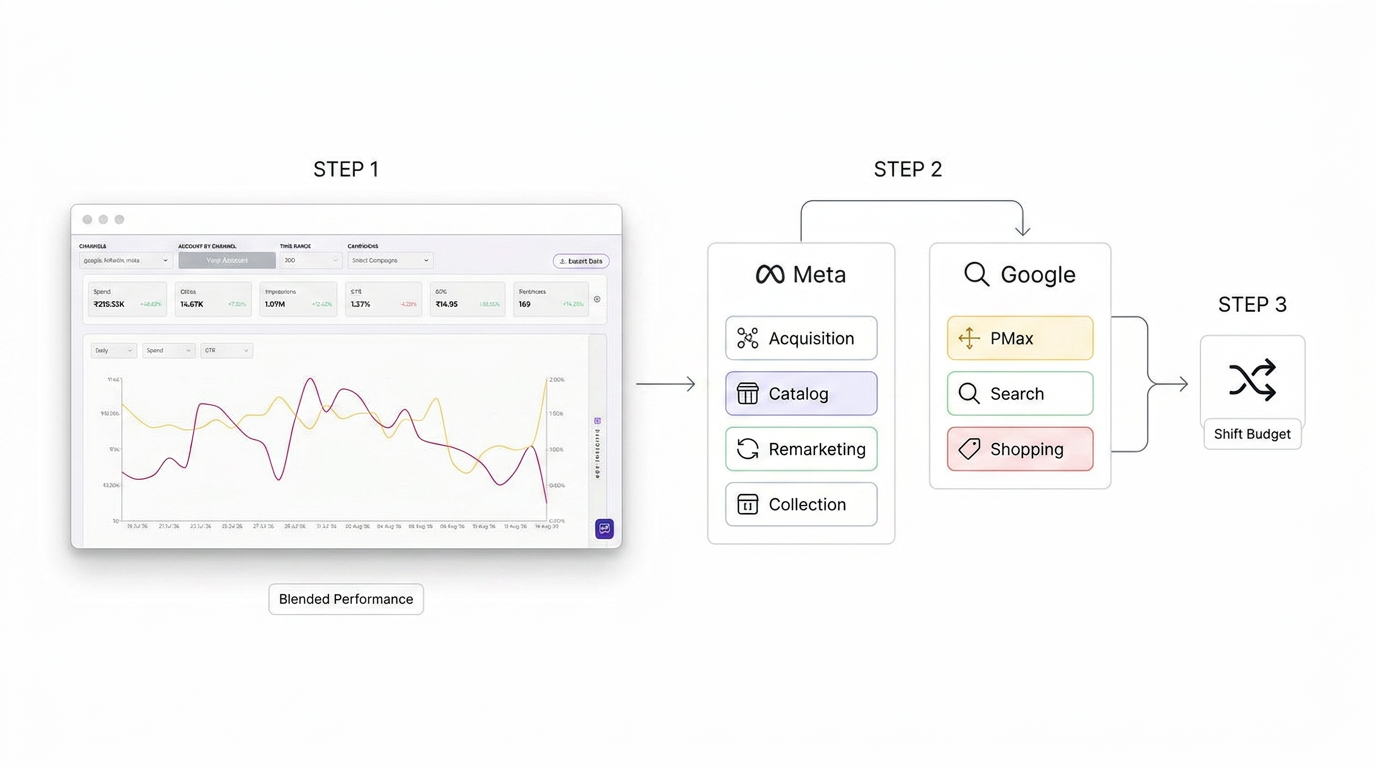
Meta: - Acquisition - Catalog - Remarketing - Collection-based campaigns
Google: - PMax - Search - Shopping - Brand/non-brand segmentation where applicable
Budget allocation across these layers isn’t static. As the account matures, spend shifts progressively from broad acquisition toward the mix of automated and remarketing campaigns that deliver the best blended return, with the balance re-evaluated regularly rather than fixed at setup.
Manually tracking incremental performance across that many layers (acquisition, catalog, remarketing, PMax, Search, Shopping) and rebalancing budget weekly is where most media buyers fall behind, even with good intentions. This is where a platform like NYX helps: Neo continuously reads blended performance across Meta and Google and surfaces where budget should shift next, so the reallocation happens on the data's schedule, not whenever someone gets time to pull a report.
FAQs
1. Why start with a 60:40 Meta-Google split instead of an even split?
Meta generates demand for products people aren't yet searching for, while Google captures intent that already exists. New D2C brands usually have little to no branded search volume, so weighting toward Meta early gets the funnel moving faster. The split is a starting hypothesis, not a fixed rule, and should shift based on which channel is actually converting cheaper.
2. How many conversions do I need before launching PMax?
Roughly 350 to 700 conversions accumulated across Search and Shopping. Below that range, PMax's algorithm doesn't have enough stable signal to tell a good customer from a lucky click, which usually shows up as volatile, expensive performance.
3. Should I turn off Search and Shopping once PMax is live?
No. Keep them running, even at reduced budget. They continue protecting high-intent terms and feeding product data PMax draws from, and they give you a baseline to check whether PMax is adding incremental value rather than just absorbing conversions Search or Shopping would have won anyway.
4. When is the right time to introduce remarketing on Meta?
Once acquisition has built a large enough audience pool to sustain it, not on a fixed calendar. Launching remarketing too early against a small pool tends to produce expensive, fatigued audiences that underperform.
5. What's the difference between site-visitor remarketing and collection-based remarketing?
Site-visitor remarketing targets anyone who visited and didn't buy, segmented by recency. Collection-based remarketing goes further by matching creative and products to exactly what the user browsed, for example remarketing Collection A to someone who viewed Collection A. It's more granular and generally converts better because the message matches actual intent
Key Takeaways
Start simple: broad Meta acquisition and Search/Shopping on Google, not a fully segmented, fully automated account from day one.
Build real conversion data before introducing heavier automation.
Introduce PMax only after the account has accumulated a stable 350-700 conversions.
Move budget toward scalable campaigns gradually, based on incremental performance, not all at once.
Build remarketing only once the audience pool is large enough to sustain it, then layer in site-visitor, high-intent, and collection-based segments as the account matures.