Quick Answer
Use no-code automation for the ad operations tasks you can write down as rules: pause this when cost passes that, shift budget on the first of the month, flag any ad set missing a naming convention. Use an AI agent for the tasks you cannot write down, because the right answer depends on context that changes. That is the whole difference: a fixed path versus a chosen one. Smaller teams should start with no-code, since it is cheaper and easier to hand over. Teams with a growing exception queue need an agent for the judgment calls. Most end up running both, which works only if someone tracks what each system owns.
Key Takeaways
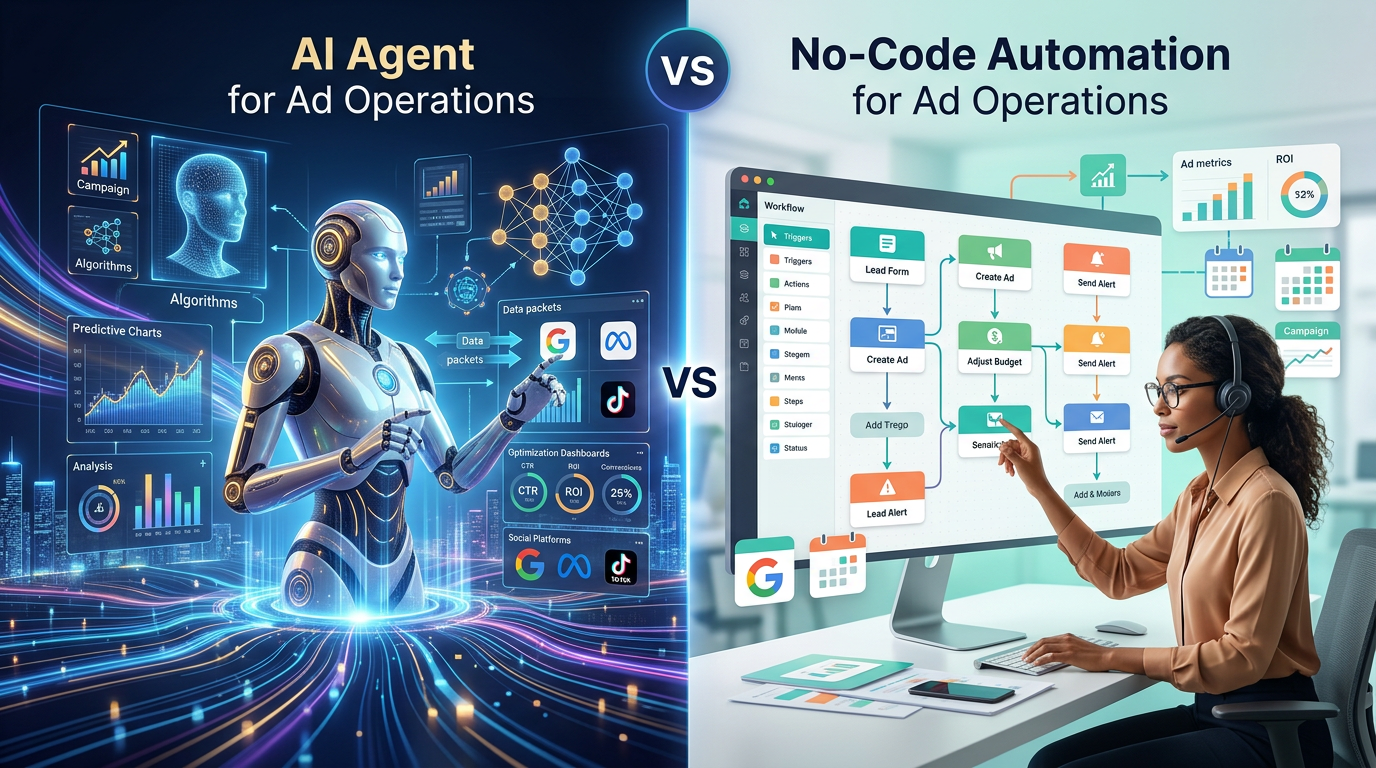
No-code automation follows a path you define. An AI agent decides its own path toward a goal you set.
Google Ads automated rules run within two hours of a trigger, which is fine for pacing and wrong for live incident response.
Rules fail silently and predictably. Agents fail creatively. The two need different controls.
Anthropic's own guidance is to use the simplest thing that works, and sometimes that means no agent at all.
Start by listing your ad ops tasks, not by picking a tool.
What Separates An Agent From A No-Code Workflow
The clearest definition comes from Anthropic, which builds these systems. It calls workflows "systems where LLMs and tools are orchestrated through predefined code paths," and agents "systems where LLMs dynamically direct their own processes and tool usage, maintaining control over how they accomplish tasks".
Strip out the model and that distinction still holds for ad operations. A no-code flow in a visual builder is a path someone drew. It runs the same way every time. An agent is given an outcome and works out the steps.
Neither is smarter in the abstract. They fit different shapes of work. The question is which shape your task has, and most ad ops teams have both kinds sitting in the same week.
What No-Code Automation Does Well In Ad Operations
No-code tools are well suited to the parts of ad ops that are genuinely mechanical. Google Ads automated rules, platform-native scripts and visual builders all cover the same ground well: scheduled budget changes, threshold pauses, naming-convention checks, pulling numbers into a sheet, alerting a channel when a metric crosses a line.
Three things make them the right default here. They are cheap to run. They are auditable, because the logic is visible on screen. And they are predictable, which matters more in ad ops than most people admit. When a rule pauses a campaign, you can point at the line that did it.
That auditability is worth more than it looks during a handover. Ad ops work changes hands often, and a visual flow can be read by whoever inherits it. A model's reasoning cannot be read the same way.
Example: month-end pacing across thirty campaigns. The logic never varies, the timing is known in advance, and any competent person can verify the rule in a minute. Pointing an agent at this adds cost and removes the audit trail.
The related pattern is covered in more depth in our comparison of rule-based campaign automation, which shares most of its strengths and limits with no-code builders.
Where No-Code Breaks In Ad Operations
The limits show up in three places, and all three are structural rather than a matter of building the flow better.
It only reacts to conditions you anticipated. A rule that pauses keywords above a cost threshold cannot tell the difference between a genuine problem and a promotional week where the higher cost was expected. It fires either way.
Its timing is not real time. Google states that automated rules take effect "within 2 hours after the conditions are triggered That window is fine for monthly pacing. It is not incident response.
Rules collide as they multiply. Google warns that "when multiple automated rules are scheduled to run on the same entities at the same time, the system may encounter incompatible changes, which can result in errors." The same documentation notes that "a rule may run, but with errors" .
That third point is the one teams underestimate. An account with forty rules built over three years by four different people is not an automated account. It is an undocumented system nobody fully understands, and the errors are quiet.
Example: a budget-pacing rule and a performance-pause rule both target the same ad set on the first of the month. One raises the budget, the other pauses the set. The account shows a paused ad set with a raised budget, and nobody notices until the weekly review.
Which Ad Ops Tasks Belong To Which System
Ad Ops Task | Better Fit | Why |
|---|---|---|
Scheduled budget pacing | No-code | The rule is arithmetic and the timing is known |
Naming-convention and tagging QA | No-code | Pass or fail against a fixed pattern |
Threshold pauses on spend | No-code | One condition, one action, fully auditable |
Pulling cross-platform numbers into a report | No-code | Structured data, stable format |
Diagnosing why performance dropped | Agent | Needs several data sources and a hypothesis |
Triaging a disapproval queue | Agent | Each rejection reason needs reading and judgment |
Deciding which creative to retire | Agent | Depends on fatigue, segment and inventory together |
Handling an exception nobody scripted | Agent | No path exists to follow |
Writing the weekly performance narrative | Agent | Turning numbers into reasoning |
The pattern is consistent. If you can describe the task as a sentence beginning "if this, then that," it belongs in a no-code flow. If describing it needs the word "depends," it belongs with an agent or a person.
What An AI Agent Adds, And What It Costs You
An agent earns its place on the tasks where the path is not knowable in advance. Reading a disapproval queue and grouping rejections by cause. Checking a performance drop against creative fatigue, auction pressure and landing-page changes before saying which one it was. Deciding what to do about a segment that started converting differently this week.
What these share is that the next step depends on what the previous step found. A rule cannot branch into territory nobody mapped. An agent can, and in ad ops that territory is most of the week.
It costs you three things in return.
The first is predictability. An agent given the same situation twice may take different routes to the same outcome, which makes step-by-step auditing harder than reading a rule.
The second is expense and latency. Anthropic is direct about this: "Agentic systems often trade latency and cost for better task performance, and you should consider when this tradeoff makes sense." The same guidance says the honest answer is sometimes "not building agentic systems at all."
The third is the temptation to over-apply it. An agent pointed at a task a rule already handles is slower and more expensive for no gain. That is a common way these projects disappoint.
The Failure Modes Are Different, So The Controls Must Be Too
This is the part that decides whether either approach survives contact with a live account, and it gets almost no attention in general automation advice.
No-code flows fail silently and consistently. The rule keeps running, keeps doing the wrong thing, and produces no alarm because from its own point of view nothing went wrong. You find out at the weekly review. The control that catches this is a scheduled audit: a list of every active rule, its owner, and the last date anyone confirmed it still made sense.
Agents fail loudly and inconsistently. A bad run is usually visible, but it may not repeat, which makes it harder to reproduce and fix. The control here is different: a bounded scope of what the agent may change without approval, a spend ceiling, and a log of actions taken with reasons attached.
Applying rule-style governance to an agent produces false confidence. Applying agent-style governance to a rules estate leaves it unreviewed. Many teams inherit the second problem.
How To Split The Work Without Building Two Systems
Start with the task list, not the tool. Write down everything your ad ops function does in a month, then sort each line by whether the decision is fixed or conditional. That sort, not a vendor comparison, tells you what you need.
Then apply three rules of thumb:
Automate the fixed work with no-code first. It is cheaper, faster to build, and easier to hand over.
Give the agent the exceptions, the diagnosis and the work that currently sits in a queue waiting for a human with context.
Keep one register of both. The failure mode of a hybrid setup is not technical, it is that nobody knows what is running.
Volume changes the answer over time. A team running a handful of campaigns can hold the whole system in one person's head, so rules are enough. A team running hundreds across several platforms cannot, and the exception queue is where the hours go. That threshold, rather than the technology, is usually what moves teams from workflow automation to agentic AI.
Two ad ops jobs sit awkwardly across the line and deserve a mention. Creative rotation is partly mechanical and partly judgment, which is why dynamic creative optimization is handled by the platform rather than by either of your systems. Budget movement between channels is a genuine agent task, because it needs a view no single platform holds, and it is the core of AI budget allocation.
Where this lands in practice depends on whether you run a unified platform or a stack of point tools, which we cover in unified AI marketing platform vs best-of-breed tool stack. On a single platform, multi-channel campaign launch and monitoring sits in one place and the register maintains itself. Across six tools, someone has to keep it by hand.
A Practical Sequence For Introducing An Agent
Teams that get this right tend to move in the same order, and it is rarely the order a vendor suggests.
Clean up before you automate. Fix the account structure, the naming conventions and the conversion tracking first. Automation applied to a messy account produces mess at speed, and neither system corrects for it.
Retire dead rules. Before adding anything, list every active rule with its owner and purpose. Most estates carry rules nobody would write today. Deleting those removes more risk than any new tool adds.
Give the agent one queue, not the account. Pick the single task costing the most human hours, usually disapproval triage or performance diagnosis, and scope the agent to that alone. Read the log for two weeks before widening its remit.
Set the boundary in writing. Decide what the agent may change on its own, what needs approval, and where the spend ceiling sits. Do this before go-live, not after the first incident.
Review both systems together. One monthly review covering rules and agent actions. Two separate reviews is how the register drifts out of date.
Example: a team automates disapproval triage, keeps its pacing rules untouched, and reviews both in the same monthly meeting. The agent's remit widens only after two clean months.
Frequently Asked Questions
Is An AI Agent Just A Smarter No-Code Workflow?
No. A workflow follows a path you drew in advance. An agent is given a goal and chooses its own steps. That difference shows up most when something unexpected happens, which is when a workflow stops being useful and an agent starts.
Can I Run Both Without Creating A Mess?
Yes, provided you keep one register of what each system owns. Most hybrid setups fail on documentation rather than technology. Nobody can say which system paused the campaign.
Which Should A Small Ad Ops Team Start With?
No-code, almost always. It is cheaper, quicker to build, and easier to hand over. Add an agent when your exception queue is consistently taking more time than the routine work it sits alongside.
Do AI Agents Replace The Ad Operations Role?
No. They shift it. Less time trafficking and pulling reports, more time on setting targets, defining what good looks like and reviewing what the automation did. The measurement and governance work grows rather than shrinks.
How Do I Know When My Rules Estate Has Grown Too Large?
Two signals. Nobody can explain what every active rule does without opening it, and changes to one rule start producing effects somewhere else. At that point you are maintaining software without version control, and consolidation matters more than adding an agent.
What Is The Most Common Mistake With Either Approach?
Building automation on a process nobody has cleaned up first. A messy account structure or an unreliable conversion setup produces automated errors at scale, whichever system you choose. The groundwork is covered in more detail in our overview of AI advertising platform features.
Bottom Line
Sort the work before choosing the tool. Fixed decisions belong in no-code automation, which is cheaper and auditable, and that is where a smaller team should stay. Conditional decisions belong with an agent, which costs more and reasons better, and that is what a team drowning in exceptions actually needs. Neither choice is permanent: volume is what moves the line. The real risk in a hybrid setup is not that one system is wrong, but that nobody keeps a record of which one is doing what.
Book a demo to see how ad operations run when launch, monitoring and optimization sit in one place.