The e-commerce advertising strategies that worked in 2019, heavy paid acquisition on Meta and Google fueled by cheap CPMs and reliable targeting, are no longer viable as a primary growth model for most D2C brands.
Customer acquisition cost has risen 40 to 60% in two years, third-party targeting data has degraded since Apple's App Tracking Transparency changes, and digital ad inventory is more saturated than the audience buying into it. The brands still growing profitably in 2026 have not abandoned paid acquisition; they have rebuilt it around AI-driven platform tools, diversified channels, and a retention engine that makes every acquired customer worth more.
This guide covers the ecommerce advertising strategies actually producing results right now, Meta's Advantage+ and Andromeda system, Google's AI Max and Performance Max, TikTok Shop's GMV Max, and the retention infrastructure that determines whether any of that paid spend pays for itself twice.
Why the Old Playbook Stopped Working
Two structural shifts explain most of the pressure D2C brands feel on paid channels today. The first is the degradation of third-party targeting data following Apple's App Tracking Transparency framework, which permanently reduced how precisely Meta, Google, and Snap can identify and retarget individual users. The second is inventory saturation: the number of brands competing for the same ad placements has grown faster than the audience itself, pushing CPMs up structurally rather than cyclically.
Better creative and better targeting both help at the margin, but neither reverses a structural trend. That is why the ecommerce advertising strategies working in 2026 combine three things at once: platform-native AI tools fed with clean data, a broader channel mix that spreads acquisition risk, and a retention system that raises the ceiling on what a single paid acquisition is worth.
Meta: Building Around Advantage+ and Andromeda
Meta's ad retrieval system, internally called Andromeda, is described by Meta's own engineering team as a personalized ads retrieval engine built to improve efficiency and performance in ad matching. For store owners, the practical translation is that hand-built interest stacks matter far less than they used to. Advantage+ is now the default setup for sales-focused campaigns, and in many accounts a full return to manual, classic campaign structure is no longer available.
What still moves performance inside that system is creative variety and clean conversion signal. Advantage+ Catalog ads have been reported to deliver roughly 38% lower cost per acquisition than manually structured catalog campaigns when fed enough product and creative variety, which makes dynamic catalog tracking a prerequisite rather than a nice-to-have.
Meta's Conversions API, which sends conversion events server-to-server rather than relying on browser tracking alone, is the mechanism that keeps that signal clean; brands running CAPI alongside the Pixel consistently report better Advantage+ delivery than pixel-only accounts.
The creative mix matters as much as the targeting setup. The current benchmark is roughly 60% user-generated content (UGC) to 40% branded creative for prospecting campaigns, inverting to about 40% UGC and 60% branded for retargeting, where trust signals and polish matter more once a shopper is already familiar with the brand.
UGC-style creative in paid social consistently outperforms brand-produced equivalents on CPM and click-through rate, largely because Meta's and TikTok's algorithms favor content that feels native to the feed rather than obviously produced. Sustaining that volume is its own problem, which is why many brands now generate on-brand creative at scale rather than commissioning every variant.
Google: AI Max, Performance Max and Intent Research Journeys
Google's biggest shifts for ecommerce in 2026 center on AI Max placements, new offer formats, and automation built around broader intent rather than exact-match precision. Ads are increasingly eligible to appear inside AI Overviews and AI Mode responses, and Google has published documentation on where those placements can show and which campaign types qualify.
The underlying pattern is the same one reshaping Meta: eligibility and performance increasingly reward advertisers with strong conversion signals and strong product data, not advertisers running the tightest exact-match keyword lists. An account still built around narrow, five-year-old exact-match logic is structurally disadvantaged in 2026's auction, regardless of budget.
Performance Max campaigns that give Google's model broader, intent-based search themes to learn from, rather than dozens of hyper-specific ad groups, consistently outperform narrowly segmented alternatives, because the algorithm has more signal to optimize against.
Search behavior itself is shifting toward what Google describes as research journeys: multi-step, comparison-heavy queries rather than single, transactional searches. That favors advertisers with rich structured product data (feeds, reviews, specifications) that Google's systems can draw on to answer a comparison-style query, not just advertisers with the highest bid.
Brands still investing in narrow, feature-by-feature ad group structures inherited from a pre-automation era are effectively asking a broad-signal system to optimize with one hand tied behind its back, and the gap between that approach and a properly fed Performance Max campaign tends to widen every quarter rather than narrow.
TikTok Shop: From Discovery Channel to Full Commerce Loop
TikTok Shop has moved past experimental status. Global GMV is projected to reach roughly $112 billion in 2026, up from about $64 billion in 2025 and $33 billion in 2024, and the US market alone grew somewhere between 68% and 108% year over year across various trackers.
From July 2025, GMV Max became the default and only supported campaign type for TikTok Shop Ads, retiring Video Shopping Ads, Product Shopping Ads and LIVE Shopping Ads for new campaign creation, with mandatory migration for existing advertisers rolling through the second half of that year. You set a daily budget and a return-on-investment target, and TikTok's algorithm selects creative, finds audiences, and optimizes placement automatically, attributing paid, organic, and affiliate-driven sales together. Early adopters report roughly 30% higher GMV using GMV Max compared to the manual ad formats it replaced.
The platform rewards authenticity over production polish more than any other major ad surface. Brands adapting creative to that environment, unfiltered, creator-led content rather than repurposed studio ads, report acquisition costs 40 to 60% lower than on more traditional platforms for comparable products, which is the practical case for AI video generation over traditional video production when volume matters more than polish.
Creator affiliate partnerships have become a core acquisition channel in their own right: TikTok's standard 6% seller commission undercuts Amazon's 8-15% range, and affiliate link engagement rates on the platform run meaningfully higher than equivalent programs on Instagram.
One caution worth building into any TikTok Shop strategy: GMV on the platform is heavily concentrated. The top 1% of US sellers reportedly drive around 60% of all GMV, and only a small share of active sellers consistently clear meaningful monthly revenue. A defensible brand aesthetic that photographs and unboxes well matters more to breaking into that top tier than raw ad budget, something our beauty and wellness work with Kindlife turned on directly.
Ecommerce Advertising Channels Compared
Channel | 2026 AI System | Strongest For | Watch Out For |
|---|---|---|---|
Meta | Advantage+ / Andromeda retrieval engine | Scaling proven offers with creative variety and clean CAPI signal | Manual, classic campaign structure is largely unavailable now |
AI Max / Performance Max | Comparison-heavy, research-journey search intent with strong product data | Narrow exact-match strategies are structurally disadvantaged | |
TikTok Shop | GMV Max | Discovery-driven categories (beauty, fashion, home) with creator-native creative | GMV is highly concentrated; most sellers underperform the headline growth numbers |
Email and SMS | Klaviyo-style flow automation | Compounding retention revenue independent of ad platform volatility | Underused by most brands; flows outperform campaigns by a wide margin when built out |
Retention: The Channel That Makes Paid Acquisition Work Twice
Retention infrastructure is not a separate discipline from ecommerce advertising, it is what determines whether paid acquisition is profitable at all once CAC has risen 40 to 60% in two years. Top-performing D2C brands generate 30 to 40% of total revenue from email and SMS combined, against a platform-wide average closer to 27%. Brands using email mainly as a broadcast channel average only 15 to 20% of revenue from it; brands running it as a genuine cross-channel automation system, with automated flows doing the heavy lifting, average 30 to 40%
The gap between campaigns and flows is stark and consistent across datasets. Automated flows represent roughly 2 to 5% of total email volume but generate 30 to 41% of total email revenue, earning somewhere between 13 and 18 times more revenue per recipient than one-off promotional campaigns. Abandoned cart flows alone average $5.64 in revenue per recipient, with top performers reaching nearly $29. SMS follows a similar pattern: flows account for under 8% of SMS sends but drive over 45% of SMS revenue, and nearly two-thirds of SMS flow revenue comes from new buyers rather than repeat customers, making SMS flows a genuine acquisition-adjacent channel, not just a loyalty tool.
The practical implication for a paid-media-first team: a dollar spent fixing a broken welcome flow or cart abandonment sequence often outperforms a dollar spent on incremental ad spend, because it compounds against every future customer rather than buying a single conversion.
A Practical Framework for 2026 Ecommerce Advertising Strategies
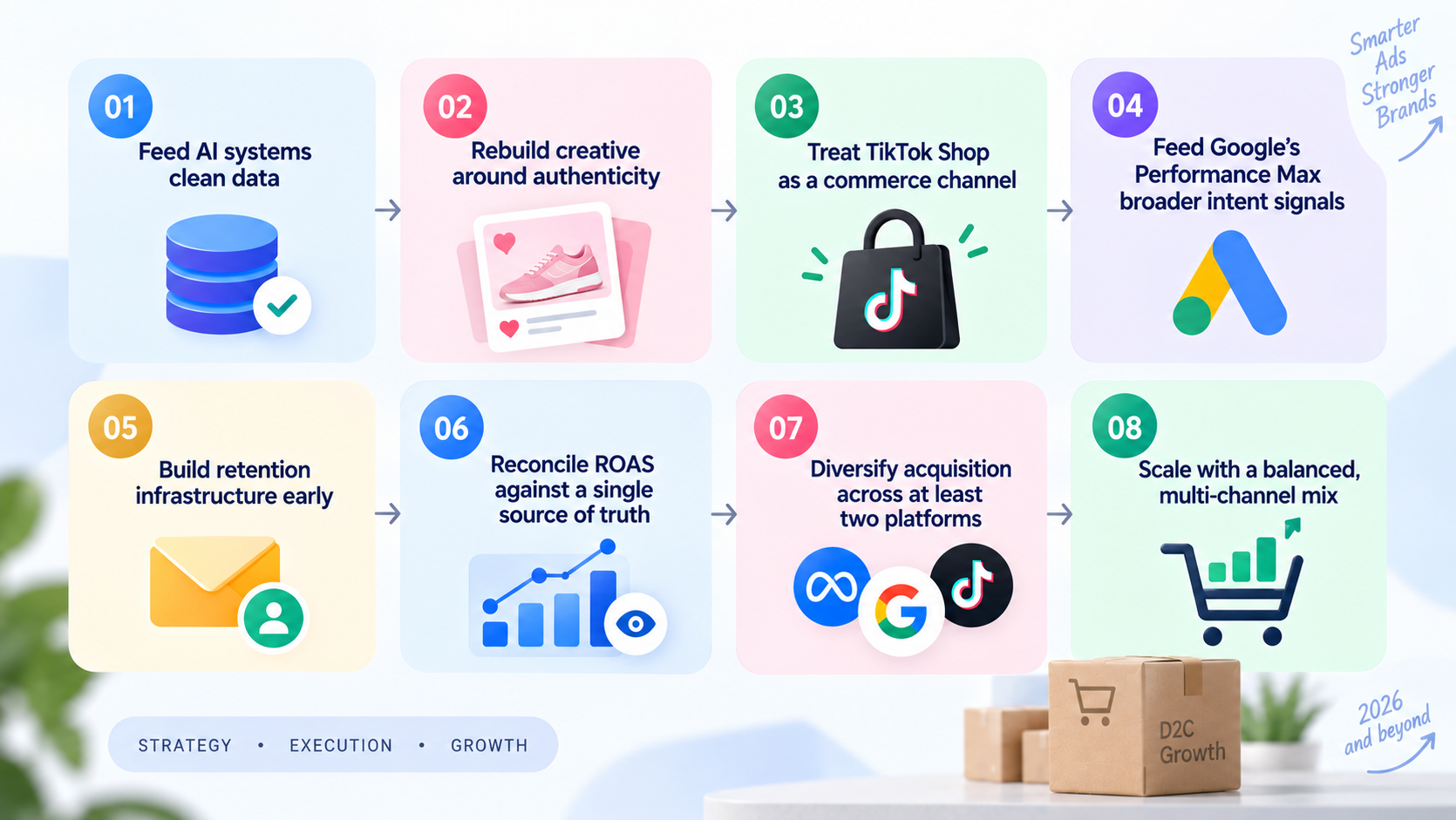
Feed AI systems clean data before optimizing creative. Advantage+, Performance Max, and GMV Max all perform in direct proportion to conversion signal quality. Install and deduplicate a Conversions API on every platform running an automated campaign type before investing further in creative testing.
Rebuild creative around authenticity, not production value. Target roughly 60% UGC-style creative for prospecting and 40% for retargeting, sourced from creators and real customers rather than studio shoots, across Meta and TikTok alike.
Treat TikTok Shop as a commerce channel, not a video ad unit. Run GMV Max rather than manual formats, invest in creator affiliate partnerships, and build a shop presence that photographs and unboxes well enough to compete for the concentrated top tier of GMV.
Feed Google's Performance Max broader intent signals. Structure campaigns around research-journey, comparison-style search behavior and strong structured product data rather than narrow exact-match keyword lists.
Build retention infrastructure before scaling paid spend further. A brand under 30% email and SMS revenue share is very likely underinvesting in the channel that makes every paid acquisition worth more over time.
Reconcile channel-level ROAS against a single source of truth. Platform-reported ROAS has been unreliable since the iOS privacy changes; brands still anchoring budget decisions on it are optimizing against a distorted signal rather than actual incremental revenue. A single cross-channel view, which is what NYX Neo is built for, is what makes that reconciliation possible.
Diversify acquisition across at least two AI-driven platforms. A brand relying entirely on Meta or entirely on Google concentrates its risk in a single algorithm's current behavior; TikTok Shop and Google search together offer a genuinely different intent profile than Meta alone. Our take on multi-channel advertising covers how to run that mix without tripling the workload.
Diversify acquisition across at least two AI-driven platforms. A brand relying entirely on Meta or entirely on Google concentrates its risk in a single algorithm's current behavior; TikTok Shop and Google search together offer a genuinely different intent profile than Meta alone.
Bottom Line
E-commerce advertising strategies in 2026 are not about picking the one channel that still works, none of Meta, Google, or TikTok is broken, they are about feeding AI-driven platform systems clean conversion data, matching creative to what each platform's algorithm actually rewards, and building a retention engine that raises the value of every customer those platforms bring in. CAC has genuinely risen and targeting has genuinely degraded, but brands treating that as a data and infrastructure problem rather than a budget problem are the ones still growing profitably. Fix measurement, diversify channels, and stop treating email and SMS as an afterthought, and the paid acquisition that still works starts working considerably harder.