This retargeting ads guide covers what actually works for D2C brands in 2026, not the segmentation-heavy playbook built for a pre-iOS 14 pixel. Retargeted users convert at roughly 43% higher rates than first-time visitors and cost 2 to 5 times less per click than cold prospecting, which makes retargeting the highest-ROI channel most D2C brands run.
The problem is that most brands still structure it the way they did in 2020: tight segments, short windows, and a generic abandoned-cart ad running on repeat until it stops converting.
What follows covers audience segmentation by funnel stage, the frequency caps and lookback windows that hold up in 2026, why campaign consolidation now beats the old segmentation approach, and the platform-specific mechanics for Meta, Google, and TikTok. For the wider acquisition picture this sits inside, see our guide to D2C paid marketing strategy across Google and Meta.
Why Retargeting Still Works When Cold Prospecting Gets Harder
Roughly 70% of ecommerce shoppers abandon their cart before completing a purchase, a figure Baymard Institute has found remarkably stable across dozens of studies, and average site-wide conversion rates sit at only 2 to 3%. Retargeting exists because most visitors were never going to convert on their first session regardless of creative or offer; the question is whether you can bring them back once intent has already been established.
The numbers back the channel decisively. Retargeted ads see roughly 10 times the click-through rate of standard display, retargeting can reduce cost per acquisition by up to 50%, and dynamic retargeting, showing the exact product a shopper viewed or abandoned, converts 2.5 to 3 times better than a generic retargeting banner. Cross-channel retargeting that combines email, display, and social recovers roughly 2.1 times more abandoned orders than any single channel alone.
Segmenting by Funnel Stage, Not by Interest
A durable retargeting strategy separates audiences by how close they are to converting, not by demographic or interest overlap. Four segments cover most D2C funnels:
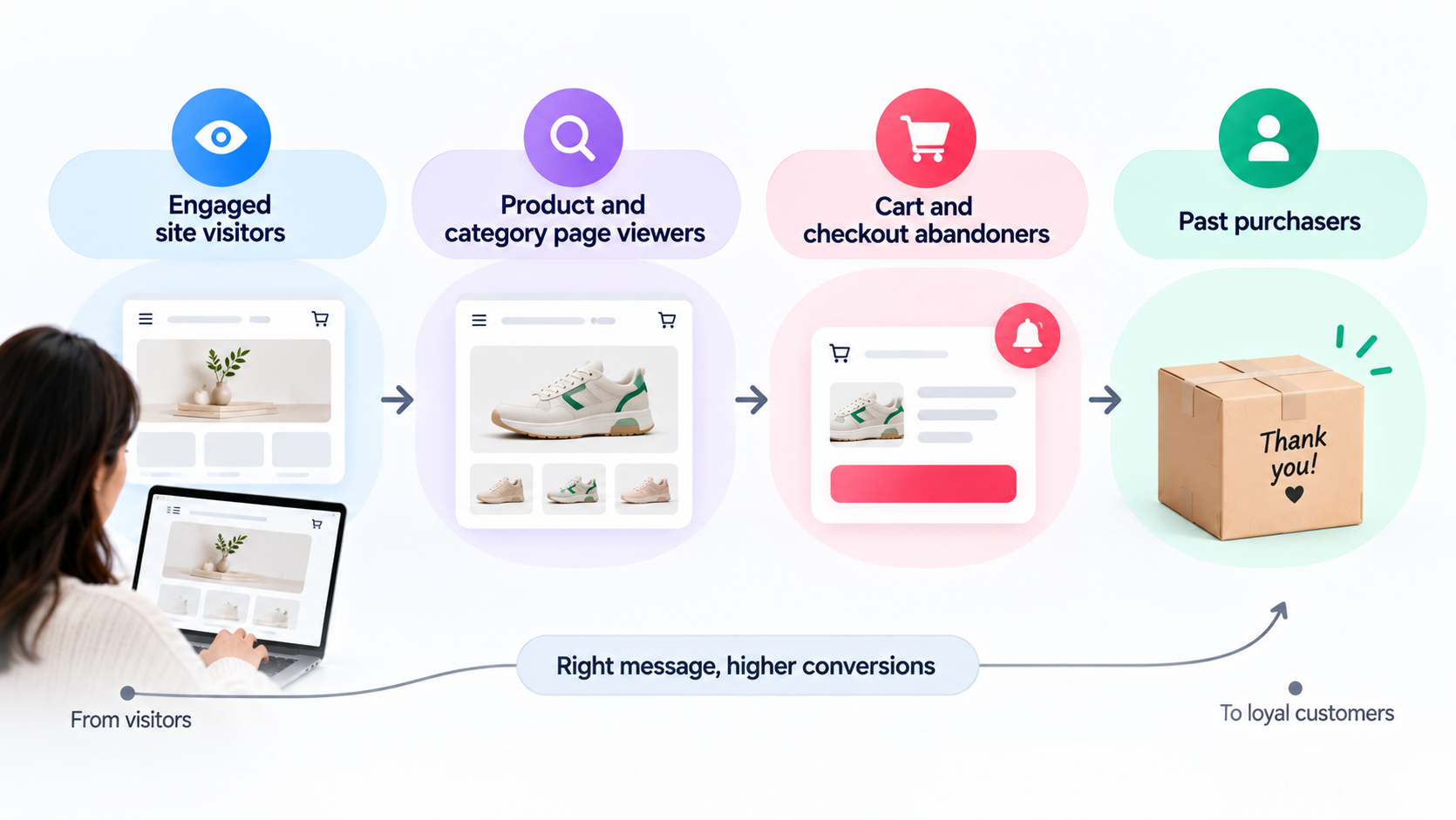
Cart and checkout abandoners (0 to 3 days). The highest-intent, highest-converting segment. Show the exact product they were about to buy, not a category-level ad.
Product and category page viewers (0 to 14 days). Visitors who explored a specific offering but did not reach checkout. Category-level messaging with social proof, reviews, customer counts, works better here than a hard sell.
Engaged site visitors (0 to 30 days). People who browsed multiple pages or spent meaningful time on-site without viewing a specific product closely. Best served with broader brand and offer content.
Past purchasers. Excluded from acquisition-style retargeting entirely and moved into a separate post-purchase or cross-sell track; showing a completed purchaser an "abandoned cart" ad is one of the most common and easily avoidable retargeting mistakes.
Personalized ad experiences tied to these segments can lift conversion rates by up to 202% compared to generic retargeting, and Dynamic Product Ads on Meta deliver roughly 56% lower cost per acquisition for the cart-abandoner segment specifically compared to static creative, which makes dynamic catalog tracking the foundation the whole segment rests on.
Frequency Caps and Lookback Windows That Hold Up in 2026
Frequency capping limits how many times a single person sees your ad in a given period, and getting it wrong in either direction costs money: too low and you under-deliver to a warm audience, too high and you actively damage brand perception.
The consistent range across current benchmarks is 3 to 6 impressions per user per week for most D2C accounts, with some guidance extending to 15 to 20 impressions per month as an upper ceiling; above roughly 20 monthly impressions, click-through rate has been shown to drop by around 38% as fatigue sets in.
Lookback windows, how long a visitor stays in your retargeting audience after their last action, should be layered rather than set as one blanket number. A 7-day window captures the highest-intent, most recent visitors and should carry your most aggressive bids.
A 30-day window casts a wider net but includes cooling interest. Beyond 90 days, remarketing effectiveness drops sharply for most ecommerce verticals; a shopper who has not returned in three months has likely moved on or found an alternative. For cart abandonment specifically, the optimal retargeting window is narrower still, roughly 3 to 7 days after abandonment, since urgency and recall both decay fast.
Why Consolidated Campaigns Now Beat Hyper-Segmentation
The segmentation-heavy playbook from 2020 and 2021, tight audiences, short windows, a separate ad set for every intent level, made sense when the pixel captured near-complete visitor data. In 2026, with Meta's Advantage+ delivery model and reduced third-party tracking, that logic runs backward: splitting retargeting into many small ad sets reduces signal volume per ad set, which slows the algorithm's optimization and produces unstable delivery.
Broad, consolidated retargeting ad sets now consistently outperform the hyper-segmented structures that worked before iOS 14 and Advantage+ reshaped how Meta delivers ads.
In practice, that means feeding one well-structured retargeting campaign 10 to 20 creative variations and letting Meta's system allocate budget to whichever creative and micro-audience combination performs best, rather than manually pre-deciding which interest group sees which ad.
Sustaining that many variants is its own constraint, which is why brands increasingly generate on-brand creative at scale rather than commissioning each one. The exception is genuinely distinct customer bases, B2B versus B2C buyers on the same site, or clearly separate product lines, where separate campaigns still make sense.
Platform-Specific Retargeting Mechanics
Meta: Advantage+ and Dynamic Product Ads
Meta's retargeting now runs primarily through Advantage+ Shopping, with Dynamic Product Ads pulling directly from your product catalog to show each visitor the specific item they viewed or abandoned. Because Advantage+ consolidates budget and audience decisions into the algorithm, the input that matters most is clean conversion data.
A Meta Pixel alone, without a server-side Conversions API, systematically understates real conversions after iOS privacy changes, and that gap directly degrades how well Advantage+ can identify and prioritize your warmest audiences.
Cap your existing-customer retargeting budget at roughly 10 to 20% of total Advantage+ spend so the algorithm does not over-index on easy, would-have-happened-anyway conversions from people who were already going to buy.
Google: Layered Remarketing Lists
Google Ads remarketing works best with multiple audience lists built at different durations, 7-day, 14-day, 30-day, 60-day, and sometimes 90-day, each bid independently rather than lumped into one list. Your shortest, highest-intent list should carry the most aggressive bids; your longest list, if you run one at all, the lowest.
Be cautious interpreting view-through conversions on Google Display remarketing: many users who see a display ad were already going to convert through another channel, so view-through data alone can overstate the campaign's true incremental impact.
TikTok and cross-channel recovery
TikTok's retargeting relies on its Events API alongside the on-site pixel, following the same deduplicated, pixel-plus-server-side pattern as Meta and Google.
The bigger lever on TikTok is creative format: carousel-style retargeting ads improve click-through rate by 25 to 45% over single-image formats, and native, creator-style retargeting content consistently outperforms repurposed studio ads on the platform, which is the practical case for AI video generation over traditional video production when volume matters more than polish.
Layering retargeting across email, display, and social rather than running any single channel in isolation is what produces the roughly 2.1x recovery lift cited above; an abandoned-cart email sent within one to three hours, followed by a retargeting ad the same day and a second touch at 24 hours, captures far more of the decaying intent window than either channel alone.
Coordinating that across platforms is where orchestration beats platform-native tools.
Retargeting Segments, Windows, and Caps at a Glance
Segment | Lookback Window | Frequency Cap | Creative Approach |
|---|---|---|---|
Cart / checkout abandoners | 3 to 7 days | 3 to 5 per week | Exact product left behind, dynamic creative |
Product / category viewers | 0 to 14 days | 3 to 4 per week | Category-level messaging with social proof |
Engaged site visitors | 0 to 30 days | 2 to 3 per week | Broader brand and offer content |
Past purchasers | Excluded from acquisition retargeting | Handled via separate post-purchase track | Cross-sell, replenishment, loyalty |
Measuring Retargeting Incrementality
Retargeting's reported ROAS is almost always inflated by people who were going to buy anyway. Someone who added a product to cart, closed the tab, and typed your brand name into Google an hour later was likely converting regardless of whether a retargeting ad ever reached them. Platform-attributed conversions do not distinguish between the two, which is why raw ROAS on a retargeting campaign is one of the least trustworthy numbers in a D2C dashboard.
A holdout test is the most reliable fix: exclude a small, randomly selected slice of your warm audience from retargeting entirely, let the rest run as normal, and compare conversion rates between the two groups after a fixed window. The gap between them is the actual incremental lift retargeting is producing, not the platform-reported ROAS.
Brands that run this test regularly often find that a meaningful share of reported retargeting revenue would have happened without the ad; the useful output is not a single number but a recurring check on whether your retargeting spend is still earning its keep as audience size, frequency caps, and creative change over time. Running it against one cross-channel view of what actually converted is what keeps the comparison honest.
View-through conversions deserve the same skepticism, particularly on Google Display and Meta placements where an ad was merely seen, not clicked, before a purchase. Treat view-through data as a directional signal about reach and recall, not as evidence of causation, and weight click-based and holdout-based measurement more heavily when deciding whether to scale a retargeting campaign's budget.
Common Retargeting Mistakes That Waste Budget
Not excluding recent purchasers. Showing a completed buyer an "you left something in your cart" ad is one of the most common and most easily fixed retargeting mistakes, and it actively damages brand trust.
Over-segmenting into small ad sets. Splitting a warm audience across too many narrow ad sets starves each one of the signal volume needed to optimize, producing unstable, underperforming delivery.
Running one static creative for months. Creative fatigue is real and measurable; rotating creative on a regular cadence, not waiting until performance visibly drops, keeps a retargeting campaign from decaying quietly. The trade-off is covered in dynamic creative optimization versus static creative sets.
Skipping the Conversions API. Pixel-only tracking understates real conversions after iOS privacy changes, which directly degrades how Advantage+, Performance Max, and equivalent systems allocate retargeting budget.
Treating retargeting budget as a fixed percentage regardless of audience size. A shrinking warm-audience pool with a fixed budget allocation wastes spend on frequency the audience cannot absorb; budget should scale with actual retargeting pool depth, not a static rule of thumb.
Generic, product-restating creative. Warm audiences already know the product. Creative that addresses a specific purchase objection, shipping time, return policy, sizing, outperforms creative that just reintroduces what the visitor already saw.
Bottom Line
The core of any effective retargeting ads guide in 2026 has not changed: reach people who already showed intent, at the right frequency, with creative that matches where they are in the funnel. What has changed is the structure underneath it. Consolidated, well-fed campaigns now outperform the tightly segmented setups that worked before Advantage+ and reduced tracking reshaped delivery, and clean conversion data, via a Conversions API alongside every pixel, matters more than manual audience-building ever did. Segment by funnel stage, cap frequency at 3 to 6 impressions a week, layer your lookback windows, exclude recent purchasers without fail, and coordinate email, display, and social into one recovery sequence rather than three disconnected ones.